


In crystal and Reiki traditions, crystals are arranged in a grid to focus intention. A crystal grid usually has a central crystal surrounded by others.
In the tradition, pointing the stones' tips towards the centre is said to concentrate energy, while pointing them outward is said to spread it. Some crystals have points at both ends, which is described as a two-way flow. These are symbolic conventions of the practice rather than physical effects.
What Are Crystal Grids?
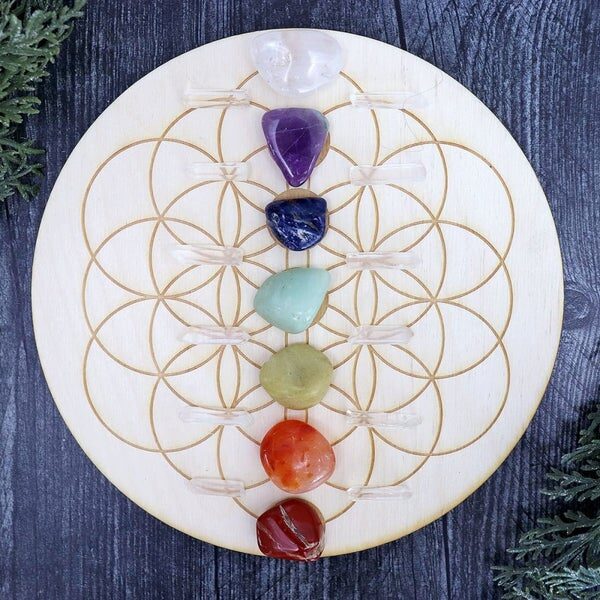
A crystal grid is used to create a calm, focused space for a practice or intention. It can be any size, though a practical indoor size is up to about 30 cm (12 in) across. You can set one up almost anywhere. If it is knocked or moved, the grid is simply rearranged; there is no need to worry that disturbing it causes harm.
If the crystals need to be moved about, place them on a cloth, board, or tray. Otherwise, a high window ledge or shelf can work well. To use crystals in a larger space, some people place them in the corners of rooms or the home, or in a garden. A grid does not have to use large stones; most arrangements use crystals between 5 and 10 cm (2 and 4 in) long.
It is good practice to dust the area and the crystals regularly; keeping them clean also keeps them looking their best. There is no need to hide a grid or to follow a strict cleansing timetable—ordinary care is enough.
A grid can be left in place for as long as you like if you keep the area and the crystals clean and re-empower it when you replace the stones.
In this practice, you place beneath the centre crystal something that represents the focus of your intention—a written intention, a name, or a photograph. The grid is then used as a focus for affirmations, for holding a person or situation in mind, or for reflecting on a past or future event. If you are holding another person or animal in mind, ask their permission first. A grid is not a treatment, and it does not replace medical or veterinary care. As with Reiki generally, the National Center for Complementary and Integrative Health notes that Reiki has not been clearly shown to be effective for any health-related purpose (NCCIH).
Four-Point Crystal Grid
This simple grid is often used for Earth-healing intentions, since the four crystals represent north, south, east, and west while the middle crystal represents the whole Earth—a crystal sphere suits this well. It can also be used for a calm atmosphere around your home or treatment room, or to hold a distant person or situation in mind.
If your lineage teaches a symbolic dedication, you may use it here; otherwise, simply arrange the crystals. Start with one in the centre (any form will do, though apart from a sphere a pyramid is often used for its four-sided base), then arrange the remaining four crystals with their pointed ends towards the centre.
Draw the Power Symbol over the grid, ensuring it covers the whole arrangement, repeat the phrase three times, and hold the intention of empowering the grid with Reiki (you can add the other two symbols as well if you wish). Hold the intention that whatever the central item represents is held in Reiki—for example, a photograph or a piece of paper with a name on it represents the person, not the actual person.
Practical care: place the grid on a stable surface where it will not be knocked over, and keep small or sharp stones away from children and pets.
Eight-Point Crystal Grid
This grid can be made any size and is often used for global situations, since it has a crystal in each of the eight directions (SE, SW, NE, and NW). It can also be used for more general intentions. After cleaning your crystals, arrange one in the centre and eight evenly spaced crystals around it, with the tips facing inward towards the central crystal.
Hold the intention of creating a focused grid, and empower it first with the Distant Symbol, which is said to help the grid connect with whatever is placed within it; then with the Harmony Symbol, associated with harmony; and finally with the Power Symbol, which brings in the Reiki—each time repeating the mantras three times. Re-empower the grid when you refresh the stones, and dust the crystals regularly. There is no set ritual schedule you must follow; keep the practice one that feels sustainable.
Twelve-Point Crystal Grid
This layout is used for holding someone or something in mind over a longer period. Place a crystal in the centre, followed by 12 equally spaced crystals in a circle around it, like the numbers on a clock face. As with the eight-point grid above, empower the grid with the three Reiki symbols.
If you place a photograph or a person's name in the grid, do so with their permission. Repeat the Distant Symbol's mantra three times, followed by the person's name three times and their location once, and hold the intention that Reiki support them for as long as you wish to keep the practice going. Then, while chanting the Power Symbol's mantra three times, draw the Power Symbol over it. Remember to include the phrase "for the greater and highest good" when holding someone in distant practice.
As you can see, there are several ways to apply your Second Degree practice. If you would like to go further, a qualified teacher can introduce you to more of the Japanese techniques.
Before You Build A Grid
A grid is a small arrangement, not a project. A few practical checks make it easier to live with:
- Choose a surface that will not be disturbed. A shelf, tray, or table is better than a floor where someone might step.
- Decide how long it will stay. A weekend, a month, or “until it feels finished” are all valid. Write the start date on the paper beneath the centre stone if you like.
- Keep it clean and safe. Dust the stones, and keep small or sharp pieces away from children and pets.
- Use what you have. Seven matching points are not required. A central stone and four smaller ones make a perfectly workable four-point grid.
- Ask before using someone's name or photo. A grid that holds another person in mind is still directed at that person.
You do not need to buy a special cloth, charge the stones under a full moon, or follow a fixed calendar. Those customs can be meaningful, but they are optional. The practice is the arrangement plus your attention.
A Minimal Three-Stone Grid
If a full layout feels like too much, try the simplest version. Place one stone in the centre and two on either side, forming a short line or a small triangle. Put your written intention under the centre stone.
Sit with the arrangement for a few minutes. If you use symbols, draw the Power Symbol over the whole group and say its name three times. Then let your attention rest on the intention, and finish by thanking the stones or simply nodding to the arrangement.
This version is easy to set up, easy to take down, and easy to keep tidy. It also makes the symbolic logic visible: a centre, a direction, and a boundary. You can add points later if you want a larger layout.
Keeping And Taking Down A Grid
A grid does not need to be permanent to be meaningful. Some people keep one in place for a season; others set one up for a single evening. When you are finished, take it down deliberately:
- Thank the stones, if that fits your practice.
- Lift the centre stone first, then the surrounding ones.
- Fold or recycle the paper intention, or keep it in a notebook if you want a record.
- Dust the stones and return them to their storage.
Taking a grid down is not a failure or a sign that the intention did not “take.” The practice has a beginning and an end, like a meditation session. If you want to continue, you can build it again later. If you feel uneasy about dismantling it, that is worth noticing: the arrangement has become a source of reassurance rather than a focus for reflection.
Questions That Come Up
Does the grid have to be a circle? No. Four-point grids are often square, and other layouts use triangles, lines, or spirals. The shape is a convention that helps you place the stones.
Do the points have to face inward? In the tradition, inward points are said to concentrate energy and outward points to spread it. That is a symbolic convention. Choose the direction that matches your intention and keep it consistent.
Can I use a grid for a health concern? You can use it as a reflective practice, but it is not a treatment and should not delay medical care. If you are unwell, speak with a qualified professional.
What if someone moves the grid? Nothing is broken. Rearrange it if you want to, or let it be. A grid is an arrangement of stones, not a fragile spell.
Can I use a grid with crystals that are not quartz? Yes. Many practitioners mix stones. Check how each material should be handled, especially if any are soft, brittle, or set in metal.
Related topic: Crystals, Chakra crystal necklaces, Crystals and health, Clear quartz, The crystal healing guide.