
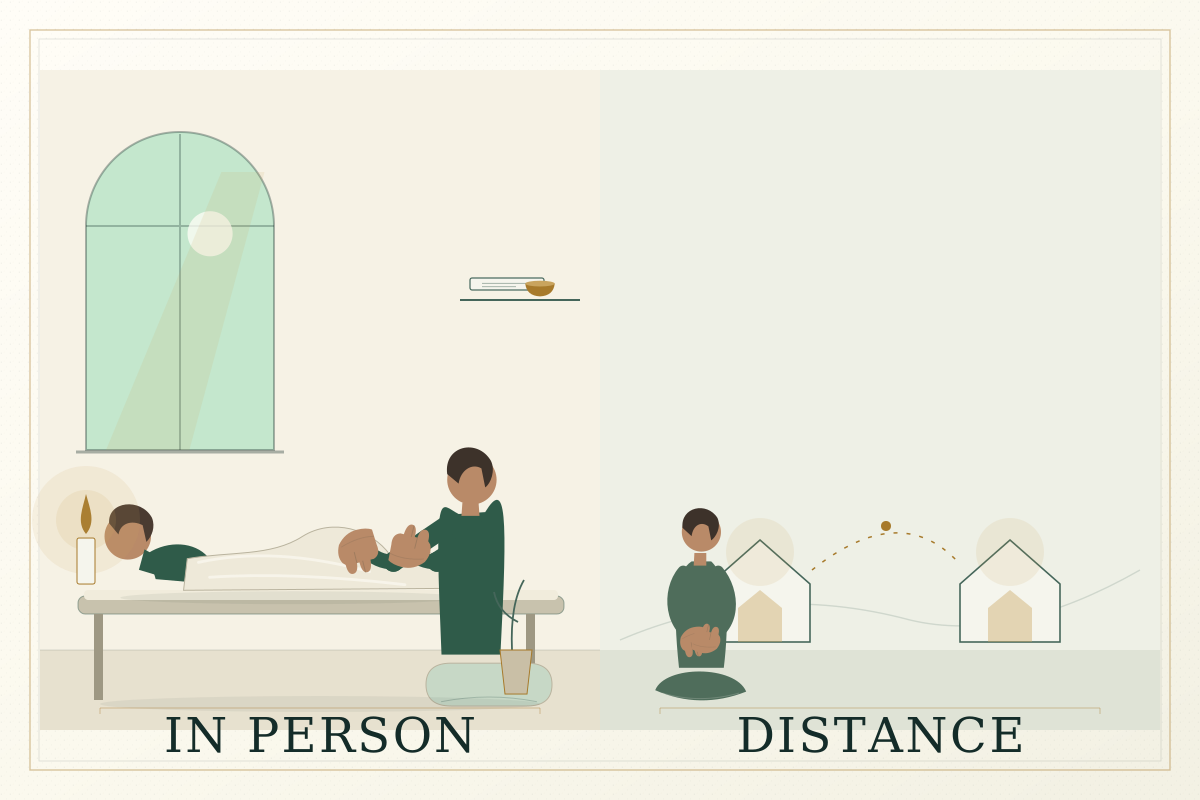
Distance Reiki and in-person Reiki come from the same tradition, but they are not the same experience. In person, you enter a practitioner's space, settle on a table or chair and may receive light touch. At a distance, you stay wherever you are while the practitioner offers the session from another location, often using a photograph, a name or a visualisation to hold you in mind.
The practical differences are easy to describe. The bigger question is what those differences mean for you: privacy, access, touch, ritual, cost, evidence and the kind of support you actually want.
The short answer
Choose in-person Reiki if you want physical presence, a dedicated treatment space, the option of light touch and a clear separation from your everyday surroundings. Choose distance Reiki if travel is difficult, you prefer your own space, or the practitioner you want is not nearby.
Neither format has been proven more effective than the other. The NCCIH says Reiki has not been clearly shown to be effective for any health-related purpose, and there is no scientific evidence for the energy field thought to play a role. Distance practice is a genuine part of the tradition, but “distance works just as well” is a belief claim, not an established medical fact.
What stays the same
A well-run distance session and a well-run in-person session share more than people expect:
- Consent comes first. You agree to the session, the time, the format and any touch. You can stop at any point.
- The session has an arc. There is usually an intake, a settling period, the main practice and a closing conversation.
- The practitioner should stay in scope. No diagnosis, no promise of a cure, no instruction to stop medical care.
- The tradition supplies the frame. Reiki lineage, attunement, hand positions, symbols and ethical precepts may all be present.
- The evidence limits are the same. A change of format does not turn a spiritual practice into a proven medical treatment.
The ethics of distant Reiki apply whether the recipient is across the room or across the world: a third party's request is not the recipient's consent, and a public figure or news event is not an invitation to send Reiki to named people.
What changes at a distance
| Feature | In-person Reiki | Distance Reiki |
|---|---|---|
| Physical contact | Light touch or hands just above the body, with consent | No contact; the practitioner works from another location |
| Setting | Practitioner's room, clinic or studio | Your home or another place you choose |
| Sensory atmosphere | Music, lighting, table, blankets, scent | Whatever you set up, plus possible video or phone connection |
| Travel | You must get there and back | None, unless you travel to a private space |
| Time zones | Usually local | Must be agreed carefully across zones |
| Interruptions | Mostly contained by the treatment room | Your household, phone and pets are part of the environment |
| Practitioner's view | Can see posture and comfort directly | Relies on your reports and the agreed check-in |
| Ritual | Shared physical space and sequence | Shared intention, often with a photo, name or visualisation |
| Cost | Session plus travel and time | Often lower overhead, though prices vary widely |
| Evidence | Studied more often in clinical settings | Studied less; reviews usually include few distance studies |
The ICRT's distant healing FAQ describes the traditional approach: a Level 2 practitioner may use a photograph, a written name or simply the thought of the person, together with the distance symbol. That is the tradition's own account of what is happening. It is not a demonstration that the practice has a measurable effect.
The honest evidence on distance
Most Reiki research studies in-person sessions. Distance Reiki appears much less often, and the studies that exist are small or limited.
A 2024 study of distant Reiki and holistic well-being followed 180 healthy adults who received 20-minute distance sessions on four consecutive days. Participants reported improved well-being, mood and vitality on before-and-after questionnaires. The abstract describes no control group, so these changes cannot establish that Reiki caused the improvement. The study does not establish a mechanism, prove a lasting effect or show that distance Reiki is equivalent to in-person care.
A 2023 systematic review of Reiki for cancer pain included seven studies, only one of which used distance Reiki. Results were mixed, and the authors called for higher-quality trials. That is a thin basis for claiming distance works as well as touch.
The fair conclusion is:
- distance Reiki is part of the tradition and some people report meaningful experiences;
- it has not been proven effective for any medical condition;
- it has not been proven equivalent to in-person Reiki;
- the relaxing setting, expectation, attention and belief may all contribute to what people notice.
None of that makes the practice worthless. It means the claim should match the evidence.
When in-person may suit you better
In-person Reiki may be the better fit if:
- you want the option of light touch and physical presence;
- you find it easier to relax when you leave your own home;
- you want a practitioner to see your posture, breathing or discomfort directly;
- you value the ritual of a dedicated room, table and uninterrupted hour;
- you are lonely and the social contact matters to you;
- you have a health condition that makes travel manageable and you want a practitioner nearby in case you need support.
In-person is not automatically “stronger”. A rushed clinic session with no consent discussion can be less supportive than a calm distance session with a thoughtful practitioner.
When distance may suit you better
Distance Reiki may be the better fit if:
- you live far from a practitioner you trust;
- travel is difficult because of disability, chronic illness, caring responsibilities or cost;
- you feel safer and more relaxed in your own space;
- you want privacy and do not want to explain your reasons for booking;
- you have sensory needs that make a clinic environment difficult;
- you want to work with a teacher in another country or time zone;
- you prefer a shorter session without the overhead of travel.
Distance practice also has practical risks: time-zone mistakes, technical problems, interruptions and a weaker sense of containment. A good practitioner will plan for those rather than pretend they do not exist.
What a distance session actually looks like
The exact format varies, but a typical session includes:
- A short intake. The practitioner asks what you want from the session, checks your consent and explains what will happen.
- A settling period. You sit or lie down in a quiet place. The practitioner may ask you to keep your eyes closed, stay silent or simply rest.
- The main practice. The practitioner offers Reiki from their location for an agreed period. They may use a photograph, your name, a visualisation or a symbol sequence.
- A closing check-in. You talk about what you noticed, ask questions and decide whether you want another session.
There is no need to feel anything in particular. Some people report warmth, tingling, tears, sleepiness or nothing at all. None of those responses proves that energy moved or that a health condition changed.
For a fuller walkthrough, see what to expect from a distance Reiki session.
Consent and scope are not optional
Distance can make boundaries feel less concrete. The practitioner cannot see you, and you cannot see them. That makes clear agreement more important, not less.
Before the session, confirm:
- Who is receiving. You, not a family member who booked on your behalf, unless you have clearly agreed.
- What you are agreeing to. A quiet Reiki session, not medical treatment, diagnosis or advice.
- How long it will last. Agree a start and finish time, including the time zone.
- What contact is allowed. Video, phone, chat or none. Whether the practitioner may contact you afterwards.
- How to stop. Agree a word or signal, and know that you can simply end the call or stop responding.
- What will not happen. No touch, no undressing, no recording without consent, no claims about your medical condition.
A practitioner should not send Reiki to someone who has not agreed, including a child, an unconscious adult or an animal, without the appropriate guardian or legal authority. The distant healing ethics guide covers third-party requests and capacity in more detail.
Three practical examples
A client in a rural area. The nearest Reiki practitioner is a two-hour drive away. She books a distance session instead, sets up a quiet room at home and uses a phone check-in before and after. She chooses distance for access, not because she believes it is medically superior.
A client who dislikes touch. He wants a quiet practice but does not want anyone's hands near him. A distance session lets him stay in his own chair with the door closed. The practitioner explains that no touch will occur and that he can end the call whenever he wants.
A client who wants physical presence. She books in person because she wants the ritual of leaving the house, lying on a table and having a contained hour away from her family. She is not making a claim that in-person Reiki is more effective; she is choosing the format that helps her relax.
The common thread is genuine choice. None of these people is being told that one format is the only “real” Reiki.
A decision checklist
Ask yourself:
- Do I want touch, or do I want to avoid it?
- Will I actually relax in my own home, or will the laundry and notifications intrude?
- Can I travel safely and comfortably?
- Do I need a practitioner nearby for practical support?
- Am I choosing distance because it is accessible, or because someone pressured me to accept a cheaper option?
- Does the practitioner explain the format clearly and respect my questions?
- Have we agreed the time zone, the length and how to stop?
- Am I expecting a medical result that Reiki cannot promise?
If you are unsure, try one session in the format that feels safer, then reassess. You do not have to commit to a package.
Questions people ask
Is distance Reiki as effective as in-person Reiki?
That has not been established. Distance Reiki is a traditional practice and some recipients report relaxation or other subjective benefits, but there is no reliable evidence that it is equivalent to in-person sessions or effective for any medical condition. Treat claims of equivalence as belief, not proof.
Does distance Reiki require a video call?
No. Some practitioners use video, some use phone or chat, and some agree a silent session with a check-in afterwards. Video can help with connection and consent; it is not required by the tradition.
Can distance Reiki be sent without my knowledge?
A practitioner should not do that. Consent is required, and a third party's request is not your consent. If someone tells you they are sending you Reiki without your agreement, you are entitled to ask them to stop.
Is distance Reiki good for anxiety?
Some people find the quiet and attention relaxing. That is not the same as proven treatment for an anxiety disorder. If anxiety is affecting your daily life, speak to a qualified mental health professional; Reiki can be a complementary practice, not a replacement for care.
Can I receive distance Reiki if I am pregnant?
Many practitioners will offer it, but you should discuss any concerns with your maternity care provider. Do not stop or change prescribed treatment because of a session, and tell the practitioner about any health condition that affects how you want to participate.
Why do some practitioners say distance is stronger?
That is a claim within their belief system, often based on the idea that energy is not limited by space. There is no scientific evidence that distance makes Reiki stronger. A practitioner can hold that view, but should not present it as a medical fact or use it to pressure you.
This school offers a free course, free attunements on request and an optional paid certificate. If you are comparing formats, start with the distance hub and the practical distance guides, then choose the setting in which you can give clear consent and feel genuinely comfortable.
Related topic: Distant Reiki, Ethics of distant healing, Two methods to do distant Reiki, Reiki distance attunement, Reiki into the past and the future.