
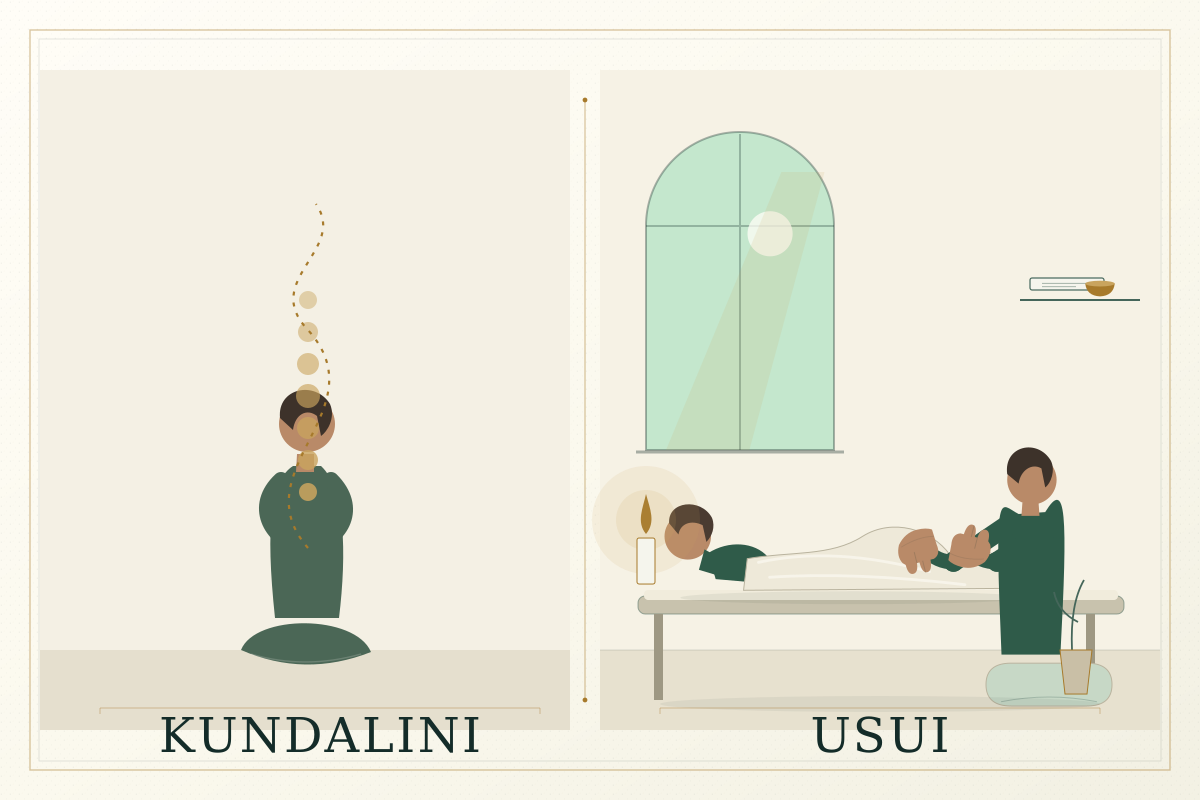
Kundalini Reiki and Usui Reiki share the word “Reiki,” and both use attunements and hands-on or hands-off practice. That is where the easy similarities end. Usui Reiki is the older Japanese lineage associated with Mikao Usui and the systems that developed from his teaching. Kundalini Reiki is a modern system, attributed to the Danish meditation teacher Ole Gabrielsen, that places kundalini energy at the centre of its attunements and practice.
The names can make Kundalini Reiki sound like an advanced Usui level. It is not. It is a separate system with its own lineage story, levels, and claims. Some of those claims — especially the idea that one Kundalini Reiki attunement is equivalent to several Usui levels — come from the system’s own teaching material, not from independent evidence.
What “Kundalini” means here
Kundalini is a concept from yogic and tantric traditions. It is often described as a dormant energy at the base of the spine that can rise through the body. The experience is interpreted in different ways by different schools, and “kundalini awakening” is not a medical diagnosis.
Kundalini Reiki uses that language. Its attunements are said to open and strengthen energy channels, clear chakras, and prepare for a gradual kundalini rising. Whatever one believes about that process, it is a spiritual framework, not a measurable physiological event that a clinician can verify.
Kundalini Reiki is also not the same as Kundalini yoga. Kundalini yoga is a physical and meditative practice with its own postures, breathing, chanting, and teaching lineage. Research on Kundalini yoga does not tell us whether Kundalini Reiki works.
Origins and lineage claims
Usui Reiki is attributed to Mikao Usui, who taught in Japan in the early 1920s. The Usui Reiki Ryoho Gakkai is associated with his teaching, which continued through his students and developed in different directions in Japan and the West. Western Usui Reiki is often associated with Chujiro Hayashi and Hawayo Takata, whose lineages introduced levels, symbols, and attunements in forms that many schools still use.
Kundalini Reiki is much more recent. Its course material attributes the system to Ole Gabrielsen, a Danish meditation teacher, and describes it as received through communion with the ascended master Kuthumi. That is a lineage claim within the tradition. It is not a historical record that can be verified in the way Usui’s teaching can be traced through the Gakkai and Western lineages.
The two systems also differ in structure. Usui Reiki commonly has three levels (with the third often divided into practitioner and master/teacher), and the symbols and attunement methods vary by lineage. Kundalini Reiki is usually taught in three levels, with attunements and a focus on opening the central channel and preparing for kundalini rising. Its materials often describe attunements as taking around 25 minutes and being available remotely.
| Feature | Usui Reiki | Kundalini Reiki |
|---|---|---|
| Typical levels | Three, with the third often split into practitioner and master/teacher | Three |
| Attunement style | Teacher-led, often in person, with lineage-specific symbols and hand positions | Often distant, around 25 minutes, focused on opening the central channel |
| Symbols | Central in many lineages, especially at Level 2 and master level | Not a central feature; the emphasis is on kundalini and the energy channels |
| Stated aim | Channel Reiki within a lineage | Prepare for and support kundalini rising |
Attunements and levels
An attunement is a ritual transmission in Reiki. In Usui lineages, it is often performed in person, though distant attunements are also offered. The student may receive one or more attunements per level, and the teacher may use symbols, breathing, and hand positions. The purpose is to establish or strengthen the student’s connection to Reiki.
Kundalini Reiki attunements are presented as a gradual opening of the energy channels. Level 1 is said to prepare the body; level 2 is said to awaken kundalini to the solar plexus; level 3 is said to complete the rising and train the student as a master. The system’s material describes additional attunements such as “Balance All,” “Diamond Reiki,” and “Crystalline Reiki,” which are not part of standard Usui curricula.
The claim that Kundalini Reiki 1 is “equivalent to Usui Reiki 1-2-3” is a good example of what to question. Equivalence would require comparable training, practice, and assessment, not just a similar energy claim. The comparison comes from Kundalini Reiki’s own materials. Check the actual teaching, practice and prerequisites with the Usui school you want to join rather than relying on that comparison.
What a session feels like
A Usui Reiki session usually involves a conversation, a sequence of hand positions or intuitive practice, and light touch or hands held above the body. The recipient remains clothed. Some practitioners use symbols; some do not. A session may last 45 to 90 minutes, depending on the practitioner and the setting.
A Kundalini Reiki session may look similar from the outside. The practitioner may use hands-on or distant practice, and the recipient may be asked to relax and notice sensations. The difference is in the framing: Kundalini Reiki is oriented toward opening the central channel and awakening kundalini, while Usui Reiki is oriented toward channeling Reiki energy within its lineage.
Some people report heat, tingling, emotional release, or spontaneous movement during either practice. Those experiences can be meaningful, but they are not evidence that a particular energy system is real or that a condition has been treated.
Training, credentials, and safety
Usui Reiki certificates and master titles are private credentials, and training varies from short courses to years of mentorship. Check local rules, insurance and scope-of-practice requirements before offering sessions professionally. Kundalini Reiki is also taught through private courses and distance attunements, and the speed of its master training is one of its selling points. A fast route to “master” is not the same as deep training in ethics, consent, and scope.
Kundalini Reiki materials sometimes suggest that the practice can help people who have had problems with a “wrong kundalini awakening.” That is a spiritual claim, not a clinical assessment. Intense meditation, breathwork, or energy practices can produce disturbing experiences, and people with a history of psychosis, dissociation, or trauma should be cautious about intensive practice and seek appropriate support.
Kundalini Reiki should not be used to diagnose or treat a medical condition. If a practitioner says that a session can replace medication, therapy, or medical investigation, that is a reason to stop. The same standard applies to Usui Reiki.
What the research shows
There is no body of clinical trial evidence for Kundalini Reiki as a system. NCCIH’s wider Reiki review does not identify a clearly established health benefit, and it describes the studies as inconsistent and often weak in design.
Research on Kundalini yoga is a separate field. Studies of Kundalini yoga may examine breathing, movement, meditation, and group practice; they do not test Kundalini Reiki attunements or the existence of kundalini as described in Reiki materials. It would be a mistake to use yoga research to validate Kundalini Reiki.
The sources reviewed here do not establish that Kundalini Reiki produces better outcomes than Usui Reiki, or the reverse. Claims that one is stronger, faster, or more complete are lineage claims, not research findings.
How to compare teachers
For Usui Reiki, ask:
- Which lineage and level are you working within, and who trained you?
- What does the training include, and how much supervised practice is required?
- Is touch involved, and can I choose hands-off practice?
- Do you use symbols or distant practice, and what do they mean in your tradition?
- How do you handle consent, emotional responses, and medical scope?
For Kundalini Reiki, ask:
- Who trained you, and what does your lineage say about the system’s origins?
- What are the three levels, and what is required between them?
- Are the attunements in person or distant, and what does the student have to do?
- Do you claim that Kundalini Reiki replaces Usui training or medical care?
- How do you support a student who has an intense or unsettling experience?
A teacher who can describe their lineage honestly and distinguish belief from evidence is more trustworthy than one who promises rapid mastery or medical results.
Questions people ask
Is Kundalini Reiki a higher level of Usui Reiki? No. It is a separate system with its own lineage, levels, and attunements. It is not a recognised advanced Usui level.
Can Kundalini Reiki awaken kundalini? That is the system’s claim. Kundalini awakening is a spiritual concept, not a medical diagnosis, and there is no reliable evidence that a Reiki attunement produces it.
Is Kundalini Reiki the same as Kundalini yoga? No. Kundalini yoga is a physical and meditative practice. Kundalini Reiki is an attunement-based energy practice.
Which is safer? Both are low-risk physically when practised with consent and without medical claims. Kundalini Reiki’s fast master training and intense-energy claims warrant extra caution about scope and aftercare.
Can I learn Usui Reiki after Kundalini Reiki? Yes, many people study more than one system. A Usui teacher may ask you to begin at their first level rather than recognising prior training.
Sources
- National Center for Complementary and Integrative Health, Reiki, last updated December 2018.
- Kundalini Reiki course material attributed to the Ole Gabrielsen lineage (lineage teaching, not independent evidence).
- Usui Reiki history and lineage material in the Reiki history guide and types of Reiki.
For the related question of how Seichim and Sekhem fit into modern Reiki, see Seichim Reiki and Sekhem. For a comparison of another modern system with Usui, see Karuna Reiki vs Usui Reiki.
Related topic: Reiki healing guides, Heyoka empath, Levels of consciousness, Inspirational quotes, The benefits of Reiki healing.