

Karuna Ki practitioners may use hand positions, scanning, or intuition in ways taught by their own lineage. These are optional spiritual practices, not assessments of a person's body or health. Traditions and teachers vary.
In a session, agree in advance whether the recipient wants hands-on Reiki, hands held above the body, or no scanning. Ask before moving to each area and before any touch. The person can decline, pause, or stop at any time. Do not scan someone at a distance or in person without their invitation.
Karuna Ki Scanning
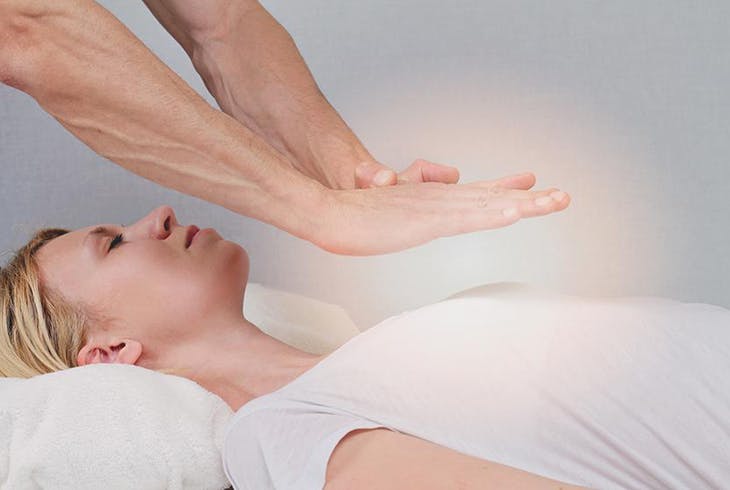
Some Karuna Ki practitioners move their hands above the body and notice warmth, coolness, tingling, or other impressions. These sensations are subjective and cannot identify illness, energy blockage, or an area that needs treatment. If you offer a session, ask only whether the person is comfortable with the practice; do not ask them to disclose a diagnosis to guide a scan. They may choose familiar Usui hand positions or skip scanning altogether.
Karuna Ki Mudras
This style of Karuna Ki includes mudras called Kai and Sha. In the tradition described here, Kai is associated with intuition and Sha with clarity, compassion, and purpose. These are spiritual meanings, not demonstrated effects on health or psychic perception. Practices differ between teachers.
Sha Mudra And Healing Meditation
If this mudra is part of your practice, you can hold it comfortably while meditating, or use another relaxed hand position. The traditional meaning of Sha may serve as a focus for compassion toward yourself and others. There is no need to make energy flow, feel warmth, or reach a particular state.
Sit or lie in a comfortable position. Let your breathing remain easy and natural; you can leave the breath alone if focusing on it is uncomfortable. If it helps, picture a gentle light or warmth around the hara, a term used in some spiritual traditions for the lower torso. Treat the image as visualization, not as a process affecting organs or bodily pathways. Stop or change the exercise whenever you wish.
Hand Scanning
In a hands-off version, hold your hands at a comfortable distance above the clothed person and move slowly only if they have agreed to that. You can also keep your hands still or skip the scan. Warmth, coolness, tingling, and other impressions are personal sensations; they are not diagnostic signs. Do not use them to select treatment, interpret symptoms, or suggest a disease.
Kai Mudra Meditation
Some Karuna Ki lineages use Kai with a meditation on compassion. If it is meaningful to you, interlace your fingers in the mudra as taught by your teacher, or choose a comfortable alternative. You may close your eyes, keep them open, or stop. Imagine compassion or a symbol from your own practice if you wish. Sensations around the forehead or a sense of insight are subjective experiences, not evidence of a psychic ability or a health reading.
Distant Practice
Only direct a Reiki practice toward another person if they have invited it. A photograph or letter may be used as a symbolic focus in some lineages, but it does not establish consent. Keep any distant practice within the boundaries the person has agreed to, and do not present it as diagnosing or treating a health condition.
Conclusion
Karuna Ki practitioners may value scanning and mudras as ways to focus attention and compassion. Their spiritual significance belongs to the practitioner's tradition and experience. Reiki has not been clearly shown effective for any health-related purpose, and evidence does not support the proposed energy field; see NCCIH's Reiki overview.
A consent-led scan, step by step
The following outline is a practical way to keep a scan clear and bounded. It is not a diagnostic procedure, and it can be shortened or skipped.
- Explain what you mean by scanning. Say that you will move your hands above the body, that you are not looking for a disease, and that the person can keep their eyes open or talk.
- Agree on touch and distance. Ask whether hands may rest on the body, hover above it, or stay away entirely. Agree on a signal for stop.
- Start at a neutral place. Begin near the feet or just outside the body rather than at the head or chest. Move slowly, and say where you are going before you go there.
- Describe your own sensations, not their body. "I notice warmth here" is different from "your liver is blocked". The first is a report of your experience; the second is a medical claim you cannot make.
- Ask before changing position. A person may be comfortable lying down and not sitting, or may need a cushion, a blanket or a break.
- Close clearly. Move your hands away, thank the person, and ask whether they want to sit quietly or talk. Do not announce a finding they did not ask for.
What to do with what you notice
A scan may produce warmth, coolness, tingling, numbness, an image, or nothing at all. These impressions can be affected by room temperature, clothing, fatigue, expectation and the simple fact that attention is being paid to a body. They are not reliable signs of illness or of an energy blockage, and they should never be used to choose a treatment, predict a diagnosis or tell someone what is wrong.
If an impression is strong, the useful response is curiosity rather than certainty. You can note it silently, keep your hands in a comfortable place, and continue with the agreed practice. If the person asks what you felt, answer honestly that it was your impression and not a medical finding. If they raise a symptom, encourage them to speak to a qualified clinician rather than offering an interpretation.
Mudras without pressure
Mudras are hand positions used in several traditions, and the meanings attached to them vary. In this lineage, Kai and Sha are associated with particular qualities, but the associations are spiritual rather than demonstrated. You can hold a mudra for a few minutes, change your hands when they ache, or use no mudra at all. There is no requirement to feel energy, hold a difficult position, or reach a special state.
If you teach a mudra, show it slowly and offer an alternative for anyone with arthritis, injury or limited hand mobility. A practice that excludes people for the sake of exact form is not more authentic; it is simply less useful.
Related topic: Karuna Ki, Chanting and toning, Four Karuna Ki Do meditations, Level one attunement, Level three attunement.