
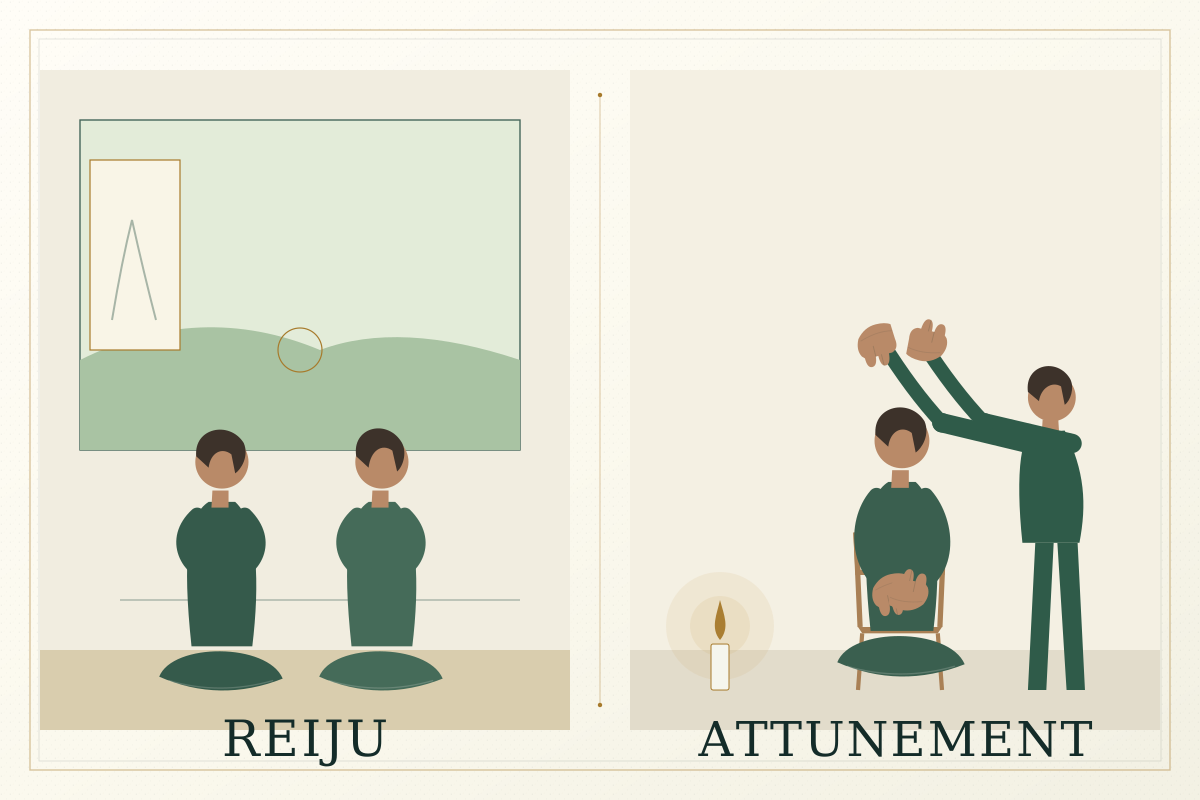
Reiju and attunement are often used as if they were synonyms. They are related, but they are not identical. Reiju is a Japanese term for a spiritual blessing or empowerment given by a teacher to a student. "Attunement" is the English word most often used in Western Reiki for a ritual that connects a student to the practice at a particular level. The two words point to the same broad territory, but their relationship is a matter of lineage and historical interpretation rather than a single agreed account.
Japanese training stages — Shoden, Okuden and Shinpiden — predate Takata's transmission to the West, so it is too simple to say that level-based initiation began with her. What the Western lineages developed was their own ritual vocabulary, emphasis on symbols, and way of packaging levels for new students. Reiju and attunement overlap, and some teachers use the terms interchangeably, but treating them as exactly the same can hide real differences in practice, repeatability, and lineage.
Two words, two histories
The Japanese word Reiju (霊授) combines characters suggesting spirit or spiritual transmission with giving, bestowing, or teaching. Translations include "spiritual blessing," "spiritual gift," and "spiritual transmission." In Reiki, it refers to a practice performed by a teacher for a student, traditionally associated with teaching and the development of the student's practice.
The word "attunement" is associated with the Western Reiki that developed through Hawayo Takata and her students. In those lineages, attunements are usually tied to levels: a first-degree attunement, a second-degree attunement, a Master attunement. The ritual often uses symbols, breath, touch or hovering hands, and a defined sequence. The teacher is said to "attune" the student to the energy of that level.
The historical relationship is not fully documented. We do not have a single authored manual from Mikao Usui describing one fixed Reiju ritual. What we have are later accounts, lineage transmissions, reconstructions, and the memorial inscription erected in 1927, which describes Usui's life and the founding of his teaching centre in Tokyo in 1922. Kisetsu, a school that writes carefully about this uncertainty, notes that today's reconstructions draw on different lines of transmission and that claims to reproduce Usui's exact original ritual should be treated with caution.
The comparison at a glance
| Feature | Reiju | Western attunement |
|---|---|---|
| Language | Japanese | English, developed in Western lineages |
| Typical context | Teaching and ongoing student development | Level-based class or initiation in many lineages |
| Repeatability | Often repeated; some lineages use it regularly | Often once per level, though repeats are common |
| Symbols | May be used, may be absent | Commonly central, especially at Level 2 and Master |
| Touch | Varies; some forms use hand positions, some intent alone | Varies; touch, hovering, breath, and visualisation are all used |
| Length | Can be brief | Can range from minutes to a longer ceremony |
| Lineage | Passed teacher to student | Passed teacher to student, usually with a level structure |
The table is a general guide, not a set of rules. You will find Reiju with symbols and attunements without them, short attunements and long Reiju, and teachers who use the words in their own way.
What Reiju means in practice
In the Japanese-derived framework, Reiju is often described as a blessing made with the intention that the student receive what they need. It is not necessarily a one-time door into a level. It can be given repeatedly as part of training, to support the student's development, or at meetings between teacher and student. The Reiki Council's lineage page even lists "attunements/Reiju/initiation" together when describing what a teacher must be authorised to pass on, which shows how closely the concepts are used in practice.
Taggart King, Shinpiden: Reiki Master Teacher Manual (Pinchbeck Press, 2009), pp. 142–157, offers one influential reconstruction. King argues that Usui used intent alone, that the practice was connected to a Tendai Buddhist blessing, and that Reiju could be understood as a "blessing of the five powers" — faith, zeal, mindfulness, meditation, and wisdom. He also describes an external ritual form with hand movements, used as a teaching tool. That is one author's interpretation, not a consensus of historians, and King himself presents it as a reconstruction. It is useful because it explains why some teachers treat Reiju as repeatable and developmental rather than as a single level ceremony.
How Western initiation rituals developed
The initiation rituals used in Western Reiki developed through Takata's teaching and the generations that followed. Takata adapted the Japanese training she had received for a new cultural context, and the lineages that grew from her work developed their own level structures and scripts. After her death in 1980, her students disagreed about succession, symbols, and standards. The result was not one Western Reiki but many lineages, each with its own attunement vocabulary.
The International Center for Reiki Training, for example, describes an attunement as the process by which a person receives the ability to give Reiki treatments, administered by a Reiki Master during class, with the energetic aspect said to be guided by a Higher Power. It also says an attunement lasts a whole life and that additional attunements at the same level refine and strengthen the connection. That is a coherent Western framework. It is not the only one.
Where the differences matter
Repeating the transmission
If Reiju is understood as a repeatable blessing, then receiving it many times is normal. If an attunement is understood as a once-per-level initiation, repetition may be framed as a refresher or a new lineage rather than as the same event. Neither view is inherently more authentic. They are different models of what the ritual does.
Symbols and secrecy
Some Western attunements are closely bound to symbols, especially at Level 2 and Master. Some Reiju forms use no symbols at all, or use them differently. This affects what a student is taught to keep private, what can be published, and how the ritual is explained.
The teacher's role
In both frameworks, the teacher is usually described as a facilitator rather than the source of the energy. But the emphasis differs. A Western attunement may foreground the Master's role in "opening" or "connecting" the student. A Reiju may foreground intention, blessing, and the student's own development. These are theological or interpretive differences, not measurable ones.
Levels and titles
Western attunements usually map onto a level system: Level 1, Level 2, Master. Reiju can exist within a level system, but it is not inherently a ladder. This is one reason comparisons between "Reiju levels" and "attunement levels" can go wrong.
Which word should you use?
Use the word your teacher uses, and explain it if you are writing for a general audience. If you received a Western-style level initiation, "attunement" is the natural term. If you received a Japanese-style blessing in a lineage that calls it Reiju, use Reiju and say what it means in that lineage. If your teacher uses both, ask what difference they intend.
What you should avoid is claiming that your local form is the universal original. The historical record does not support a single unbroken, identical ritual from Usui to the present. It supports a family of practices that developed in different directions.
If you are choosing a course, ask what the teacher means by the word they use. That tells you more than the label on the certificate. For the practical difference between the ritual and the paperwork, see attunement vs certificate. For the question of whether you need either to practise, see do you need an attunement?.
Related topic: Levels and attunements, Advanced Reiki training, Reiki Level 2 course, After the third degree, Attuning your students.