
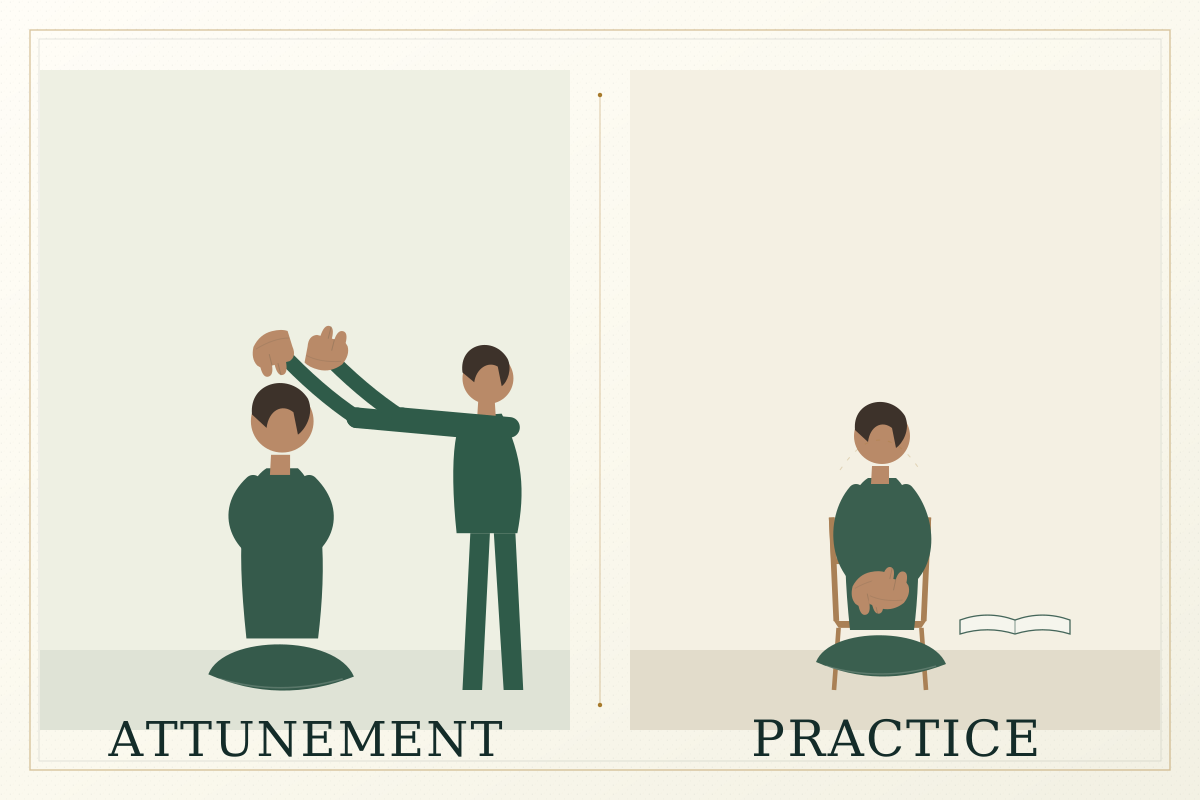
The honest answer depends on what you mean by "practise." If you mean exploring Reiki's principles, reading its history, and using its meditations for your own reflection, you can begin without an attunement. If you mean practising the Usui tradition as a lineage holds it, many branches of that tradition say an attunement is the point at which the practice is passed on. If you mean offering sessions to the public, the attunement is only one part of a larger question about training, insurance, and local expectations.
There is no single worldwide legal rule that says "no attunement, no Reiki." In the UK, the Reiki Council explains that practitioners do not legally have to register with any regulatory authority; the International Center for Reiki Training makes a similar point about government licensing. Regulation varies by country, and "legal" and "traditional" remain different standards. A tradition can require an initiation without the state requiring one.
The three meanings of "practise"
| What you want to do | Is an attunement normally expected? | What else matters |
|---|---|---|
| Read about Reiki and use its principles as reflection | No | Curiosity, context, and honest language about what you are doing |
| Give Reiki to yourself as a spiritual practice | In Usui lineages, yes for the traditional form | Instruction, practice, and a teacher who can answer questions |
| Offer sessions to other people | In Usui lineages, yes | Consent, insurance, local rules, and supervised practice |
| Teach or pass on attunements | Yes, plus specific teacher authorisation | Lineage permission, mentoring, and teaching skill |
The confusion comes from collapsing these rows into one. A person who has never been attuned can still benefit from the five principles or from quiet meditation. That does not make them a Reiki practitioner in the sense a lineage means. A person who has been attuned once is not automatically ready to run a professional practice. The attunement opens a door within a tradition; it does not supply the experience that follows.
Why Usui lineages place attunement at the centre
In Usui Reiki Ryoho and the Western lineages that developed from it, Reiki is described as a practice passed from teacher to student rather than a technique assembled from books. The Reiki Council describes Reiki as taught by Reiki Master/Teachers and says students go through initiation or attunement before they are able to treat themselves and others. The International Center for Reiki Training similarly describes attunement as the occasion when a Master passes the capacity to practise Reiki to a student.
These accounts explain the teacher–student relationship within Reiki. In that tradition, an attunement is not a reward for completing videos; it is the transmission that makes the practice lineage-based. That is why teachers ask who attuned them, and why a lineage chart matters to some students more than a certificate does.
There is also a practical reason for the emphasis. An attunement is usually embedded in a class where someone explains hand positions, consent, boundaries, and what to do if a recipient becomes emotional. The ritual and the teaching support each other. A transmission with no instruction leaves a student with little idea how to practise safely.
What you can learn without an attunement
A great deal of Reiki's surrounding knowledge is not secret. You can study:
- the life of Mikao Usui and the development of the system;
- the five principles and their different English translations;
- the history of the Usui Reiki Ryoho Gakkai and the Western lineages;
- the names and general roles of the Level 2 symbols, where a teacher has chosen to publish them;
- meditation, breathing, and self-reflection practices that accompany Reiki;
- the ethics of touch, consent, and referral.
This course's lessons and manuals are free to read before you request anything. You can use the material to decide whether the tradition interests you. What you cannot honestly claim from reading alone is that you have received the lineage transmission or that a Reiki teacher has authorised you to pass it on.
Can you attune yourself?
Some contemporary teachers offer self-attunement methods, and some books describe ways of "attuning yourself" through intention or visualisation. These approaches exist, and it would be inaccurate to say that nobody practices them. What is fair to say is that they are not equivalent to receiving an attunement from a teacher within a lineage, and different schools disagree sharply about whether they are valid.
If self-attunement appeals to you, ask what tradition the method comes from, who authorised the teacher who published it, and whether the method is recognised by any lineage body. You may still choose to use it as a personal practice. Just do not describe it as a traditional Usui attunement if it is not one. The distinction protects you from overstating your training and protects others from being misled.
Distance attunements and the "in person" question
Many teachers now offer distance attunements, including this course. The Reiki Council's description of National Occupational Standards refers to practitioners having been "attuned/initiated in person," which reflects one UK professional standard rather than a universal rule. Other schools treat distance attunement as valid, and the tradition contains different views about what distance means.
If you are choosing a distance attunement, ask how it is arranged, what preparation is expected, and whether you will have a chance to ask questions afterwards. A distance format is not automatically careless, and an in-person format is not automatically thorough. The quality lies in the teaching and the relationship, not only in the geography.
Practising on other people
Before you offer Reiki to anyone else, the attunement question is joined by several others:
- Consent. Explain what you propose to do, where you will place your hands, and that the person can stop at any time.
- Scope. Do not diagnose, promise a cure, or advise someone to stop medical treatment.
- Insurance. Many insurers expect evidence of training; ask what they accept.
- Setting. A hospice, clinic, or spa may have its own requirements, including a professional register.
- Competence. Start with people you know, keep sessions short, and get feedback.
The guide to certificates covers the paperwork side. The certification vs accreditation article explains why a certificate from one school may not satisfy an insurer or employer.
A simple way to decide
If your goal is personal exploration, begin with the free lessons and see whether the practice holds your attention. If it does, request an attunement when you are ready to commit to the traditional form. If your goal is to treat others, add supervised practice and check the practical requirements where you live before you advertise. If your goal is to teach, ask specifically about teacher authorisation, not just about reaching a level.
You do not have to resolve every question before you start. You do have to be accurate about what you have and have not received. That honesty is worth more than any title.
Related topic: Levels and attunements, Advanced Reiki training, Reiki Level 2 course, After the third degree, Attuning your students.