
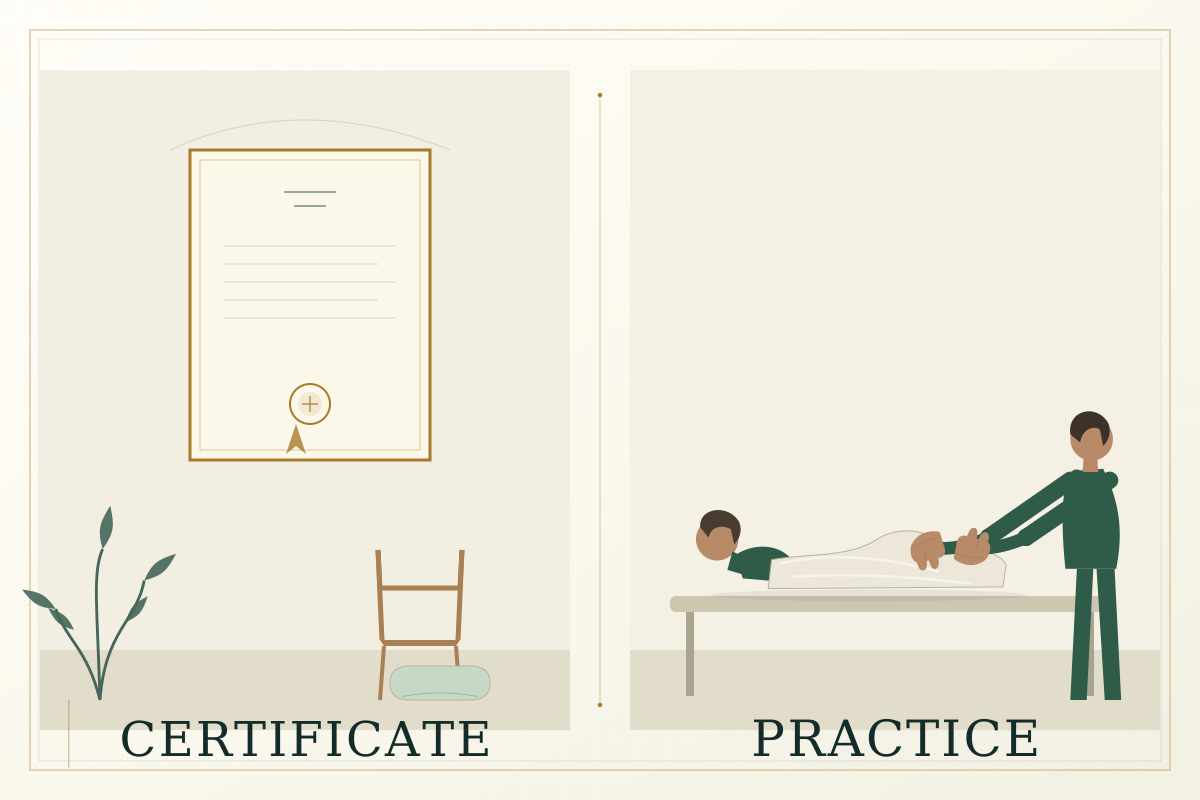
No single worldwide law says you must hold a Reiki certificate before you can place your hands on yourself or offer Reiki to a consenting friend. In the UK, the Reiki Council notes that practitioners do not legally have to register with a regulator, and the International Center for Reiki Training states that there are no governmental licensing programmes for Reiki in the US at the time of its FAQ. Regulation varies, but "not legally required" is not the same as "never needed." A certificate can be asked for by an insurer, a venue, an employer, a professional register, or a teacher you want to study with.
The useful question is not "Do I need a certificate?" but "What is this certificate for, and who is asking for it?" A certificate is evidence of training. It is not proof of competence, a licence, or a guarantee that anyone else will recognise it.
What a Reiki certificate usually records
A typical certificate includes:
- the student's name;
- the level or course title;
- the teacher's or school's name;
- the date;
- sometimes a lineage line and a signature;
- sometimes a statement of hours or assessment.
What it records varies enormously. One certificate may represent a weekend class with supervised practice. Another may represent an online purchase with no contact at all. The document itself does not tell you which, which is why asking about the training behind it matters more than the paper.
In this course, the lessons and manuals are free, attunements are free on request, and certificates are optional paid purchases. The certificate is a record of the level you studied; it does not unlock lessons and it is not an accreditation. You can study and practise without buying one.
When someone may ask for a certificate
Insurance
Many practitioner insurers ask for evidence of training before they will cover you. They may specify a minimum level, hours, or a recognised school. Ask the insurer directly what it accepts rather than assuming that any Reiki certificate will do.
Venues and employers
A hospice, clinic, spa, gym, or community centre may require proof of training and insurance before allowing you to work on its premises. Some settings also require registration with a professional body. These are organisational rules, not Reiki law.
Professional registers
In the UK, the Complementary and Natural Healthcare Council (CNHC) holds a voluntary register for Reiki practitioners. The Reiki Council explains that registration is not absolutely necessary but can give greater recognition, and that NHS staff can refer to CNHC registrants. Entry usually requires more than a basic level certificate: a verified professional course or independent verification against national standards.
Further training
A teacher may ask for a certificate from your previous level before accepting you onto the next one. This is a reasonable way for them to check that you have covered the prerequisites, although some teachers will assess prior learning differently.
What a certificate does not prove
A certificate does not prove that you are a safe practitioner, a skilled one, or one whose training is recognised outside the school that issued it. It does not make you a healthcare professional. It does not give you permission to diagnose or to advise anyone to stop medical treatment. It does not guarantee that an insurer, venue, or register will accept it.
The International Center for Reiki Training states that there are no governmental licensing programmes for Reiki, though it runs its own licensing programme for teachers. The Reiki Council describes a voluntary system of verification and registration. Neither arrangement turns a Reiki certificate into a state licence.
How to check whether a certificate is meaningful
Ask these questions before you rely on one:
- Who issued it? A named teacher or school with a traceable lineage is easier to verify than an anonymous PDF.
- What did the course require? Attendance, practice, assessment, case studies, or only a payment?
- How many hours? A weekend introduction and a year-long practitioner course are not equivalent.
- Is the school recognised by a body? If so, which body, and what exactly does that recognition cover?
- Does the certificate state a level and a date? Vague certificates are hard to use for insurance or further training.
- Can the issuer confirm it? A verifiable contact and records system matters if anyone checks.
Be wary of certificates that describe the holder as "certified" or "accredited" without saying by whom, or that imply a legal right to practise medicine. The words are not regulated in the same way everywhere.
If you do not have a certificate
You can still study, practise on yourself, and share Reiki with consenting friends and family, subject to the tradition you follow and any local rules. If you later want insurance or a venue, you may need to complete a training course that satisfies those requirements. That is not a reason to buy the first certificate you see; it is a reason to ask what the requirement actually is.
If you already have a certificate but feel under-prepared, additional supervised practice may be more useful than another document. A certificate can open a conversation with an insurer or a teacher, but it cannot substitute for experience.
Certificate, attunement, and accreditation are three different things
The attunement vs certificate guide explains the traditional transmission that a certificate may or may not accompany. The certification vs accreditation article explains why an "accredited" course is not necessarily a licence. And the guide to practising without an attunement looks at the tradition's own expectations.
If you are studying with this course, you can request a free attunement when you are ready and decide about the optional certificate separately. Neither decision needs to be rushed.
Related topic: Levels and attunements, Advanced Reiki training, Reiki Level 2 course, After the third degree, Attuning your students.