
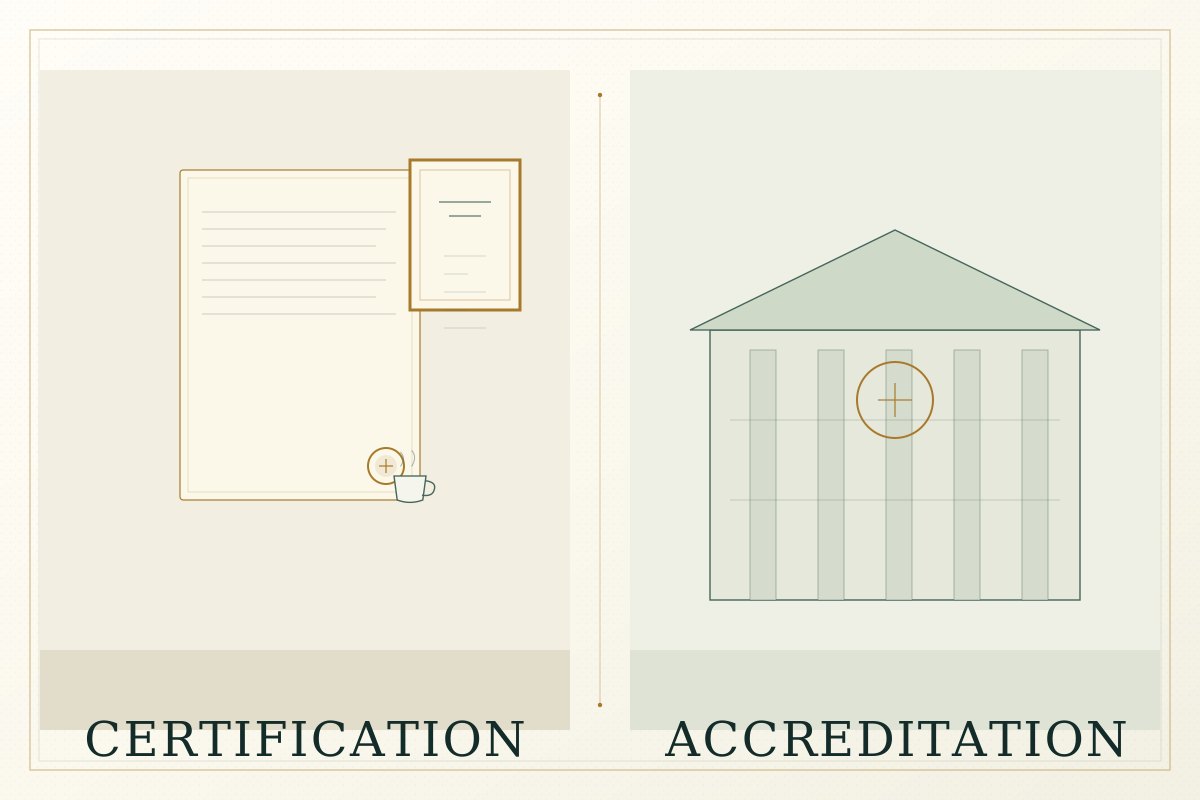
Certification and accreditation are often used as if they were interchangeable quality marks. They are not. Certification usually means that an individual has completed a course or met a school's requirements. Accreditation usually means that an external body has reviewed a course, a provider, or a practitioner against a standard. You can have one without the other, and neither is, by itself, a government licence to practise medicine.
The words also vary by country. In one context, an "accredited Reiki course" may mean a course verified by a professional association. In another, it may mean a training provider approved by a commercial body. In a third, it may mean nothing more than a logo. The only way to know is to ask who did the accrediting and what they actually checked.
A plain-language comparison
| Term | What it usually means | Who grants it | What it does not mean |
|---|---|---|---|
| Certification | A record that you completed a course or level | A teacher, school, or training provider | That you are competent, insured, or licensed |
| Course accreditation | An external body has reviewed a course against its criteria | A professional association, awarding body, or commercial provider | That the course is legally required or universally recognised |
| Practitioner accreditation or verification | A body has checked a practitioner's training and standards | A professional register or verifying organisation | That the practitioner is a state-licensed health professional |
| Government licence | Legal permission to practise a regulated profession | A government regulator | That Reiki is regulated in the same way as medicine |
The distinctions matter most when you are choosing a course, applying for insurance, or describing your qualifications to the public.
What Reiki certification is
A Reiki certificate is usually a document from a teacher or school. It may record attendance, completion of a level, a short assessment, or simply that you paid for the class. The content and rigour vary enormously.
In this course, the lessons and manuals are free, attunements are free on request, and certificates are optional paid purchases. The certificate is a record of the level you studied. It is not an accreditation, and it does not make the course a licensed professional qualification. You can read more in the guide to Reiki certificates.
Certification can still be useful. It gives you a dated record, helps a new teacher understand what you have covered, and may satisfy an insurer's basic evidence requirement. The mistake is treating it as a universal passport.
What accreditation means in Reiki
Accreditation is a relationship between an organisation and a standard. The organisation says, in effect: "We have looked at this course or practitioner and they meet our criteria." The value of that statement depends on who is making it and what the criteria are.
In the UK, the Reiki Council is a lead advisory body rather than a government regulator. It explains that practitioners do not legally have to register with any regulatory authority, but that voluntary registration with the Complementary and Natural Healthcare Council (CNHC) can give greater recognition. The Reiki Council also describes a professional practitioner certificate and course verification through member organisations. These are voluntary quality structures, not a state licence.
The International Center for Reiki Training states that there are no governmental licensing programmes for Reiki in the US at the time of its FAQ, while running its own licensing programme for teachers. Other countries vary. That is a private arrangement, not a statutory one.
Why "accredited" can be misleading
The word "accredited" is not always protected. A course provider may use it to mean that its own internal committee approved the course, that a commercial directory lists it, or that a professional association reviewed it. Those are different levels of scrutiny.
Questions that cut through the ambiguity:
- Who accredits the course? Name the body, not just the logo.
- What standard was used? Is it a published curriculum, an hours requirement, an assessment, or a fee?
- Is the body a regulator or an association? An association can set standards without having legal authority.
- Does the accreditation expire? Is there continuing professional development or re-verification?
- What does it allow the graduate to do? Can they join a register, obtain insurance, or work in a specific setting?
- Is it recognised where you intend to practise? Recognition is often local.
If a provider cannot answer those questions clearly, the word "accredited" is doing marketing work rather than quality work.
Certification, accreditation, and competence
None of these markers guarantees competence. A certified practitioner may be excellent or inexperienced. An accredited course may be rigorous or merely well marketed. A verified practitioner may have met a standard on paper but still be a poor fit for a particular client.
Competence is built through practice, feedback, supervision, and reflection. Certificates and accreditations are signals that can help you choose where to start, but they are not substitutes for judgment. This is true in Reiki as in many other unregulated or lightly regulated fields.
What to check if you want to practise professionally
If you plan to charge for sessions or work in a clinic, hospice, spa, or other organisation, check the actual requirements of that setting:
- Insurance. Ask the insurer what training and certification it accepts.
- Venue. Ask the manager what evidence and checks they require.
- Professional register. Find out whether registration is expected, and with which body.
- Local rules. Some countries or regions regulate touch-based therapies or health claims, even when Reiki itself is not licensed.
- Scope of practice. Know what you will not do: diagnose, prescribe, promise a cure, or replace medical care.
The Reiki Council's verification page, its training page and its guidance on public and professional practice set out one national framework. They are useful even if you practise elsewhere, because they show the difference between a school certificate and a professional standard.
A practical rule
Ask what the document is for before you compare logos. If it is a record of study, a school certificate may be enough. If it is a condition of insurance, a venue or a register, ask that body what it accepts. Accreditation only helps if you know who granted it and what they checked.
For the ritual side of training, see attunement vs certificate. For the practical question of whether you need a certificate at all, see do you need a Reiki certificate?
Related topic: Levels and attunements, Advanced Reiki training, Reiki Level 2 course, After the third degree, Attuning your students.