
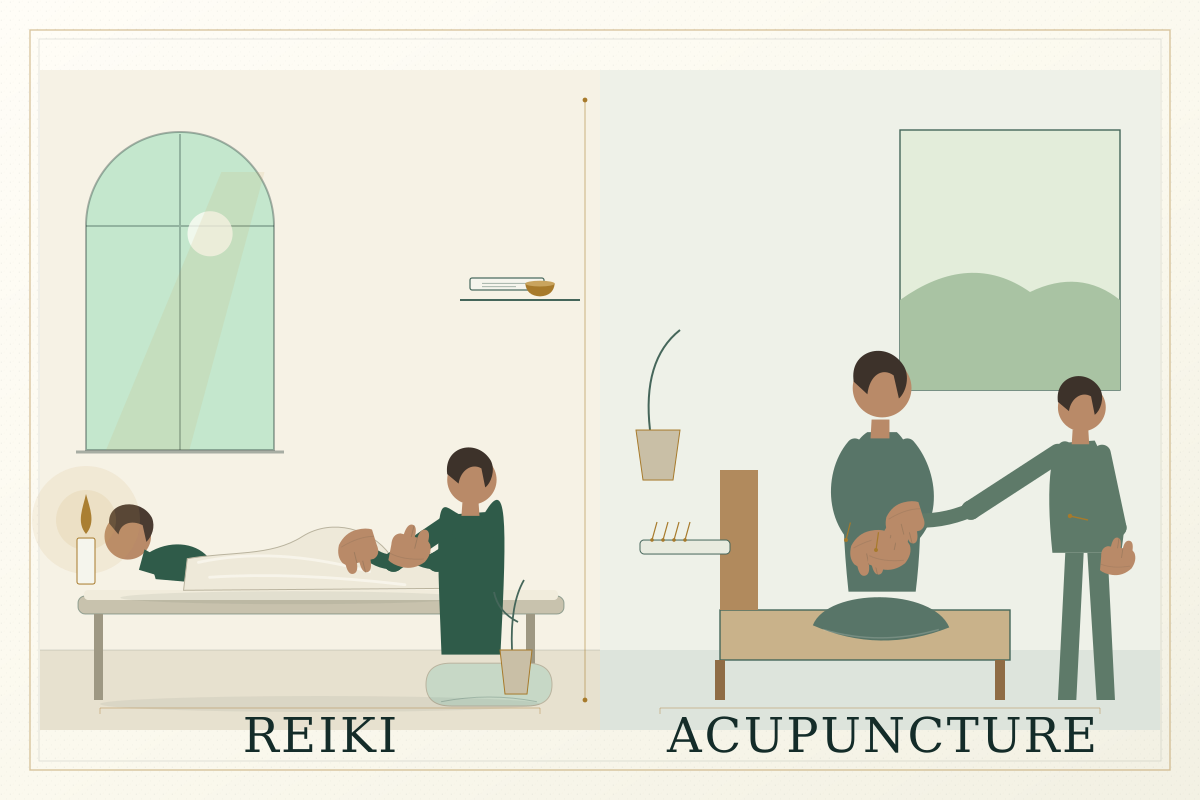
Reiki and acupuncture are often grouped together as “energy therapies,” but the resemblance is mostly at the level of explanation. One is a needling practice with a long Chinese medical tradition and a growing body of clinical research. The other is a Japanese spiritual practice in which a practitioner places hands lightly on or near a fully clothed person. They feel different, carry different risks, and are regulated in different ways.
The practical answer is not that one is more “real” than the other. Acupuncture has better evidence for some kinds of pain, and specific safety rules that come with breaking the skin. Reiki involves no needles, and some studies report symptom improvements, but the evidence does not establish it as a general medical treatment. If you are choosing between them, the useful questions are about training, consent, what the practitioner claims, and whether either is being offered instead of appropriate medical care.
What actually happens in each session
Acupuncture uses fine, sterile, single-use needles inserted at selected points. A practitioner may manipulate the needles by hand or add a small electrical current, which is called electroacupuncture. Sessions commonly focus on a painful area or a pattern identified through traditional Chinese medicine, and a course of treatment may involve several visits (NCCIH).
Reiki is usually received while lying on a table or sitting in a chair, fully clothed. The practitioner rests their hands lightly on the body or holds them just above it, often moving through a sequence of positions. There is no needle, no electrical device, and no physical manipulation of tissue. A session may be silent or include quiet conversation, and some practitioners use symbols or distant practice within their own tradition.
| Feature | Acupuncture | Reiki |
|---|---|---|
| Main action | Fine needles inserted into the skin | Light touch or hands held near the body |
| Clothing | Usually removed or adjusted around the treatment area | Remains on |
| Equipment | Sterile single-use needles, sometimes electrical stimulation | Treatment table or chair; no needles |
| Typical focus | A symptom, condition, or traditional Chinese medicine pattern | Relaxation and a spiritual practice of “universal energy” |
| Evidence base | Some evidence for certain pain conditions | No clearly established efficacy for health conditions |
The comparison is not symmetrical. Acupuncture is a physical intervention with measurable local effects, even though how it works is not fully understood. Reiki is a practice whose central claim — a universal energy that can be directed for healing — has no accepted scientific support. That does not make a Reiki session meaningless to the person receiving it, but it does change what can honestly be promised.
Qi, meridians, and Reiki energy are not the same idea
Traditional Chinese medicine describes qi moving through meridians, and acupuncture points are understood in relation to that system. Reiki describes a universal life energy said to be drawn through the practitioner. The two vocabularies can sound similar in English, especially when both are translated as “energy,” but they come from different traditions and describe different things.
It is common for wellness writing to blur them together. That blurring is not helpful when you are trying to understand a treatment. Acupuncture points are specific locations with traditional needling instructions. Reiki hand positions are not the same map, and a Reiki practitioner does not need to know acupuncture points to practise Reiki. Equating the two makes both harder to assess.
There is also a difference in how the traditions are held. Acupuncture is embedded in a medical system with textbooks, licensing exams, and clinical practice standards in many countries. Reiki is held through lineages, attunements, and teacher-to-student transmission. A Reiki master’s title is a religious or spiritual teaching credential, not a medical licence.
Training, licensing, and jurisdiction
Acupuncture regulation depends on where you live. In the United States, most states license acupuncturists, but the requirements vary; the National Center for Complementary and Integrative Health directs readers to its credentialing and licensing information rather than offering a single national rule. The U.S. Food and Drug Administration regulates acupuncture needles as medical devices and requires them to be sterile and labelled for single use.
In the United Kingdom, the NHS advises people choosing a private complementary therapist to look for a professional organisation accredited by the Professional Standards Authority, and notes that many complementary therapists are not required by law to be registered. That general position does not make acupuncture risk-free; it means the consumer has to check the practitioner’s training and local requirements rather than assuming a statutory title. The NHS complementary therapies page explains the UK position.
Reiki has no equivalent statutory licence in the UK or the US. Certificates and “master” titles come from schools, lineages, or private organisations. Some are detailed and include supervised practice; others are short online courses. A certificate can show that someone completed a course, but it does not establish clinical competence, insurance cover, or a right to practise a regulated health profession.
What the research can and cannot tell you
For acupuncture, the evidence is strongest for some pain conditions. NCCIH summarises reviews in which acupuncture was more effective than no treatment for back or neck pain and for knee osteoarthritis pain, and notes that the difference between acupuncture and sham acupuncture was smaller than the difference between acupuncture and no treatment. That pattern suggests that nonspecific effects — expectation, attention, the practitioner relationship — contribute to the benefit.
That does not mean acupuncture is “just placebo.” It means the evidence is complex, the effects vary by condition, and the quality of studies is not uniform. NCCIH also notes that how acupuncture works is not fully understood and that research points to effects on the nervous system, local tissue, and nonspecific factors.
NCCIH’s December 2018 Reiki overview describes inconsistent research and an unproven proposed energy field. Newer reviews deserve consideration alongside that older summary. A 2026 meta-analysis of 15 surgical-care trials reported improvements in postoperative symptoms with moderate-to-low certainty. Its authors caution that placebo effects may contribute and do not recommend routine clinical adoption. These findings concern short-term symptoms around surgery; they do not establish disease treatment, a Reiki energy mechanism or superiority to acupuncture.
The sources reviewed here do not establish a direct comparison that would settle which approach is better for a specific condition. The interventions are different, the outcomes are hard to blind, and the traditions make different claims. Anyone who presents such a comparison as settled is going beyond the evidence.
Safety and scope
Acupuncture is generally low-risk when performed by a trained practitioner with sterile technique, but it is not risk-free. NCCIH notes that complications have occurred from non-sterile needles and improper delivery, and that serious adverse effects can include infection, punctured organs, and injury to the central nervous system. People taking blood-thinning medication or with bleeding disorders, skin infection, or certain other conditions should discuss the risks with a qualified practitioner and their own clinician.
Reiki does not break the skin, so it does not carry needling risks. That is a genuine practical difference. Those findings concern a specific setting and do not establish Reiki as a disease treatment or a replacement for medication or surgery. A recipient’s relaxation alone cannot demonstrate an energy mechanism. A Reiki session can be a pleasant, calming experience without being clinically effective.
Both practices raise the same boundary question: is the practitioner clear about what they can and cannot do? A practitioner who suggests that either approach can diagnose a condition, replace prescribed treatment, or remove the need for medical investigation is a reason to pause. So is pressure to buy a long course of sessions before you have seen whether the first one suits you.
How to compare practitioners
For acupuncture, ask:
- Which licence or registration do you hold, and which local body oversees it?
- Are the needles sterile and single-use, and how do you handle sharps?
- What training do you have in the condition I want help with?
- What are the realistic benefits and risks, and how many sessions before we review progress?
- Will you coordinate with my doctor or other clinicians if I ask you to?
For Reiki, ask:
- What training and lineage are you working within, and who taught you?
- What happens in a session, including touch, symbols, and anything said about health?
- Do you carry insurance, and do you have a complaints or ethics process?
- Will you make any medical claims, and how do you respond if I want to stop?
- Are you willing to work alongside my medical care without asking me to delay it?
Those questions are more useful than a generic “are you certified?” A certificate is a starting point, not a substitute for clear scope, consent, and honesty about evidence.
Can they be used alongside each other?
Some people use acupuncture for a specific pain problem and Reiki for relaxation, and there is no general rule that the two cannot coexist. The important issue is not compatibility between the practices but the care plan around them. Tell each practitioner what else you are using, especially if you take medication, have a bleeding disorder, are pregnant, or are receiving treatment for a serious condition.
Do not use either practice to postpone an assessment for a symptom that needs medical attention. NCCIH’s advice for acupuncture is direct: do not use it to delay seeing a health care provider about a health problem. The same caution applies to Reiki, and it applies most strongly when a practitioner discourages ordinary medical care.
Questions people ask
Is Reiki a form of acupuncture? No. Acupuncture uses needles inserted into the skin. Reiki uses light touch or hands held near the body and has no needling component.
Does acupuncture work better than Reiki? For some pain conditions, acupuncture has meaningful clinical evidence; Reiki does not have comparable evidence for any health condition. That is not the same as saying acupuncture will work for you, or that Reiki cannot feel valuable.
Can Reiki replace acupuncture? No. They are different practices with different training and safety considerations. Reiki is not a substitute for a needling treatment or for medical assessment.
Is acupuncture safe if I take blood thinners? That is a question for your prescribing clinician and a qualified acupuncturist. NCCIH and the NHS both note increased bleeding risk as a consideration, and the decision depends on your individual circumstances.
Do I have to believe in Reiki for it to work? Belief may shape how relaxing or meaningful a session feels, but it does not turn Reiki into an established treatment. A practitioner should not require you to accept medical claims as a condition of receiving care.
Sources
- National Center for Complementary and Integrative Health, Acupuncture: Effectiveness and Safety, last updated October 2022.
- National Center for Complementary and Integrative Health, Reiki, last updated December 2018.
- NHS, Herbal medicines and complementary therapies, reviewed 1 May 2026.
If you want to understand how Reiki fits alongside other touch-based and movement-based practices, the healing guides hub groups the comparisons, and Reiki vs Qigong looks at the difference between a received session and a practice you do yourself.
Related topic: Reiki healing guides, Heyoka empath, Levels of consciousness, Inspirational quotes, The benefits of Reiki healing.