
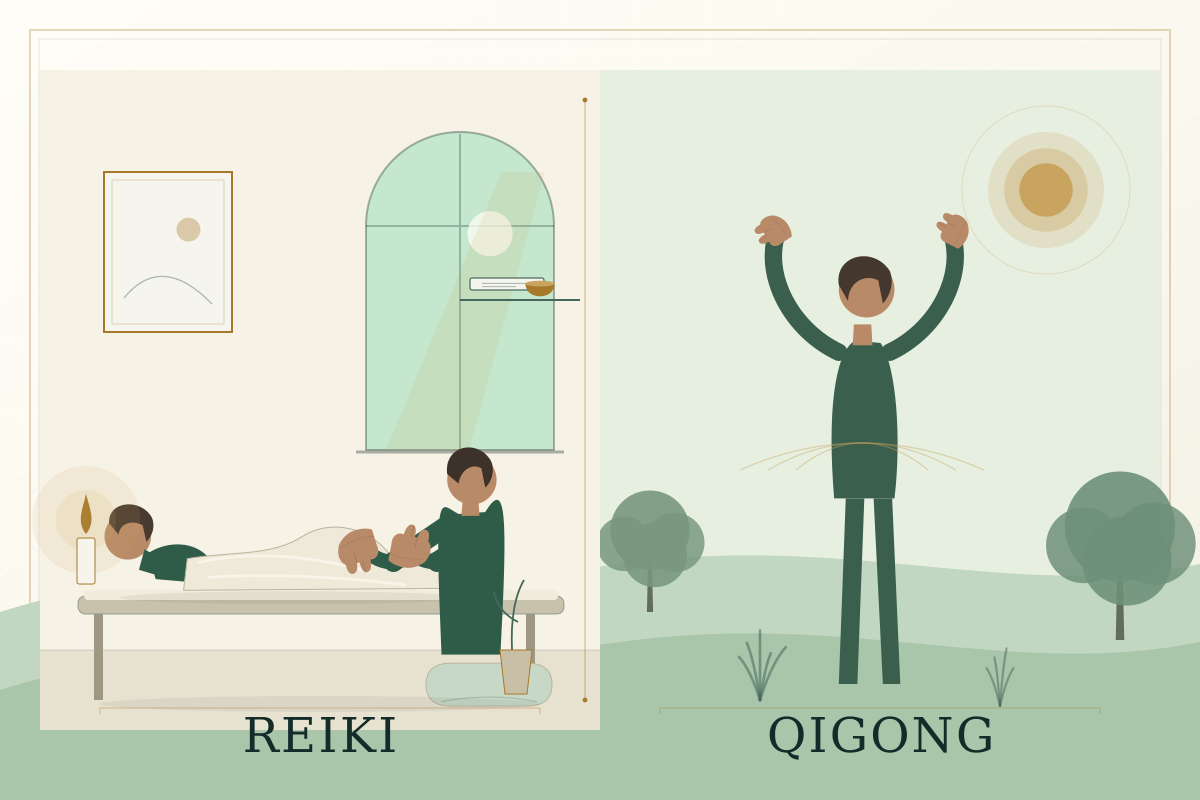
The shortest way to tell Reiki and qigong apart is to ask who is doing the practice. In a typical Reiki session, the recipient lies down, remains clothed, and receives light touch or hands held near the body. In qigong, the person practising is usually the one moving, breathing, and directing attention. One is primarily a session you receive; the other is primarily a practice you learn.
That distinction matters because it changes what “working” means. Qigong is a form of meditative movement, so any benefit may come through gentle exercise, breathing, attention, and routine. Reiki is a passive spiritual practice, so its claimed mechanism is not exercise at all. Comparing them as if they were two brands of the same energy treatment misses the most important difference.
One is received, the other is practised
Qigong, pronounced “chi gong,” developed in China within traditional Chinese medicine. It combines regulated breathing, gentle movement, posture, and focused attention. Some forms are moving and some are mostly still; tai chi is often described as a form of qigong when practised for health.
A qigong class usually involves standing or seated movements, guided breathing, and time to notice sensations. You wear loose clothing and may use a mat or chair. The teacher demonstrates and corrects, and the practice is something you can continue at home. There is also “external qigong,” in which a practitioner claims to direct qi toward a client, but that is a different activity from the self-practice most classes teach.
A Reiki session is usually quieter and more passive. The recipient does not need to learn a sequence or hold a posture. The practitioner follows a lineage-based method, often moving through hand positions, and may use symbols or distant practice. The recipient’s main task is to remain comfortable and say if anything is unwelcome.
| Question | Qigong | Reiki |
|---|---|---|
| Who practises? | The participant, usually in a class or at home | The practitioner, while the recipient rests |
| Body | Gentle movement, posture, and breath | Stillness; light touch or hands near the body |
| Clothing and equipment | Loose clothing, mat or chair, sometimes props | Fully clothed; table or chair, no equipment |
| Learning curve | Ongoing practice and instruction | No skill required to receive a session |
| Claimed basis | Qi cultivated through breath and movement | Universal energy channelled through the practitioner |
Qi and Reiki energy are related words, not the same theory
Both traditions use the English word “energy,” and that makes them easy to conflate. In qigong, qi is understood within Chinese medicine as a vital substance or functional principle cultivated through breath, movement, and intent. In Reiki, the practitioner is said to channel a universal energy that supports healing. The words overlap; the systems do not.
A qigong teacher may talk about the dantian, meridians, or the smooth flow of qi. A Reiki practitioner may talk about chakras, attunements, or symbols. Neither vocabulary is a scientific description of a measurable force, and neither should be presented as one. The useful question is not which energy theory is correct, but what the practice involves and whether it is being offered honestly.
What a session or class actually feels like
A beginner qigong class often starts with standing practice: feet grounded, knees soft, arms moving slowly, breath coordinated with movement. The teacher may guide you through a short sequence and then repeat it. You might feel warmth, stretch, or tiredness. Those are ordinary effects of movement and attention, not proof that qi has been unblocked.
A Reiki session is usually one-to-one and mostly silent. You may feel warmth from the practitioner’s hands, tingling, or nothing in particular. The practitioner may move through a fixed sequence or work intuitively. A responsible practitioner will explain that touch is optional and that you can stop at any time.
Qigong can be practised alone after learning the basics; Reiki is usually received from someone else, although self-Reiki is part of many lineages. Qigong has a visible skill progression — you learn the movements and can see yourself improving. Reiki’s progression is through attunements and practice within a lineage, not through a physical technique you can observe.
Training and regulation
Qigong instructors do not have to be licensed in the United States, and the practice is not regulated by the federal government or individual states. There is no national standard for qigong certification; different organisations offer training with different criteria and levels. That does not mean training is worthless, but it does mean you have to ask what a teacher actually studied and how long they practised before teaching.
Reiki has a similar regulatory picture. There is no statutory Reiki licence in the UK or the US, and “master” or “certified” titles come from private schools and lineages. In the UK, the practical check is whether a practitioner belongs to a voluntary register accredited by the Professional Standards Authority; registration is not a legal requirement for most complementary therapists.
In both fields, a certificate is a claim about training, not a guarantee of competence. A qigong teacher with a weekend certificate and years of personal practice may be more useful than one with a long list of credentials and no teaching skill. A Reiki practitioner with a short online attunement may be sincere but unprepared for the ethical questions that arise when someone is unwell. Ask about both training and actual practice.
What the research shows
Qigong has a more substantial research base than Reiki, largely because it is a form of exercise that can be studied with standard outcomes such as pain, balance, lung function, and quality of life. NCCIH summarises research in fibromyalgia, COPD, Parkinson’s disease, balance and fall prevention, and some other areas. It also notes that many studies are small, heterogeneous, or not rigorous enough to support firm conclusions.
The findings depend on the exercise, study population and outcome measured; they cannot be transferred to every qigong style or to Reiki. It is a reason to see qigong as a gentle activity that may support function and well-being for some people, alongside appropriate medical care. The physical activity component is real, and it is plausible that some benefits come from movement, breathing, and routine rather than from qi.
Reiki’s proposed energy field is unproven, and study quality and results vary. A 2026 review of surgical-care trials found promising short-term symptom results but rated certainty moderate to low. That does not establish general health benefits or a clinical advantage over qigong.
The sources reviewed here do not establish a reliable head-to-head comparison of Reiki and qigong. The practices differ in duration, mode, and outcome, so a simple “which works better” answer would be misleading.
Safety and scope
Qigong is generally a safe form of activity, but it is still movement. NCCIH notes that side effects in studies have been minor, such as muscle soreness and headache, and that pregnant women should talk with their health care providers before starting because some movements may need modification. People with balance problems, recent surgery, or painful joints should choose a class that matches their ability and tell the teacher.
Reiki does not involve movement or needles, so its physical risks are low. The bigger risks are indirect: a practitioner may discourage medical care, imply that a session can diagnose a condition, or apply pressure to continue sessions. A recipient who is unwell may also find that lying still for a long time is uncomfortable, and should be free to change position or stop.
With either practice, the boundary is the same. Neither should be used to delay investigation of a new or worsening symptom. NCCIH’s advice for qigong is not to use it to postpone seeing a health care provider, and the same applies to Reiki.
How to choose a teacher or practitioner
For qigong, ask:
- What style do you teach, and what does a beginner class involve?
- How much of the class is movement, breath, and seated meditation?
- What is your training, and how long have you been practising and teaching?
- Can you adapt movements for an injury, pregnancy, or limited mobility?
- Do you make health claims, or do you present qigong as exercise and practice?
For Reiki, ask:
- Which lineage and level are you working within, and who trained you?
- Is touch involved, and can I choose hands-off practice?
- What do you say a session can and cannot do?
- Do you have insurance and a complaints process?
- Will you work alongside my medical care without asking me to delay it?
If you are drawn to both, they can coexist: qigong as a personal movement practice and Reiki as a quiet received session. The combination is not a treatment plan, and it does not replace medical advice.
Questions people ask
Is qigong a type of Reiki? No. Qigong is a Chinese practice of movement, breath, and attention. Reiki is a Japanese spiritual practice usually received from a practitioner. They have different histories and methods.
Can qigong be done hands-off? Some qigong is mostly still and internal; external qigong may involve a practitioner’s hands near the body. That is not the same as a Reiki session, even if the setup looks similar.
Which is better for anxiety? There is no reliable evidence that either is a specific treatment for anxiety. Qigong may help through gentle exercise, routine, and breathing; Reiki may help some people relax. Anyone with persistent anxiety should seek appropriate care.
Do I need to believe in qi or Reiki energy? You do not need to accept a metaphysical theory to try either practice, but you should not be asked to accept medical claims as a condition of care. A good teacher or practitioner can explain the tradition without presenting it as established science.
Sources
- National Center for Complementary and Integrative Health, Qigong: What You Need To Know, last updated February 2022.
- National Center for Complementary and Integrative Health, Reiki, last updated December 2018.
- NHS, Herbal medicines and complementary therapies, reviewed 1 May 2026.
For the needle-based comparison, see Reiki vs Acupuncture; for the difference between passive Reiki and active breath practices, see Reiki vs Breathwork.
Related topic: Reiki healing guides, Heyoka empath, Levels of consciousness, Inspirational quotes, The benefits of Reiki healing.