
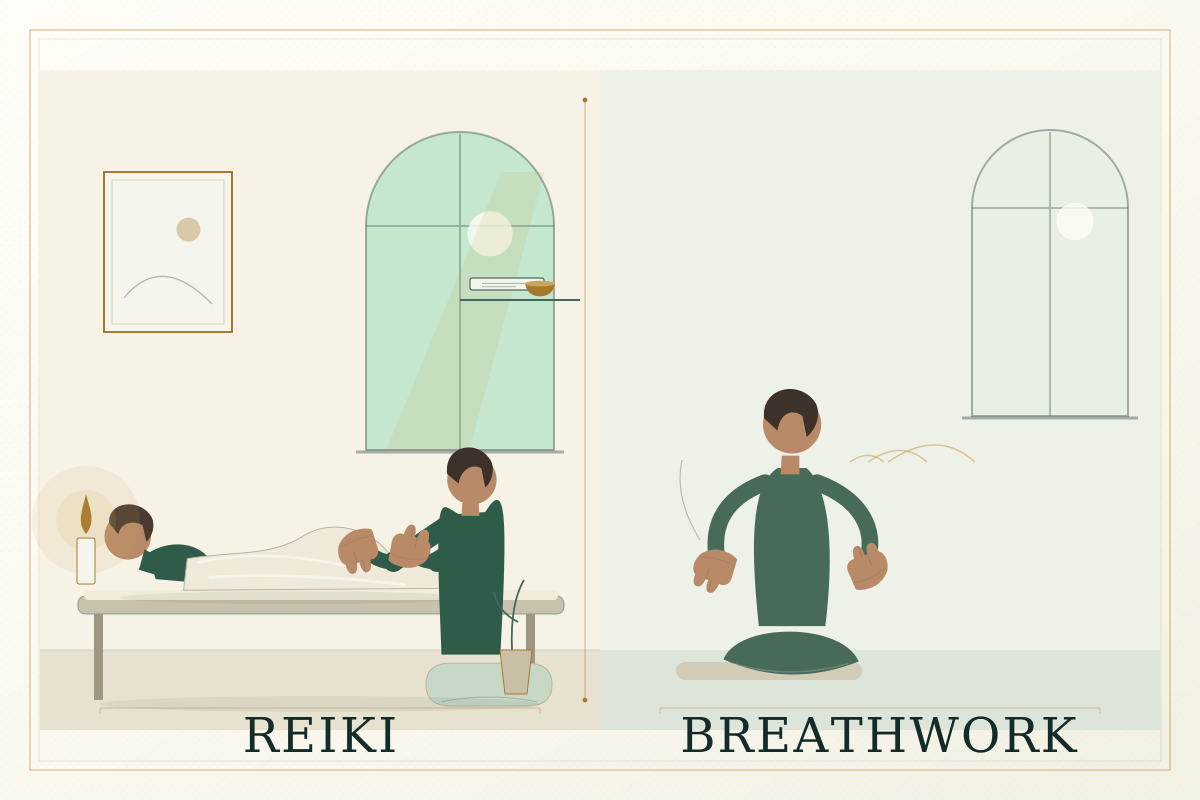
Reiki and breathwork are sometimes offered as complementary ways to relax, but they ask different things of the person receiving them. Reiki is passive: you rest, remain clothed, and receive light touch or hands held near the body. Breathwork is active: you deliberately change your breathing, often for a sustained period, under a teacher’s guidance.
That difference changes the risk profile. A Reiki session is unlikely to make you dizzy or breathless. A breathwork session can, especially if it involves fast breathing, long holds, or intense physical effort. The comparison is not about which practice is more spiritual; it is about what each one does to the body and what evidence supports it.
What “breathwork” can mean
Breathwork is an umbrella term. It includes gentle slow-breathing exercises, pranayama from yoga, coherent breathing, box breathing, and high-ventilation practices that use rapid breathing or prolonged breath holds. Some are taught in a clinical or stress-management setting; others are part of retreats, performance coaching, or spiritual workshops.
The distinction matters because the evidence and risks are different. Slow, comfortable breathing has a reasonable rationale for relaxation and is generally low-risk for healthy people. High-ventilation breathwork is more intense, can produce strong physical sensations, and should not be treated as a casual relaxation exercise.
A Reiki session does not require you to alter your breath. You may be invited to breathe naturally, and some practitioners use a shared breathing rhythm as a cue for settling, but the practice is not a breathing technique.
What happens in a session
A breathwork session usually begins with instructions and a safety conversation. You may sit or lie down, often with eyes closed and music playing. The facilitator guides a pattern: faster breathing, deep breathing, holds, or a sequence of active and restful phases. Some sessions are one-to-one; many are group events.
A Reiki session is quieter. You lie on a table or sit in a chair, fully clothed. The practitioner may talk you through what will happen, then place hands lightly or hold them above the body. You do not need to count breaths, hold your breath, or push through discomfort.
| Feature | Breathwork | Reiki |
|---|---|---|
| Your role | Actively change your breathing | Rest and receive |
| Typical setting | Group or one-to-one, seated or lying | One-to-one, table or chair |
| Physical effort | Can be low or intense, depending on method | Minimal |
| Main risks | Dizziness, fainting, panic, strain | Discomfort with touch, indirect medical delay |
| Training | Unregulated; varies widely | Lineage-based; varies widely |
What the research shows
A 2023 meta-analysis of randomised controlled trials found that breathwork was associated with small-to-medium improvements in self-reported stress, anxiety, and depressive symptoms compared with non-breathwork controls. The authors described most studies as at moderate risk of bias and cautioned against a “miscalibration between hype and evidence.”
A separate 2023 review of high-ventilation breathwork described profound subjective and physiological effects and called for rigorous clinical testing. It did not establish high-ventilation breathing as a treatment for psychiatric or physical conditions.
Reiki’s clinical evidence is less developed. NCCIH describes inconsistent results and no clearly established health benefit. The sources reviewed here do not establish a clinical advantage of breathwork over Reiki, or the reverse.
The honest summary is that both practices may help some people feel calmer, but neither is a proven treatment for a medical condition. Breathwork has the stronger rationale as a nervous-system practice, but it also has more intense variants and more opportunities for adverse effects.
Safety: keep the breath gentle
Breathwork is not automatically safe because it is “just breathing.” Rapid breathing can cause dizziness, tingling, cramps, and fainting. Long breath holds can be hazardous, especially in water or for people with heart, lung, or seizure conditions. Intense breathwork can also bring up strong emotional material, which is not the same as resolving trauma.
For a general audience, the sensible boundary is gentle, comfortable breathing without prolonged retention or forced hyperventilation. The NHS’s stress-breathing guidance is a useful reference: breathe in gently through the nose, out through the mouth, without forcing the breath, and repeat for a few minutes. That is a relaxation exercise, not a clinical treatment.
If you have a heart or lung condition, uncontrolled high blood pressure, epilepsy, a history of panic attacks or psychosis, are pregnant, or are recovering from surgery, talk to a clinician before doing intense breathwork. Stop and seek medical advice if you develop chest pain, fainting, severe dizziness, or breathlessness that does not settle. Do not do breath holds in water or while driving.
Reiki has fewer physical risks, but it is not free of indirect risk. A practitioner who claims that Reiki can replace medication, or who treats emotional release as proof that the practice is working, can cause harm by encouraging delay. Touch should be optional, and the recipient should be able to stop at any time.
Training, credentials, and scope
Breathwork has no single statutory credential. Training ranges from short courses to long facilitator programs, and different schools teach different techniques. Some practitioners have backgrounds in yoga, physiotherapy, psychology, or nursing; others do not. A certificate does not tell you whether the facilitator can screen for risk or handle a participant in distress.
Reiki also lacks statutory regulation. Certificates and master titles are private credentials, and training varies widely. UK practitioners may belong to a voluntary register accredited by the Professional Standards Authority, but there is no statutory Reiki licence.
For breathwork, the most important credential may be the facilitator’s willingness to screen participants, explain the technique in advance, and stop the session if someone is struggling. For Reiki, it may be the practitioner’s clarity about consent, touch, and medical scope.
How to compare providers
For breathwork, ask:
- What style of breathwork do you teach, and how intense is it?
- What screening do you do for heart, lung, seizure, pregnancy, and mental health risks?
- Will there be breath holds or rapid breathing, and can I opt out of them?
- What do you do if someone becomes dizzy, panics, or wants to stop?
- What do you claim breathwork can do, and what do you say it cannot do?
For Reiki, ask:
- Which lineage and level are you working within, and who trained you?
- Is touch involved, and can I choose hands-off practice?
- Do you use symbols or distant practice, and what do they mean in your tradition?
- Will you make medical claims or ask me to change my care?
- How do you respond if I become emotional or uncomfortable?
If a breathwork facilitator pushes you to continue through dizziness or discourages you from seeking medical advice, leave. If a Reiki practitioner tells you that stopping a session will interrupt your healing, that is pressure, not consent.
Questions people ask
Is Reiki a form of breathwork? No. Reiki may include quiet breathing, but it is not a breathing technique. Breathwork requires you to change your breath deliberately.
Does breathwork have scientific support? Some forms of slow breathing have research support for relaxation and stress, but the evidence is limited and heterogeneous. High-ventilation breathwork is still being studied and is not an established treatment.
Can breathwork be dangerous? Intense breathing and long breath holds can cause dizziness, fainting, and strain, and can be risky for people with certain medical conditions. Gentle breathing without prolonged retention is much lower risk.
Which is better for anxiety? There is no reliable evidence that either is a specific treatment for anxiety. Breathwork has a more direct physiological rationale; Reiki may be relaxing for some people. Persistent anxiety needs appropriate care.
Can I combine them? Some people use Reiki for quiet rest and breathwork for a daily practice. Tell each practitioner what else you are doing, and do not let either practice delay medical care.
Sources
- Fincham GW, Strauss C, Montero-Marin J, Cavanagh K, Effect of breathwork on stress and mental health: A meta-analysis of randomised-controlled trials, Scientific Reports, 2023.
- Fincham GW, Kartar A, Uthaug MV, et al., High ventilation breathwork practices, Neuroscience & Biobehavioral Reviews, 2023.
- National Center for Complementary and Integrative Health, Reiki, last updated December 2018.
- NHS, Breathing exercises for stress, reviewed 12 June 2026.
- NHS, Herbal medicines and complementary therapies, reviewed 1 May 2026.
For the difference between Reiki and a movement practice, see Reiki vs Yoga. For a quiet, self-directed practice, see Reiki vs Mindfulness Meditation.
Related topic: Reiki healing guides, Heyoka empath, Levels of consciousness, Inspirational quotes, The benefits of Reiki healing.