
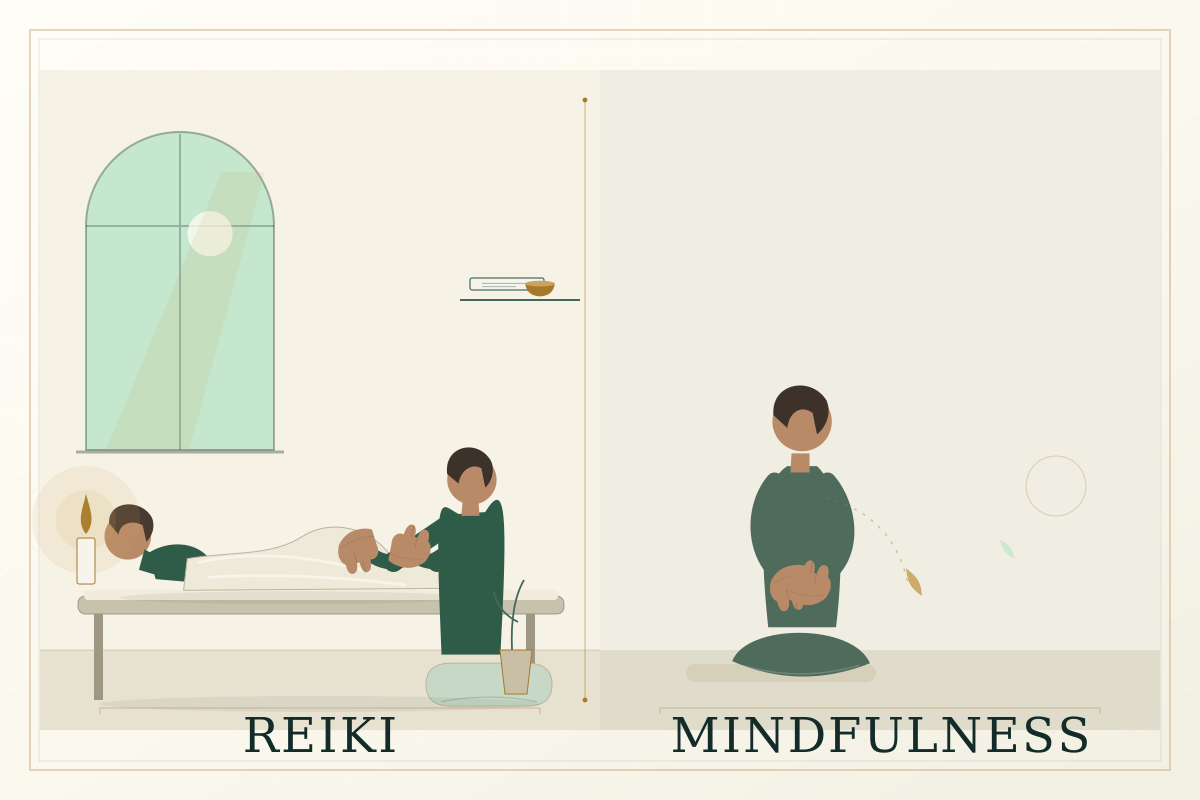
Reiki and mindfulness meditation are often recommended for the same reason: people feel calmer after them. But they are different kinds of practice. Mindfulness is something you learn to do yourself — noticing thoughts, sensations, and surroundings without immediately reacting. Reiki is usually something you receive from a practitioner who claims to channel universal energy.
The distinction matters because mindfulness has a substantial research base and a defined set of course formats, while Reiki’s evidence is much weaker and its claims are metaphysical. Mindfulness is not simply “Reiki without the hands,” and Reiki is not “mindfulness with touch.” They can coexist, but they answer different questions.
The short answer
Mindfulness is a self-directed attention practice. It asks you to observe the present moment — breath, body, sounds, thoughts — without judgment. Reiki is a passive spiritual practice in which a practitioner places hands lightly on or near the body and claims to direct energy.
If you want a skill you can use on your own, mindfulness is the clearer fit. If you want a quiet received session within a spiritual lineage, Reiki is the closer fit. Neither is a replacement for medical or mental health care.
What mindfulness actually is
Mindfulness is often taught through programs such as mindfulness-based stress reduction (MBSR) or mindfulness-based cognitive therapy (MBCT). MBSR usually runs for eight weeks and combines guided meditation, gentle movement, and discussion about applying awareness to daily life. MBCT integrates mindfulness with cognitive behavioural therapy and is used for recurrent depression in some healthcare settings.
The practice can be formal — sitting meditation, body scan, walking meditation — or informal, such as paying attention while washing dishes or walking to work. The core instruction is not to empty the mind or achieve bliss. It is to notice what is happening and return attention when it wanders.
A Reiki session does not teach a skill. The recipient may feel relaxed, emotional, or nothing in particular. The practitioner may be silent or talk through the session, but the recipient is not usually given a daily practice to continue.
What a session or course looks like
A mindfulness course is educational. You attend classes, practise at home, and learn to work with distraction, discomfort, and difficult emotions. A teacher may guide meditations and invite questions. The setting is usually a group, in person or online, and the course may include readings and homework.
A Reiki session is one-to-one and shorter. You lie on a table or sit in a chair, fully clothed. The practitioner may use a sequence of hand positions, light touch or hover, and symbols depending on the lineage. There is no homework, no group discussion, and no requirement to learn a technique.
| Feature | Mindfulness meditation | Reiki |
|---|---|---|
| Your role | Practise attention and awareness | Rest and receive |
| Typical format | Eight-week course, class, or daily practice | One-to-one session |
| Training | Teacher training varies; no single licence | Lineage-based attunement and mentorship |
| Main claim | Training attention can change how you relate to experience | Universal energy supports healing |
| Evidence | Some evidence for some mental health outcomes | No clearly established efficacy |
Training, credentials, and regulation
Mindfulness teaching is not statutorily regulated in most places. Teachers may train through MBSR or MBCT programs, university courses, retreat centres, or secular mindfulness organisations. There is no single government licence, and the quality of teacher training varies.
Some mindfulness programs have defined curricula and supervision requirements. MBSR, for example, has a recognised eight-week structure and teacher-training pathways, though the details depend on the provider. A certificate can show that someone completed a program; it does not guarantee competence or suitability for every group.
Reiki has no statutory licence either. Certificates and master titles are private credentials, and training ranges from short attunements to long apprenticeships. In the UK, a voluntary register accredited by the Professional Standards Authority is a useful signal, not a legal requirement.
For both, ask about the teacher’s training, supervision, and experience with the population you are part of. A teacher who works with trauma, chronic pain, or depression needs more than a general meditation certificate.
What the research shows
Mindfulness has a larger and more rigorous evidence base than Reiki, though it is not uniform. NCCIH summarises research on mindfulness-based approaches for anxiety, depression, stress, pain, sleep, and some other outcomes. The results are promising in places but uneven: studies vary in quality, different programs produce different results, and some findings are preliminary.
A notable 2018 analysis of more than 12,000 participants found that mindfulness-based approaches were better than no treatment for anxiety and depression and worked about as well as established evidence-based therapies in some comparisons. That does not mean mindfulness is a universal treatment or that it works for everyone.
NCCIH also reports that negative experiences can occur. A 2020 review found that about 8% of participants in the included studies reported a negative effect, most commonly anxiety or depression, and that few studies have examined harms systematically. That is a reminder that meditation is not risk-free, especially for people with trauma or serious mental health conditions.
Reiki’s evidence is thinner still. NCCIH finds no clearly established health benefit, and the studies are inconsistent. The evidence summarized here does not establish a direct comparison of their benefits.
Safety and scope
Mindfulness is generally low-risk, but it is not always comfortable. Sitting with difficult thoughts can be distressing, and intensive retreats can destabilise people with trauma, dissociation, psychosis, or severe depression. A trauma-sensitive teacher should offer choices, avoid pressure to close the eyes or sit still, and be clear about when to seek clinical support.
Reiki has fewer psychological demands because the recipient is not asked to meditate. The main risks are indirect: a practitioner may claim to diagnose illness or provide medical treatment, discourage medical care, or treat emotional release as proof that the practice is working. Touch should be optional, and the recipient should be able to stop at any time.
Neither practice should be used to delay assessment for a new or worsening symptom. If meditation or Reiki brings up intense distress that does not settle, seek appropriate mental health support.
How to compare providers
For mindfulness, ask:
- What training have you completed, and are you supervised?
- Is this MBSR, MBCT, or another program, and what does the course involve?
- How do you adapt the practice for trauma, anxiety, or chronic pain?
- What do you do if a participant becomes distressed?
- Do you make medical claims, or do you present mindfulness as a practice with limits?
For Reiki, ask:
- Which lineage and level are you working within, and who trained you?
- Is touch involved, and can I choose hands-off practice?
- Do you use symbols or distant practice, and what do they mean in your tradition?
- Will you make medical claims or ask me to change my care?
- How do you respond if I become emotional or uncomfortable?
A mindfulness teacher who can explain the difference between a course, a retreat, and therapy is easier to trust than one who promises transformation. A Reiki practitioner who is clear about consent and scope is safer than one who relies on mystery.
Questions people ask
Is Reiki a type of meditation? Reiki is a spiritual practice, and some practitioners meditate before or during a session. But a Reiki session is not the same as learning mindfulness, and the recipient is not usually practising a meditation technique.
Can mindfulness replace therapy? No. Mindfulness may be helpful alongside therapy, but it is not a substitute for assessment and treatment of a mental health condition. MBCT is a structured program with a specific evidence base, not a general replacement for care.
Which is better for anxiety? Mindfulness has more evidence for anxiety than Reiki, but it does not work for everyone and can be uncomfortable for some people. Reiki may be relaxing without being a treatment.
Do I have to believe in energy for Reiki to work? Belief may shape how meaningful a session feels, but it does not establish a medical effect. A practitioner should not require you to accept medical claims.
Can I do both? Yes, if both suit you. Tell each practitioner what else you are doing, and do not let either practice delay medical care.
Sources
- National Center for Complementary and Integrative Health, Meditation and Mindfulness: Effectiveness and Safety, last updated June 2022.
- National Center for Complementary and Integrative Health, Reiki, last updated December 2018.
- NHS, Herbal medicines and complementary therapies, reviewed 1 May 2026.
For a Reiki-specific meditation guide, see A Reiki Master’s Guide to Meditation. For the difference between Reiki and a movement practice, see Reiki vs Yoga.
Related topic: Reiki healing guides, Heyoka empath, Levels of consciousness, Inspirational quotes, The benefits of Reiki healing.