
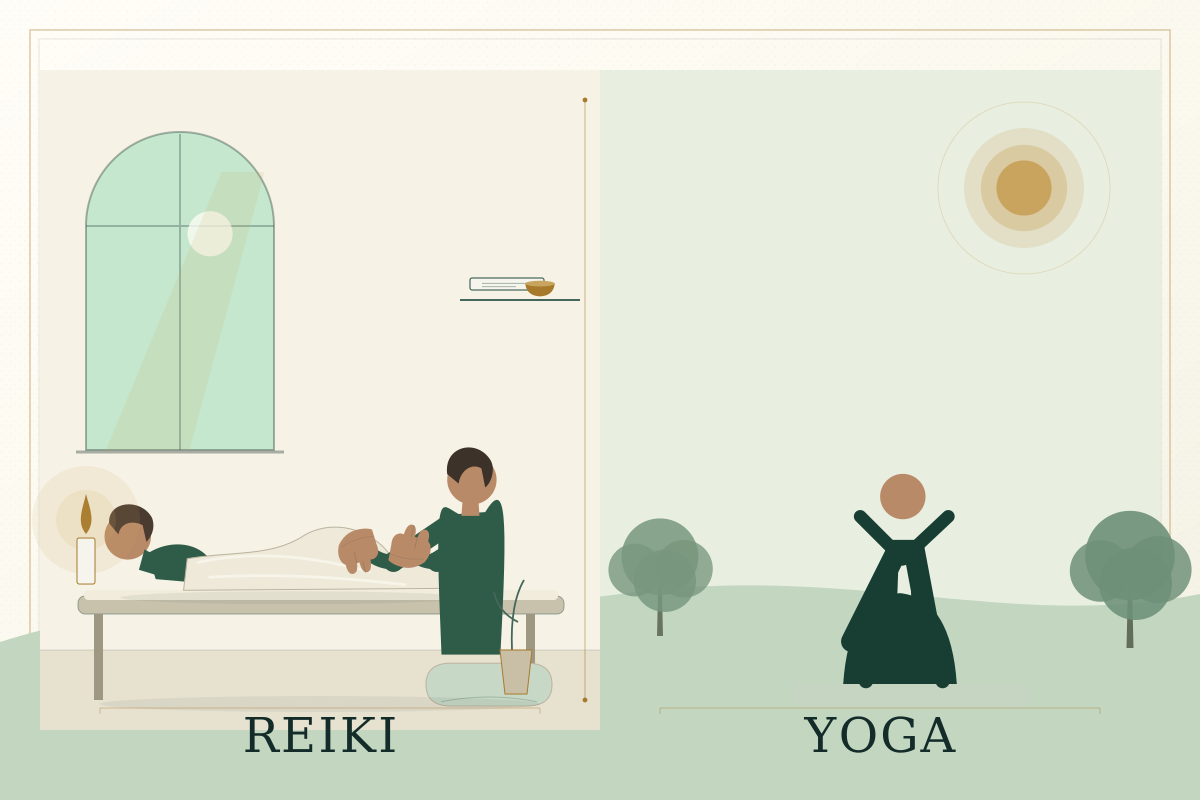
Yoga and Reiki are both rooted in spiritual traditions and both are often described as ways to bring the body and mind into balance. In practice, they ask very different things of you. Yoga is something you do: you move, hold postures, breathe, and pay attention. Reiki is usually something you receive: you lie down, remain clothed, and a practitioner places hands lightly on or near the body.
That difference is the key to comparing them. Yoga is a form of physical activity with a spiritual and philosophical history. Reiki is a passive energy practice with a Japanese lineage. One can improve strength, balance, and flexibility; the other does not involve exercise at all. Neither is a substitute for medical care, and neither should be sold as medical treatment.
What a yoga class involves
A yoga class usually includes postures (asanas), breathing practices (pranayama), and some period of relaxation or meditation. Styles range from gentle and restorative to vigorous and athletic. A class may be held in a studio, a gym, a community hall, or online. You wear comfortable clothing, use a mat, and sometimes use blocks, straps, blankets, or bolsters.
Teachers may offer physical adjustments — hands-on guidance to move a limb or deepen a pose. Adjustments are not universal, and consent should be sought. Some classes are heated, which adds a separate set of risks. A beginner class should explain the shape of the session and offer modifications.
A Reiki session has none of that movement. You remain clothed on a table or chair, and the practitioner’s hands are the main event. There is no mat, no sequence of postures, and no physical effort. Some practitioners play music or use symbols, but the recipient is not exercising.
| Feature | Yoga | Reiki |
|---|---|---|
| Your role | Active movement, breath, and attention | Rest and receive |
| Setting | Group class or one-to-one | One-to-one session |
| Equipment | Mat, props, sometimes heat | Table or chair; no equipment |
| Physical effort | Low to high, depending on style | Minimal |
| Training | Teacher training and private registries | Lineage-based attunement and mentorship |
Touch and consent
Yoga teachers may use hands-on adjustments, and some students find them helpful while others do not. A responsible teacher will ask before adjusting, explain what they are doing, and respect a “no.” If a teacher adjusts you without warning or ignores your request to stop, that is a consent problem, not a teaching style.
Reiki touch is usually lighter and more still, but the same principle applies. A practitioner should explain where they will place their hands, offer a hands-off option, and avoid sensitive areas unless you have agreed. A hands-off Reiki session is complete; it is not an inferior version.
In both settings, you should be able to say “not today” without having to justify it. That is especially important if you have pain, a history of trauma, or a body image concern.
Training, credentials, and regulation
Yoga teacher training is not government-licensed in most places. Yoga Alliance, a private credentialing body, registers teachers through 200-hour and 500-hour level credentials (RYT 200 and RYT 500) and registers schools that meet its standards. Those credentials are widely recognised in the yoga industry, but they are not a medical licence or a guarantee of teaching quality.
Reiki training is also unregulated. Certificates and master titles come from private schools and lineages, and the length and depth of training vary enormously. In the UK, a voluntary register accredited by the Professional Standards Authority is a useful check, but it does not make Reiki a licensed profession.
For yoga, the more useful questions may be about the teacher’s experience with the style and population you are joining: beginners, older adults, pregnancy, injury, or limited mobility. For Reiki, the more useful questions are about lineage, touch, and the claims the practitioner makes.
What the research shows
Yoga has a substantial research base, though it is uneven because “yoga” covers many different practices. NCCIH summarises evidence suggesting that yoga may help with general wellness, stress, balance, sleep, and some pain and mental health outcomes. It also notes that studies vary widely in style, dose, and population, which makes it hard to draw firm conclusions.
The physical activity component is real. Yoga can improve flexibility, strength, and balance for some people, and it can be a form of exercise. Results from one type of class or study population cannot be transferred to every style of yoga or every person.
Reiki, by contrast, has no clearly established health benefit in NCCIH’s review, and the studies are inconsistent. The evidence summarized here does not establish which is better overall; they involve different activities and can serve different purposes.
Safety and scope
Yoga is generally safe for healthy people when taught appropriately, but injuries happen. NCCIH notes that sprains and strains are the most common injuries, that older adults may be at higher risk, and that beginners should avoid extreme practices such as headstands, shoulder stands, the lotus position, and forceful breathing. People with injuries, pregnancy, balance problems, glaucoma, or severe high blood pressure may need modifications.
Reiki has fewer physical risks because it does not involve movement or pressure. The main risks are indirect: a practitioner may claim to diagnose illness, discourage medical care, or use touch in a way that feels unsafe. A recipient who is unwell may also find lying still uncomfortable and should be free to change position.
Neither practice should be used to delay medical assessment. If a yoga teacher or Reiki practitioner tells you that a new or worsening symptom is a sign of “release” or “blocked energy” and does not need medical attention, get a second opinion.
How to compare providers
For yoga, ask:
- What style do you teach, and is this class suitable for my experience and any limitations?
- Do you offer hands-on adjustments, and can I opt out?
- What training and credentials do you hold, and how long have you taught this population?
- How do you modify poses for pregnancy, injury, or limited mobility?
- Is the room heated, and what are the risks if I am not used to heat?
For Reiki, ask:
- Which lineage and level are you working within, and who trained you?
- Is touch involved, and can I choose hands-off practice?
- Do you use symbols or distant practice, and what do they mean in your tradition?
- Will you make medical claims or ask me to change my care?
- How do you respond if I become uncomfortable or want to stop?
A yoga class and a Reiki session can coexist in a wellness routine. The combination is not a treatment plan, and it does not replace medical advice.
Questions people ask
Is yoga a form of Reiki? No. Yoga is an active practice of movement, breath, and attention. Reiki is a passive energy practice usually received from a practitioner.
Can yoga be hands-off? Yes. Many teachers do not use physical adjustments, and you can ask for none. That does not make the class less effective as exercise.
Does Reiki count as exercise? No. A Reiki session involves minimal physical activity. It does not build strength, flexibility, or cardiovascular fitness.
Which is better for stress? Both may help some people feel calmer. Yoga has a stronger evidence base for physical and mental health outcomes, but the styles and studies vary. Reiki may be relaxing without being a treatment.
Can I do yoga while receiving Reiki? Yes, if both are appropriate for you. Tell each practitioner about the other, and do not let either practice delay medical care.
Sources
- Yoga Alliance, Credentialing options, accessed 23 October 2026.
- National Center for Complementary and Integrative Health, Yoga: Effectiveness and Safety, last updated August 2023.
- National Center for Complementary and Integrative Health, Reiki, last updated December 2018.
- NHS, Herbal medicines and complementary therapies, reviewed 1 May 2026.
For the difference between Reiki and a breath practice, see Reiki vs Breathwork. For a Chinese movement practice, see Reiki vs Qigong.
Related topic: Reiki healing guides, Heyoka empath, Levels of consciousness, Inspirational quotes, The benefits of Reiki healing.