
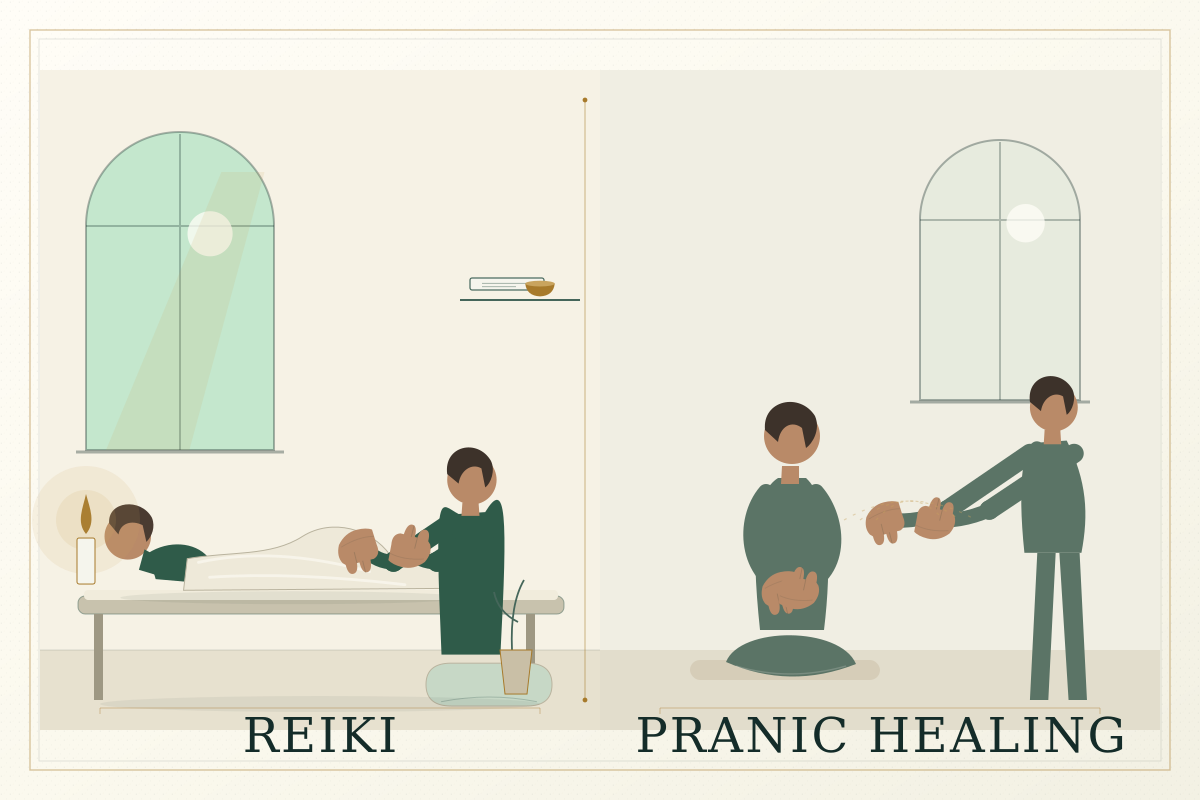
Reiki and Pranic Healing are both described as energy practices, and both use ideas about chakras and a life force. The resemblance runs deeper than the vocabulary, but the methods are not interchangeable. Pranic Healing is a structured system with set protocols, usually practised with the hands above the body. Reiki is a lineage-based spiritual practice, often involving light touch and a simpler session format.
The practical difference is that Pranic Healing presents itself as a teachable technique with procedures for specific complaints. Reiki presents itself as a relationship to a universal energy, transmitted through attunement. One is closer to a curriculum; the other is closer to a contemplative tradition. Neither has the clinical evidence needed to support treatment claims, and both require the same caution about practitioners who promise more than they can deliver.
Where the two systems come from
Pranic Healing was developed by Choa Kok Sui, a Filipino teacher born in 1952, and is now taught internationally through organisations that train and certify instructors. Its own materials describe a multi-level system of energy medicine, with protocols for what it calls cleansing and energising the energy body. The US organisation describes its mission beginning in 1988, when it established its first centre outside the Philippines.
Reiki is attributed to Mikao Usui in early twentieth-century Japan and passed through several lineages and Western adaptations. A Reiki practitioner is usually trained through a teacher, receives attunements at one or more levels, and may learn symbols depending on the lineage. The practice is spiritual in framing and does not have a central governing body.
Both histories are modern in their organised forms, even when they draw on older ideas. Pranic Healing’s chakra language and Reiki’s Japanese lineage are not evidence that either system is ancient or medically validated.
What happens in a session
A Pranic Healing session usually begins with a conversation about what the client wants help with. The practitioner may scan the energy body with their hands, then use sweeping movements above the body to “cleanse” and focused hand positions to “energise” specific areas. The client remains clothed and is usually seated or lying down. Physical contact is not normally part of the technique, and the practitioner may work at a short distance from the body.
A Reiki session is usually quieter and less procedural from the recipient’s point of view. The practitioner may use a fixed sequence of hand positions, rest hands lightly on the body, or hold them just above it. Some lineages use symbols, some do not, and some practitioners offer distant sessions. The recipient does not need to understand a protocol.
| Feature | Pranic Healing | Reiki |
|---|---|---|
| Usual contact | Hands above the body; not a massage | Light touch or hands near the body |
| Structure | Set protocols, scanning, cleansing, energising | Lineage-specific hand positions or intuitive practice |
| Client role | Answer questions, remain comfortable | Rest and receive; consent to touch |
| Training | Organised levels and instructor certification | Teacher-to-student attunements and lineage |
| Central claim | Prana can be manipulated to correct energy imbalances | Universal energy supports the recipient’s healing |
The comparison is not a ranking. A highly structured system can be taught consistently, but structure does not make its central claim true. A looser lineage can preserve a meaningful spiritual practice, but lineage does not establish clinical benefit.
Training, titles, and regulation
Pranic Healing training is organised through its own schools and organisations. Instructors are certified within that system, and advanced levels involve further courses and practice. That certification is a private credential. It is not a government licence to diagnose illness or provide medical treatment, and it does not make Pranic Healing a regulated health profession in the UK or the US.
Reiki has a similar regulatory position. There is no statutory Reiki licence, and “master” or “certified” titles come from schools, lineages, or private associations. In the UK, the NHS directs people to voluntary registers accredited by the Professional Standards Authority rather than to a statutory Reiki register.
In both systems, the important questions are about scope and conduct. Does the practitioner describe the work as spiritual or supportive, or do they claim to diagnose illness and provide medical treatment? Do they have insurance and a complaints process? Do they pressure clients to continue sessions? A certificate does not answer those questions.
Does Pranic Healing have better evidence than Reiki?
Not in any clear sense. There is no large, independent body of evidence that Pranic Healing changes the course of any named condition. A small number of trials have been published, and they are worth reading closely rather than treating as proof.
A 2023 randomised, double-blind trial of 30 people with diabetic foot ulcers reported better wound outcomes in the group receiving Pranic Healing alongside standard therapy than in the control group. The authors were affiliated with the World Pranic Healing Foundation, and the trial was small. A 2024 single-blind trial of 76 men with lower urinary tract symptoms reported greater improvement in some symptom and sleep measures when Pranic Healing was added to medication; several authors were employed by the World Pranic Healing Foundation, which also provided financial support.
Those trials are not worthless, but they are preliminary. Small samples, practitioner affiliation, and the difficulty of blinding an energy practice all limit what can be concluded. They do not establish Pranic Healing as a treatment for diabetic foot ulcers, urinary symptoms, or any other condition.
Reiki’s evidence is also limited. NCCIH’s consumer summary finds no clearly established health benefit and describes a literature that is inconsistent and mostly of modest quality. No study directly compares Reiki with Pranic Healing, so claims that one is “more effective” are not supported.
Safety, consent, and scope
Pranic Healing is usually non-contact, which reduces some of the touch-specific consent issues that arise with hands-on work. It does not remove the need for clear boundaries. A practitioner should explain what they will do, avoid touching without permission, and stop if the client is uncomfortable. Claims that a session can detect or remove disease are a warning sign, especially if they encourage delay in medical care.
Reiki has similar indirect risks. The touch is light, but a recipient who has pain, a recent injury, or a history of trauma may not want any contact. A responsible practitioner offers a hands-off option and does not interpret a client’s stillness or tears as proof that an energy block has cleared.
With either practice, the central safety rule is that energy work is not a diagnostic method. A practitioner who tells you that a serious symptom is “energetic,” or that you do not need a doctor because the energy is clearing, is overstepping. Symptoms that are new, worsening, or unexplained need appropriate medical assessment.
How to compare practitioners
For Pranic Healing, ask:
- Which level have you completed, and who certified you?
- What exactly happens in a session, and will you touch me?
- Do you use a fixed protocol for my concern, or adjust it during the session?
- What do you claim the session can do, and what do you say it cannot do?
- Do you have insurance and a complaints process?
For Reiki, ask:
- Which lineage and level are you working within, and who trained you?
- Is touch involved, and can I choose hands-off practice?
- Do you use symbols or distant practice, and what does that mean in your tradition?
- Will you make medical claims or ask me to change my care?
- How do you handle a client who becomes emotional or uncomfortable?
If you are considering either practice alongside medical treatment, tell your care team what you are using. Do not stop prescribed medication or skip an investigation because a practitioner says the underlying cause is energetic.
Questions people ask
Is Pranic Healing a form of Reiki? No. Both use ideas about energy and chakras, but Pranic Healing is a separate system with its own founder, protocols, and training organisations. Reiki has different lineages and attunement practices.
Is Pranic Healing hands-on? It is usually practised with the hands above the body rather than as a massage. Some practitioners may use light contact, so ask before the session.
Which is more effective? There is no reliable comparative evidence. Pranic Healing has a few small trials with affiliation issues; Reiki has a broader but inconclusive research base. Neither is established as a treatment.
Can I learn Pranic Healing online? Many organisations offer online courses, but the quality and scope vary. A course completion does not give you a medical licence or permission to diagnose.
Is it safe to combine either with medication? Tell your prescribing clinician what you are using. Neither practice should be a reason to stop or change prescribed treatment.
Sources
- U.S. Pranic Healing, Our Journey, accessed 23 October 2026.
- NHS, Herbal medicines and complementary therapies, reviewed 1 May 2026.
- Nittur A, Pavan B, Ganapathy R, et al., Pranic Healing as a Complementary Therapy in Diabetic Foot Ulcer Management, Global Advances in Integrative Medicine and Health, 2023.
- Nanjundaswamy R, et al., Effectiveness of Pranic Healing as complementary therapy on lower urinary tract symptoms and sleep, Complementary Therapies in Medicine, 2024.
- National Center for Complementary and Integrative Health, Reiki, last updated December 2018.
For a comparison with nursing-developed touch practices, see Reiki vs Healing Touch; for the broader question of how Reiki relates to other energy healing, see Reiki vs Energy Healing.
Related topic: Reiki healing guides, Heyoka empath, Levels of consciousness, Inspirational quotes, The benefits of Reiki healing.