
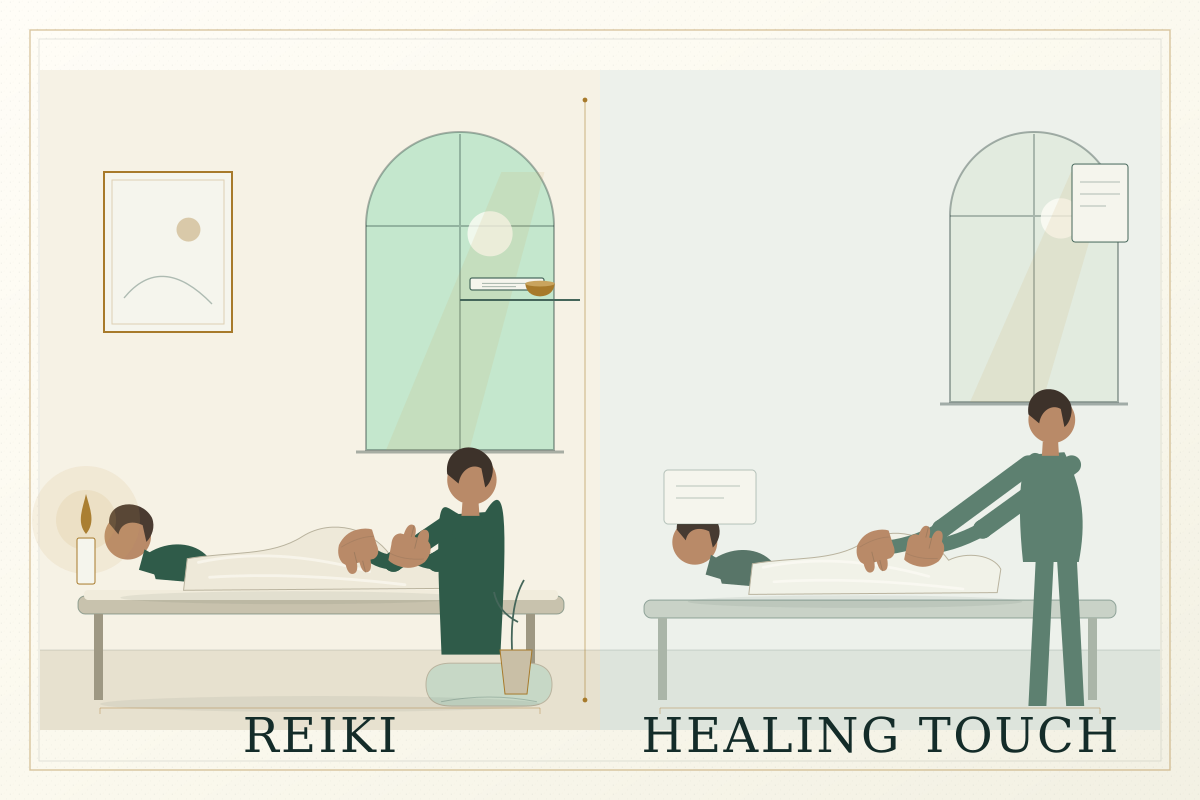
Healing Touch and Reiki are easy to confuse because both involve a clothed client, a treatment table, and a practitioner’s hands. Both are described as working with a human energy field, and both are offered in hospitals and private practices. The differences appear when you ask who developed the method, how practitioners are trained, and what the session is designed to do.
Healing Touch is a standardized program that grew out of nursing continuing education. It has a defined curriculum, a certification pathway, and a professional vocabulary of intake, assessment, and documentation. Reiki is a spiritual lineage transmitted through attunements, with far more variation between teachers. Healing Touch is not simply “Reiki with nurses,” and Reiki is not an earlier version of Healing Touch.
The short answer
If you want a structured, protocol-based session with a practitioner who has completed a standardized, multi-level Healing Touch curriculum, Healing Touch is the more formalized route. Its training and optional certification are separate from a healthcare licence, so check any practitioner’s clinical background independently. If you want a spiritual practice rooted in a Japanese lineage, with symbols, attunements, and a teacher-student relationship, Reiki is the closer fit.
Neither is a licensed medical treatment in the sense that medicine, nursing, or physiotherapy are licensed. Neither has evidence strong enough to support disease-treatment claims. The choice is about the kind of practice you want, not about which one is medically superior.
Origins and the organisations behind the names
Healing Touch was developed by Janet Mentgen, a nurse who wanted to bring a hands-on energy practice into patient care. Healing Beyond Borders, the nonprofit professional organisation, says it was founded by Mentgen in 1996 and that it educates and certifies Healing Touch practitioners and instructors. The Healing Touch Program describes its own lineage as beginning in 1989 as nursing continuing education and now provides a standardized five-level curriculum.
Reiki is attributed to Mikao Usui in early twentieth-century Japan. It passed through Japanese and Western lineages, and there is no single governing body. A Reiki practitioner’s authority comes from their teacher and lineage, not from a national curriculum. Some Reiki schools are highly structured; others are informal.
That organisational difference is real. Healing Touch has an identifiable curriculum, a certification body, and a scope-of-practice document. Reiki has many schools, and the meaning of “Reiki master” varies enormously.
Touch: light contact, hover, or both
Healing Touch is often described as hands-on, and much of it is. Practitioners use gentle hand movements and light touch, and they may also work just above the body. The Healing Touch Program describes sessions in which the practitioner places hands lightly on or just above the body and uses techniques to clear, balance, and restore energy flow.
Therapeutic Touch, by contrast, is more consistently non-contact. That is one reason the two are confused: both are nursing-linked energy practices, but their usual hand relationship is different. Healing Touch also has a larger, more standardized technique set, while Therapeutic Touch is built around a smaller sequence of phases.
Reiki may be hands-on or hands-off depending on the lineage, the practitioner, and the client’s preference. Many Reiki practitioners use a light touch through a sequence of positions; others keep their hands above the body. A recipient who does not want to be touched should be able to request a hands-off session in either Healing Touch or Reiki.
What a session involves
A Healing Touch session usually begins with an intake conversation and a period of centering. The practitioner may assess the energy field, agree on an intention with the client, and then use one or more techniques. The session commonly lasts about 45 to 60 minutes, and the client remains fully clothed. The Healing Touch Program describes a ten-step process grounded in a nursing care model.
A Reiki session is usually simpler in form. The practitioner may ask what you hope to get from the session, explain what will happen, and then begin. There may be a fixed sequence of hand positions, a more intuitive approach, or the use of symbols. Some practitioners offer distant sessions; Healing Touch also has remote practice in some settings, but its core training is oriented toward in-person care.
| Feature | Healing Touch | Reiki |
|---|---|---|
| Origin | Nursing practice developed by Janet Mentgen | Japanese spiritual lineage attributed to Mikao Usui |
| Curriculum | Standardized five-level program with certification | Varies by teacher and lineage |
| Usual contact | Light touch and work just above the body | Light touch or hands-off, depending on lineage |
| Session shape | Intake, assessment, intention, techniques, documentation | Conversation, hand positions or intuitive practice |
| Professional body | Healing Touch Program and Healing Beyond Borders | No single governing body |
Training, certification, and clinical settings
Healing Touch training is more standardized than most Reiki training. The Healing Touch Program describes a five-level curriculum totaling 108 hours of professional education, with certification for practitioners and instructors. Healing Beyond Borders separately educates and certifies practitioners and instructors through its own program. The Healing Touch Program’s continuing education is accredited by the American Nurses Credentialing Center, which is a nursing continuing-professional-development accreditation, not a government licence to practise energy therapy.
Reiki training varies from a short online attunement to years of mentorship. There is no national curriculum and no statutory Reiki licence. Certificates are private credentials, and a “master” title may mean a weekend course or a long apprenticeship.
Healing Touch is used in hospitals, clinics, and hospice settings, often as a supportive comfort practice. That setting can create an impression of medical endorsement that the evidence does not fully support. A hospital offering a volunteer Healing Touch service is not the same as a hospital prescribing it as treatment. Reiki is also offered in some hospitals, usually through volunteer or integrative-care programs.
What the research says, and what it does not
Research on Healing Touch and Reiki is difficult to compare because the practices are not standardized in the same way. Healing Touch has a defined technique set, but studies still vary in dose, setting, and outcome. A 2021 narrative review of non-contact biofield practices, including Reiki, Therapeutic Touch, and Healing Touch, found that mechanisms remain unknown and that the research is difficult to interpret.
NCCIH’s Reiki review is more direct: it finds no clearly established health benefit and notes that most studies are not high quality. Healing Touch organisations describe their own research as supportive of relaxation, stress reduction, and quality of life; those are plausible comfort outcomes, but they are not evidence that the practice is a medical treatment.
The evidence summarized here does not establish that Healing Touch is better than Reiki, or the reverse. Claims that one has “more science” usually reflect the existence of a research program and a professional organisation, not a decisive clinical comparison.
Safety and scope
Both practices are generally low-risk when they remain non-invasive and the client is comfortable. The main risks are indirect:
- a practitioner may imply that an energy assessment can diagnose a condition;
- a client may delay medical care because a session is offered as an alternative;
- touch may be unwelcome or painful, especially after surgery, during pregnancy, or after trauma;
- a hospital setting may lend more authority to the practice than the evidence supports.
Healing Touch’s scope-of-practice language is a useful model: the practice is supportive and complementary, not a substitute for medical diagnosis or treatment. Reiki practitioners should hold the same boundary, even when their lineage has no formal scope document.
If you are receiving medical care, tell your clinician that you are using either practice, especially if you are considering touch near a surgical site, a port, an injury, or an area affected by lymphoedema. Ask the practitioner to avoid that area unless your clinician has said contact is safe.
How to compare practitioners
For Healing Touch, ask:
- Which level have you completed, and are you certified through the Healing Touch Program or Healing Beyond Borders?
- What does the intake and assessment involve, and will you write or share notes?
- Will you touch me, and can we agree on areas to avoid?
- What do you claim the session can help with, and what do you say it cannot do?
- Do you have insurance and a complaints process?
For Reiki, ask:
- Which lineage and level are you working within, and who trained you?
- Is touch involved, and can I choose hands-off practice?
- Do you use symbols or distant practice, and what do they mean in your tradition?
- Will you make medical claims or ask me to change my care?
- How do you respond if I become emotional or uncomfortable?
Those questions reveal more than a certificate alone. A practitioner who can explain their scope, welcome a hands-off request, and avoid medical promises is safer than one who relies on a title.
Questions people ask
Is Healing Touch the same as Reiki? No. Healing Touch is a nursing-developed, standardized program with its own curriculum and certification. Reiki is a Japanese spiritual lineage with many independent schools.
Is Healing Touch hands-on? Much of it uses light touch, but practitioners may also work just above the body. Ask before the session if contact matters to you.
Can a nurse do Healing Touch instead of medical treatment? No. It is a complementary comfort practice, not a replacement for nursing assessment, medication, surgery, or other medical care.
Which has better evidence? Neither has evidence strong enough to support disease-treatment claims. Healing Touch has a more organized research program; Reiki has a broader but inconclusive literature. There is no reliable head-to-head comparison.
Is a Healing Touch certificate a licence? No. Certification is a private professional credential. It is not a government licence to diagnose illness or provide medical treatment.
Sources
- Healing Beyond Borders, Who We Are, accessed 23 October 2026.
- Healing Touch Program, What is Healing Touch and Professional Standards, accessed 23 October 2026.
- Matos LC, Machado JP, Monteiro FJ, Greten HJ, Perspectives, Measurability and Effects of Non-Contact Biofield-Based Practices, International Journal of Environmental Research and Public Health, 2021.
- National Center for Complementary and Integrative Health, Reiki, last updated December 2018.
For the more consistently non-contact nursing practice, see Reiki vs Therapeutic Touch. For a structured system with a different protocol, see Reiki vs Pranic Healing.
Related topic: Reiki healing guides, Heyoka empath, Levels of consciousness, Inspirational quotes, The benefits of Reiki healing.