
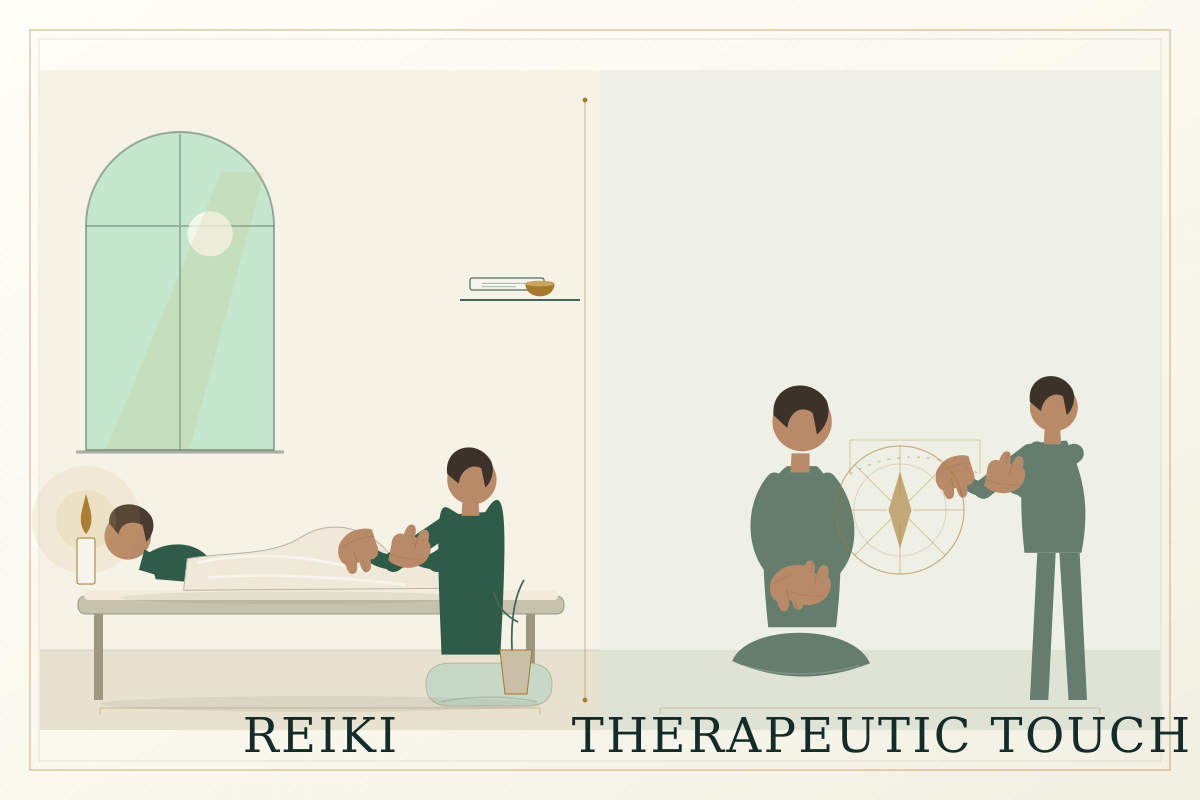
Therapeutic Touch and Reiki are often mentioned in the same breath because both are described as energy practices involving the hands. The similarity is real, but it can obscure a useful distinction. Therapeutic Touch is a nursing-developed technique with a defined sequence, usually performed with the hands a short distance from the body. Reiki is a spiritual lineage received through attunement, with much more variation in how it is taught and practised.
The names also create confusion with Healing Touch, a separate nursing-linked program. Healing Touch commonly uses light touch or work just above the body and has its own five-level curriculum. Therapeutic Touch is more consistently non-contact and is associated with a different history and professional network. Neither is a licensed medical treatment, and neither has evidence strong enough to support disease-treatment claims.
The short answer
Therapeutic Touch is the more procedural, usually hands-off option. A session tends to follow a sequence: the practitioner centers, assesses the energy field, “unruffles” it with hand movements, and directs energy. Reiki is more likely to involve a fixed set of hand positions or an intuitive flow, and it may include light touch, symbols, or distant practice.
If you are choosing between them, the practical questions are about touch, training, and the claims being made. Therapeutic Touch may appeal if you want a nursing-framed technique with minimal contact. Reiki may appeal if you want a spiritual lineage and a teacher-student relationship. Neither choice should be based on a promise of medical benefit.
What a Therapeutic Touch session involves
Therapeutic Touch was developed in the 1970s by Dolores Krieger, a nursing professor, together with Dora Kunz, a healer and writer. It was adapted from the “laying on of hands” tradition and framed as a nursing practice rather than a religious ritual.
A session usually begins with centering: the practitioner settles their attention and intention. They may then assess the client’s energy field by passing their hands a few inches above the body, looking for differences in temperature, tingling, or other sensations. The “unruffling” phase involves slow hand movements intended to clear congestion in the field. The practitioner then directs energy to areas said to need it.
The client usually remains fully clothed and may sit or lie down. Physical contact is not normally part of the technique, although a practitioner may rest a hand on a shoulder or foot in some settings. A session may last around 20 to 30 minutes, though this varies. There is no needle, no massage, and no requirement to remove clothing.
What a Reiki session involves
A Reiki session is usually quieter and less standardized. The practitioner may begin with a short conversation, then place their hands lightly on the body or hold them just above it. Some practitioners move through a sequence of positions covering the head, torso, and limbs; others work intuitively. The recipient remains clothed and can ask for hands-off practice.
Reiki lineages differ on symbols, attunements, and the role of the teacher. Some practitioners use the three common Usui symbols; others use additional symbols or none. A session may be in person or distant. The unifying feature is the claimed transmission of a universal energy through the practitioner, not a fixed clinical protocol.
Healing Touch is not Therapeutic Touch
The two names are close enough that many articles treat them as synonyms. They are not.
Healing Touch was developed by Janet Mentgen, a nurse, and grew into a standardized program with a five-level curriculum, certification, and professional organisations. Its practitioners commonly use light touch as well as work just above the body, and sessions often include a structured intake and assessment. Therapeutic Touch is more consistently non-contact, has a smaller technique set built around centering, assessment, unruffling, and direction, and is associated with the Nurse Healers-Professional Associates International (NH-PAI).
The distinction is not absolute. Some Healing Touch practitioners work entirely off the body; some Therapeutic Touch practitioners may use light contact. But if someone offers you “Therapeutic Touch” and then performs a long sequence of hands-on positions, it is fair to ask which training and tradition they are actually working within.
| Feature | Therapeutic Touch | Healing Touch |
|---|---|---|
| Founders | Dolores Krieger and Dora Kunz | Janet Mentgen |
| Usual contact | Hands above the body; usually non-contact | Light touch and work just above the body |
| Structure | Centering, assessment, unruffling, direction | Standardized techniques, intake, assessment, documentation |
| Professional network | Nurse Healers-Professional Associates International | Healing Touch Program and Healing Beyond Borders |
| Training | Nursing continuing education and workshops; no universal licence | Five-level program with certification |
Training, credentials, and jurisdiction
Therapeutic Touch is taught through workshops, nursing continuing education, and practitioner training programs. There is no universal licence to practise Therapeutic Touch, and no government body that certifies a “Therapeutic Touch therapist” in the way a state licenses a nurse or physician. Some nurses integrate it into their practice under their nursing scope; others offer it privately.
Reiki has a similar absence of statutory regulation. Certificates and master titles are private credentials, and training ranges from short courses to long apprenticeships. UK practitioners may join a voluntary register accredited by the Professional Standards Authority, but Reiki itself is not a licensed profession.
In both practices, a nursing background can matter. A nurse who offers Therapeutic Touch may have clinical assessment skills that a lay practitioner does not. That does not make the energy technique itself a medical treatment, but it can affect how safely the practitioner handles a client with complex health needs.
What the research shows
Therapeutic Touch has been studied for pain, anxiety, sleep, and wound healing, but the evidence is mixed and often limited by small samples and difficult blinding. A 2021 narrative review of non-contact biofield practices found that mechanisms remain unknown and that research is hard to interpret.
The most direct challenge to Therapeutic Touch’s central claim came from a blinded study published in JAMA in 1998. Twenty-one experienced practitioners were asked to identify which of their hands was closer to an investigator’s unseen hand. They identified the correct hand in 44% of trials, close to chance. The study concluded that the practitioners could not detect a human energy field.
That study tested the claim that practitioners can sense a field; it did not test whether a session feels relaxing or meaningful. Those are different questions. But the result is a serious problem for anyone who claims that Therapeutic Touch works through a measurable energy field. It also illustrates why anecdotes and practitioner confidence are not enough.
The Reiki evidence does not settle the comparison. NCCIH describes inconsistent results and no clearly established health benefit. No trial directly compares Therapeutic Touch with Reiki, so claims that one is better remain unsupported.
Safety and scope
Therapeutic Touch is non-invasive, and serious physical harm is unlikely when it is practised within a clear scope. The main risks are indirect: a practitioner may imply that an energy assessment can diagnose illness, discourage medical care, or use the nursing frame to lend unearned authority to a claim.
Reiki carries similar indirect risks. Because it often involves touch, there is also the question of consent and comfort. A recipient should be able to choose hands-off practice, ask for a particular area to be avoided, and stop at any time without being told that stopping will interrupt their healing.
Both practices should be presented as supportive or spiritual, not as substitutes for diagnosis, medication, surgery, or mental health care. If a practitioner says that a session can diagnose a serious condition, replace prescribed treatment, or tell you to stop medication, that is a reason to leave.
How to compare practitioners
For Therapeutic Touch, ask:
- Where did you train, and how long was the course?
- Are you a nurse or other regulated health professional, and are you practising within that scope?
- Will you touch me, or is the session entirely off-body?
- What happens in the assessment, and what do you do with what you sense?
- What do you claim the session can and cannot do?
For Reiki, ask:
- Which lineage and level are you working within, and who trained you?
- Is touch involved, and can I choose hands-off practice?
- Do you use symbols or distant practice, and what do they mean in your tradition?
- Will you make medical claims or ask me to change my care?
- Do you have insurance and a complaints process?
A practitioner who is clear about the limits of the technique is more trustworthy than one who hides behind vague energy language. The same applies to organisations: a professional body, a code of ethics, and a complaints process are useful signals, but they do not turn an unproven technique into a medical treatment.
Questions people ask
Is Therapeutic Touch the same as Healing Touch? No. They are separate practices with different founders, training, and typical hand contact. Healing Touch is more likely to use light touch; Therapeutic Touch is more consistently non-contact.
Does Therapeutic Touch require touch? It is usually performed with the hands a few inches above the body. Some practitioners may use light contact, so ask before the session.
Is Therapeutic Touch a nursing treatment? It was developed within nursing and is taught to some nurses, but it is not a licensed medical treatment. Nursing scope varies by jurisdiction and employer.
Can Therapeutic Touch detect illness? No. There is no reliable evidence that a practitioner can diagnose illness by sensing an energy field, and the 1998 blinded study found that practitioners could not detect the field under controlled conditions.
Which is better, Reiki or Therapeutic Touch? There is no reliable evidence that either is a medical treatment. The choice is about the kind of practice, the amount of touch, and the practitioner’s training and conduct.
Sources
- Straneva JA, Therapeutic touch coming of age, Holistic Nursing Practice, 2000.
- NHS, Herbal medicines and complementary therapies, reviewed 1 May 2026.
- Matos LC, Machado JP, Monteiro FJ, Greten HJ, Perspectives, Measurability and Effects of Non-Contact Biofield-Based Practices, International Journal of Environmental Research and Public Health, 2021.
- Rosa L, Rosa E, Sarner L, Barrett S, A close look at therapeutic touch, JAMA, 1998.
- National Center for Complementary and Integrative Health, Reiki, last updated December 2018.
For the standardized, often hands-on nursing program, see Reiki vs Healing Touch. For the difference between Reiki and a structured no-touch system, see Reiki vs Pranic Healing.
Related topic: Reiki healing guides, Heyoka empath, Levels of consciousness, Inspirational quotes, The benefits of Reiki healing.