
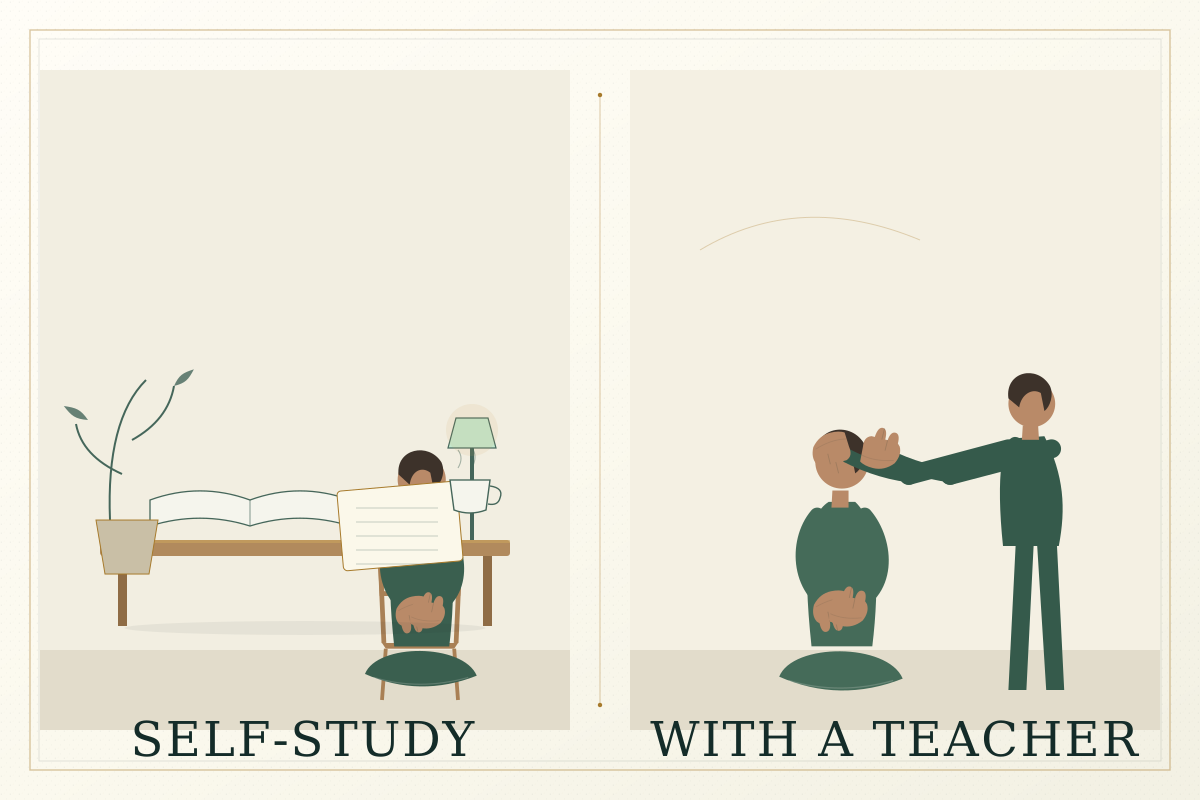
You can teach yourself a great deal about Reiki. You can read its history, learn its principles, follow guided meditations, and build a quiet daily practice without paying for a course. What you cannot do, within the way many Usui lineages understand the tradition, is confer an attunement on yourself and then describe it as a traditional lineage transmission. That is not because books are forbidden or because teachers are gatekeepers by nature. It is because the tradition defines the attunement as something passed from teacher to student.
So the useful answer is a split one: yes to self-study, no to self-authorisation. The line between them is easier to see when you separate what can be read from what a lineage treats as transmission.
What "self-taught" can reasonably mean
Reiki is not only a ritual. It is also a body of ideas and practices that can be studied in the open:
- History. The life of Mikao Usui, the Usui Reiki Ryoho Gakkai, Chujiro Hayashi, Hawayo Takata, and the development of Western Reiki are discussed in books, articles, and primary-source translations.
- Principles. The five principles can be read, reflected on, and used as daily prompts without any initiation.
- Meditation and breathing. Gassho meditation, quiet sitting, and simple breath awareness are not secret techniques. They can be practised alone.
- Self-reflection. Keeping a practice journal, noticing habits, and working with the principles are personal disciplines.
- Reiki's context. You can learn how Reiki relates to other spiritual and complementary practices, and what the evidence does and does not show.
This course publishes its lessons and manuals for free. You can read them before deciding whether to request an attunement. That is a legitimate way to explore.
What self-study cannot confer
In the Usui tradition, the attunement is the transmission that connects a student to the practice and authorises them within a lineage. The Reiki Council describes Reiki as taught by Master/Teachers, with students going through initiation or attunement. The International Center for Reiki Training describes the ability as transferred from teacher to student through attunement rather than acquired from reading.
Those are claims about how the tradition works, not measurable scientific facts. But they define the tradition's own boundaries. If you have not received an attunement from a teacher, you can still practise meditation and self-reflection, but you should not describe yourself as a traditionally attuned Reiki practitioner or claim a lineage you do not have.
The same applies to teaching. Reading a manual does not authorise you to pass on attunements. Teacher authorisation is a separate step in most lineages, and it usually involves specific instruction, practice, and permission.
What about self-attunement?
Some contemporary teachers describe self-attunement methods, and some books present them as valid. These methods exist, and it would be inaccurate to pretend that everyone rejects them. But they are not the same as receiving an attunement from a teacher within a recognised lineage, and schools disagree about their status.
If you are drawn to a self-attunement method, ask:
- Where does the method come from?
- Who taught it to the person publishing it?
- Is it recognised by any lineage or professional body?
- What does it claim to do, and is that claim testable?
You may choose to use it as a personal ritual. Just be precise in how you describe it. "I learned a self-attunement method from this book" is honest. "I am a Usui Reiki Master" is not, unless the relevant training actually happened.
Distance study is not the same as no teacher
A distance course can include real teaching: explanations, feedback, live sessions, and an attunement arranged at a distance. Many students prefer it because they live far from a teacher or have caring responsibilities. The quality depends on the course, not on whether the teacher is in the room.
If you are considering a distance course, ask how the practical elements are handled. Will you practise on someone and receive feedback? Can you ask questions? Is the attunement live or recorded? What happens if you feel unwell or overwhelmed afterwards? A good distance course does not pretend that distance removes the need for support.
A responsible self-study path
If you want to study alone for now, you can build a simple structure:
- Read the core material. Start with the free lessons and one reliable history overview. Note where the sources disagree.
- Practise the principles. Choose one principle a week and notice where it shows up in daily life.
- Establish a short daily practice. Ten minutes of quiet sitting or Gassho is more useful than an occasional long session.
- Keep a journal. Record what you did, what you noticed, and what you want to understand better. Avoid turning every sensation into a diagnosis.
- Practise on yourself only. Do not offer sessions to others until you have appropriate training, consent practices, and insurance.
- Review after a month or two. Ask whether you want to continue alone, find a teacher, or stop. All three are valid.
This path will not give you a lineage, but it can give you a grounded relationship with the material. If you later take a class, you will arrive with better questions.
When to look for a teacher
Consider finding a teacher when you want:
- a traditional attunement;
- feedback on hand positions and session structure;
- help understanding a lineage's specific practices;
- a community of practice;
- preparation for offering sessions to the public;
- teacher training.
Look for someone who can explain their lineage, describe what a class includes, and answer questions without pressure. The guide to choosing a Reiki teacher and the guide to preparing for Master training go into more detail.
Red flags in self-study materials
Be cautious when a book or course:
- promises that you will "become a Reiki Master" in a weekend with no practice;
- claims that Reiki cures specific diseases;
- says you must buy more products to "activate" your attunement;
- presents one lineage's ritual as the only valid form;
- discourages you from asking questions or checking sources;
- uses invented history or fake credentials.
None of these are unique to Reiki. They are general signs that the material is selling certainty rather than teaching a practice.
A workable balance
Self-study is a sound way to learn the surrounding material and test whether the practice holds your interest. If you later want the traditional transmission, find a teacher and ask what their lineage requires. Until then, describe your practice plainly: reading, reflection and meditation, not a lineage you have not received. You can read more about what an attunement involves and whether you need one to practise.
Related topic: Levels and attunements, Advanced Reiki training, Reiki Level 2 course, After the third degree, Attuning your students.