
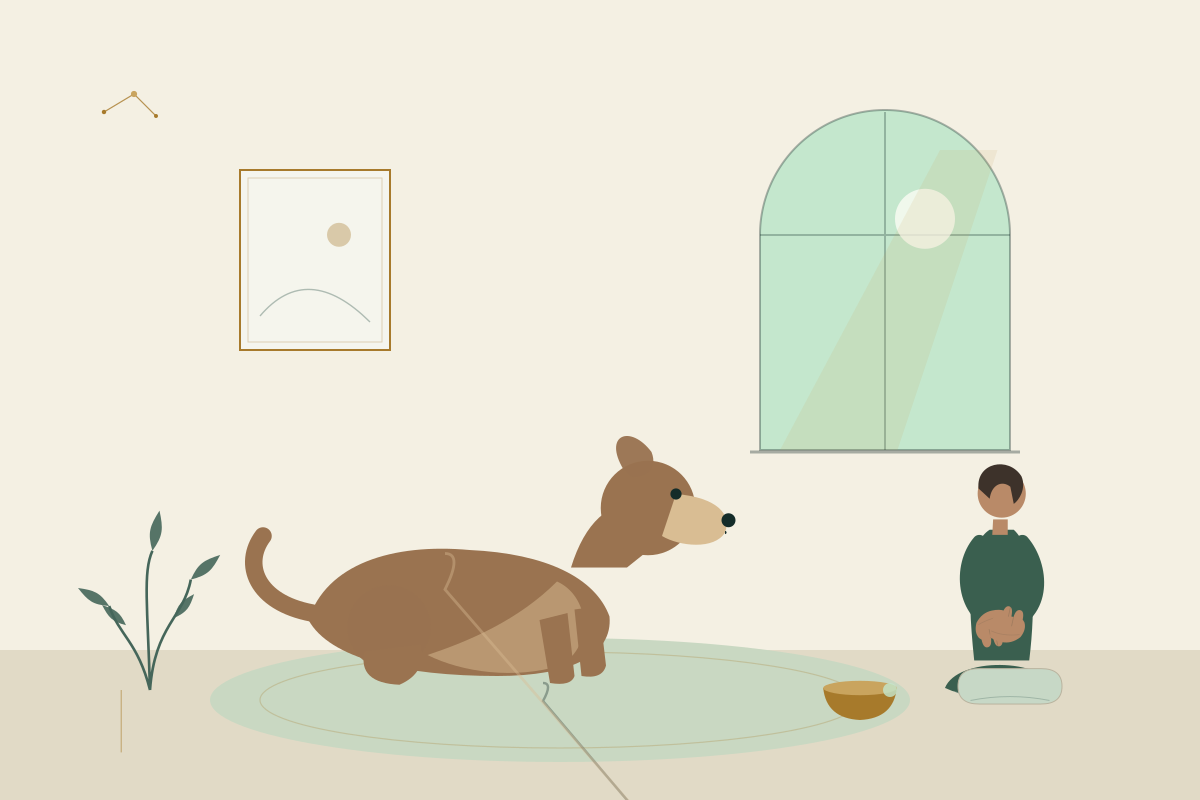
Reiki for dogs is a quiet spiritual practice offered in a dog's presence. The dog decides whether to stay, move away, or ignore you, and that choice is the practice. It is offered alongside ordinary and veterinary care, never instead of it. If a dog has pain, anxiety, digestive trouble or a behaviour change, ask a veterinarian first.
This guide assumes you already know the broad approach in Animal Reiki and the multi-species practical guidance in Using Reiki on Animals. Here the focus is on what changes when the animal in front of you is a dog: how dogs read our posture, why equipment and leashes matter, and how to adapt a session at home, on a walk, or in a clinic.
A ten-minute practice with a dog
Settle yourself before you settle anywhere near the dog. Put both feet on the floor, let your shoulders drop and take three natural breaths. Do not pace the breath or use it to change the dog. In the Reiki form you were taught, set a quiet intention: may this time be safe and unforced, and may the dog keep as much distance as it wants. This is a spiritual intention, not a promise about energy or an outcome.
Sit at an angle to the dog, with your hands resting on your thighs, palms down. Let the dog see you without being stared at. If it approaches, keep your hands still; if it moves away, do not follow. Watch the jaw, ears, weight and tail rather than looking for a sign that Reiki is "working". A dog that lies down at the far side of the room has made a choice.
End when the dog shifts, looks toward the exit or loses interest. Thank it silently in whatever way your practice uses, rise slowly and leave first. Afterwards, reflect on one question: did I wait for the dog, or did I ask it to perform? Tell the handler what you did in plain language, without claiming a health or behaviour change.
Reading a dog's comfort without over-reading it
Dogs communicate through the whole body, not one wagging tail. The RSPCA's guide to dog body language describes relaxed dogs as having loose posture, a relaxed mouth, natural ears and smooth hair. Worried dogs may lower their body and head, tuck the tail, pull their ears back, lick their lips, yawn, or turn their head away. A stiff body, raised hair, hard stare, wrinkled nose or exposed teeth is a clear request for distance.
Those are general signals, not a chart that tells you what a dog is feeling in every situation. A wagging tail can be friendly, excited, tense or conflicted. A dog may approach you and then freeze. A dog may lie down nearby but keep its eyes fixed on your hands. Watch for changes from the dog's own baseline, and give space when the signals are mixed.
Stop or move back if the dog:
- turns its head or body away, or leaves the room;
- stiffens, freezes, holds its breath, or stops responding to ordinary sounds;
- tucks its tail, pins its ears, raises its hackles, or shows the whites of its eyes;
- growls, snaps, barks sharply, or backs into a corner;
- pants, trembles, drools or paces in a way that seems out of context.
Do not call these signs "releasing energy" or proof that the dog needs more Reiki. They are reasons to stop.
Touch, equipment and no-go areas
Many dogs enjoy ordinary stroking, but that does not mean every dog wants touch during a Reiki session. Hands-off practice is complete. If the dog already welcomes gentle contact, the person responsible agrees, and the dog remains loose and free to move, you might rest a hand lightly on a shoulder or the middle of the back. Keep the touch still and brief. Do not lean over the dog, hug it, cup its head, or put hands around its neck.
Avoid placing hands on the head, neck, spine, belly, joints or an injured area unless a veterinarian has said contact is appropriate and the dog is clearly comfortable. Do not press, massage, or move a limb to "release" anything. Reiki is not a physical therapy technique, and a dog in pain may bite even if it has never bitten before.
Equipment matters. A dog on a lead may feel trapped if you stand in the lead's path or hold it while trying to sit quietly. Ask the handler to keep the lead loose, or work with the dog off-lead only in a securely enclosed space. Never tether a dog for a session. If the dog wears a harness, do not slip fingers underneath it or use it to hold the dog still. Leave collars and tags alone.
Home, walks and the veterinary clinic
At home. A dog's own bed or a quiet corner is usually the best place. Other dogs in the household can change everything: one dog may guard the sofa, another may crowd the dog receiving attention. Work with one dog at a time, or let the group settle naturally without separating anyone by force. If a dog is crate-trained and chooses to rest in an open crate, do not close the door for a session or reach inside. The crate is the dog's space.
On a walk. A pavement or park is not a good place for a formal session. There are traffic, other dogs, weather and people who want to touch the dog. A brief pause on a familiar route, with the dog sniffing and choosing where to stand, is enough. Do not stop in the middle of a walk and hold the dog still. If the dog wants to keep moving, walk on.
At the vet. Clinics are unfamiliar, often stressful, and full of other animals. Do not offer Reiki in a waiting room without the clinic's permission, and do not stand in the way of staff. If the vet invites you to sit quietly with the dog after an examination, keep it brief and follow their handling advice. A dog may be more comfortable with its handler doing the touching, or with no touch at all. Ask before assuming.
When a dog is anxious, reactive or in pain
An anxious dog does not need a longer session or a stronger intention. It needs a predictable environment, a safe distance and a plan. If a dog is fearful of visitors, do not use Reiki as exposure therapy by cornering it with your presence. If a dog is reactive on the lead, do not sit in a busy place and call it calm. Behaviour has many causes, and a qualified behaviourist or veterinary behaviourist can assess it. The RSPCA's guidance on separation-related behaviour makes the same point: distress when left alone is a welfare problem, not a dog being stubborn.
Pain is another reason to be cautious. A dog may hide pain, become irritable, stop jumping, or change how it sleeps. Do not use a session to test whether a painful area can be touched. Keep hands away, keep the dog warm and comfortable, and let a veterinarian examine it. Reiki should not delay pain relief, medication, surgery, physiotherapy or a follow-up appointment.
A caregiver may choose to sit quietly with a dog after a vet visit, if the dog wants company. Remaining nearby is only an observable behavior; it does not show that Reiki changed the dog or treated anything. Do not promise a calmer dog, faster recovery or changed diagnosis.
Working with the handler and the vet
The handler knows the dog's normal behaviour and its triggers. Ask them to stay nearby if that helps, but never to restrain the dog so you can continue. Agree in advance what you will do, how long you will stay, and what will make you stop. If the dog is under treatment, follow the clinic's handling advice and leave health decisions to the vet.
Do not ask a vet to endorse Reiki. A useful partnership is simple: the vet leads on health, you offer quiet presence, and the dog's comfort decides the rest.
Practical questions
Should I work with a dog on a lead? A loose lead is fine if the dog can turn away and the handler keeps it slack. Do not tether the dog or stand in the lead's path. If the lead tightens because the dog wants to leave, end the session.
What if the dog falls asleep? Let it sleep and do not move closer. Sleep is rest, not an invitation to touch; leave quietly when convenient.
When should I stop? At the first clear turn away, stiffening, lip-lick, yawn, tucked tail or look toward the exit. A short session that ends on the dog's terms is better than a long one.
Related topic: Animal Reiki, Animal Reiki: how to do it, Using Reiki on animals, Reiki for Cats, Reiki for Horses.