
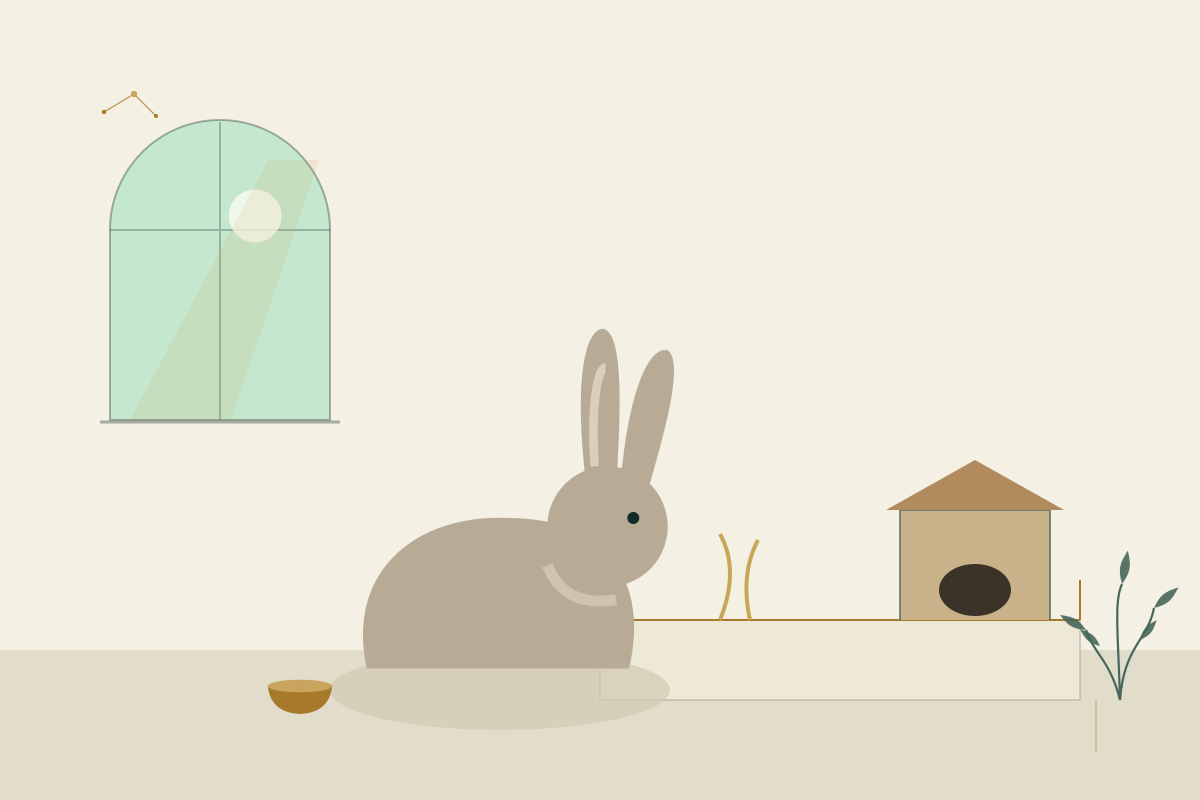
Rabbits are prey animals. Being picked up, held on the back or removed from familiar ground can feel like being caught by a predator, even when the human means well. Reiki for rabbits therefore looks different from Reiki for a dog or cat: the rabbit stays on the floor, in or near its own space, with every route to hiding left open. There is no handling requirement, and a session can be a few minutes of quiet presence while the rabbit eats, rests or ignores you.
Reiki for rabbits sits alongside that practical care, not as a substitute for it. A rabbit's stillness cannot prove that a session helped; its ability to move away or hide is the more honest guide. For the shared principles, read Animal Reiki and Using Reiki on Animals. This page focuses on the rabbit-specific details: trancing, safe handling, companions, enclosure design and the digestive problems that need urgent veterinary care.
Why the floor changes everything
A rabbit on the floor has some control. A rabbit lifted into a lap or placed on a table has much less. Offer Reiki at ground level, in the rabbit's familiar room or enclosure area, and sit or kneel quietly nearby. Do not block the hutch door, the run entrance or the route under a chair. Do not close the rabbit in a small area with you.
Let the rabbit approach. It may sniff your shoe, circle you, thump, or hop away. All of those are answers. Do not follow it, pick it up, or lure it with food to keep it close. If it settles at a distance, that is enough. A rabbit who flops down nearby may be relaxed, but a rabbit who lies still with wide eyes is not necessarily comfortable. Learn the difference between a relaxed flop and a frozen crouch.
The RSPCA's guide to rabbit behaviour describes relaxed rabbits as having ears close together and pointing outwards, loose posture and soft eyes. A worried rabbit may flatten its ears against its back, crouch with its head low and pupils dilated, hide, thump its back legs, turn and flick its feet, box with its front paws, or sit up tense with its tail raised. A rabbit may also freeze rather than run.
Trancing is not relaxation
Some people believe a rabbit held on its back is calm. It is not. The RSPCA's guidance on tonic immobility explains that rabbits placed on their backs may become still because they are "playing dead", a fear response. Their heart and breathing rates rise, their stress hormones increase, and they may hide more afterwards. The more often it happens, the faster they become still, which is not evidence that they have learned to enjoy it.
Never turn a rabbit onto its back to give Reiki, and do not use a "relaxing hold" that leaves it immobile. Do not wrap it tightly, hang it, or hold it against its will. A veterinary team may use specific handling for an examination when it is medically necessary, but that is a clinical decision, not a spiritual technique.
If a rabbit must be handled
A Reiki session should not require picking a rabbit up. If the rabbit needs to be moved for its own safety, or for a vet visit, use safe handling. The RSPCA's rabbit handling guide advises supporting the back and bottom at all times, holding all four feet against your body, staying low to the ground, and never picking a rabbit up by the ears. Rabbits have fragile spines and can be seriously injured if they struggle or are dropped.
Move slowly and quietly. Covering the eyes with a towel or the crook of your arm can help some rabbits feel more secure, but never block the nostrils. Keep the handling as brief as the task allows. If a rabbit is struggling, do not tighten your grip; put it down safely and try a different approach. For a Reiki session, the simplest approach is not to pick it up at all.
Companions, hiding places and enclosure territory
Rabbits are social animals, and compatible companionship is generally recommended. Bonding is not a matter of putting two rabbits together and hoping: introductions should be gradual and supervised, with advice from a rabbit-experienced vet or qualified behaviourist. Some rabbits must be kept apart for health, behaviour or welfare reasons, and a bereaved rabbit should not be given a new companion without a plan. If you are working in a home with a bonded pair, do not separate them for a session. Let them stay together and choose whether to approach. A rabbit may hide behind its companion, and that is a valid choice.
Hiding places are essential. Do not remove a rabbit's tunnel, box or cover to "encourage" it to interact. Do not reach into a hutch or run to stroke a rabbit that has retreated. If the rabbit is in a run, sit outside it rather than opening the run and entering. If it is free-ranging indoors, keep doors and windows secure and cables protected, but do not corner it.
The RSPCA's rabbit environment guidance emphasises space, shelter, safe hiding places and the ability to exercise. A rabbit who is confined to a small hutch, unable to stand up and hop, or without appropriate space, companionship or enrichment has a welfare problem that Reiki cannot solve. The practical answer is more space, suitable companionship where it is safe and well planned, appropriate food and veterinary care, not a longer session.
Outdoor rabbits and predator stress
Outdoor rabbits are exposed to foxes, cats, dogs, birds of prey, weather and unfamiliar noises. A rabbit who freezes at the hutch door or refuses to come out may be frightened, not stubborn. Do not open the hutch and sit with it in a way that blocks its escape. Do not handle it at dusk when predators are active, and do not assume that a rabbit in a run is comfortable because it is outside.
If a rabbit is new to a home, keep changes gradual. The RSPCA notes that rabbits can take time to adjust and that sudden changes in routine can be stressful. Sit quietly at a distance at the same time each day, without expecting contact. If the rabbit never relaxes, review its housing, companionship, noise and handling before trying again.
Digestion, teeth and pain
Rabbits are herbivores with a delicate digestive system. They need constant access to hay or grass, fresh water, a suitable space to exercise and companionship. A rabbit that stops eating, produces fewer or smaller droppings, sits hunched, grinds its teeth, drools or becomes unusually quiet may be in pain or may have a digestive problem that becomes serious quickly. Contact a veterinarian promptly. Do not wait to see whether Reiki helps.
Dental disease is common, especially in older rabbits. Signs can include changes in eating, drooling, swelling around the mouth, reduced droppings or weight loss. Arthritis can make it hard to move, use a ramp or clean itself. A rabbit may not show pain until it is very unwell, so any change in behaviour or routine deserves a vet check. The RSPCA's senior rabbit guidance is a useful checklist for older animals, including mobility, weight, dental care and flystrike risk.
A floor-level practice
Sit outside the run or enclosure, on the floor, with your back supported and your hands on your knees. Let the rabbit keep its tunnel, box and route past you. Take a few natural breaths and set, within your own Reiki practice, a simple intention: may this space stay quiet and predictable. Do not direct the intention at the rabbit or wait for it to respond.
Let the rabbit eat, dig, groom or ignore you. If it approaches, stay still and let it investigate; do not offer food to bring it closer or reach out to stroke it. If it thumps, freezes, flattens its ears or retreats, stop. A rabbit that stays in its tunnel has answered just as clearly as one that hops away.
Leave before the rabbit feels it has to hide. Thank it silently, rise slowly and close the door or gate quietly. In reflection, ask what the rabbit's ears and feet told you, and whether you stayed at floor level. Tell the handler what happened without claiming a change in health or behaviour.
Working with the handler and the vet
The handler knows whether the rabbit is tame, nervous, bonded, unwell or new to the home. Ask before entering the rabbit's space, and do not ask the handler to hold the rabbit still for you. If the rabbit is under veterinary care, follow the clinic's advice about handling, feeding and medication. Do not suggest that Reiki can replace pain relief, dental treatment, surgery or a follow-up appointment.
Rabbit questions
Why not hold the rabbit? A rabbit lifted from the floor loses control and may panic or struggle, risking spinal injury. A session does not require handling.
There is only one rabbit. Should I get another? Compatible companionship is generally recommended, but bonding needs a gradual, supervised introduction and advice from a rabbit-experienced vet or qualified behaviourist. Do not add a rabbit casually or immediately.
What does a thump mean? It can signal alarm, annoyance or arousal. Treat repeated thumping, a frozen crouch or a retreat into a tunnel as a request for space.
Related topic: Animal Reiki, Animal Reiki: how to do it, Using Reiki on animals, Reiki for Dogs, Reiki for Cats.