


Some people include Reiki in how they care for an animal. Treat it as an optional spiritual practice, not a way to diagnose or treat an illness or injury. Reiki has not been shown to replace veterinary care. The AVMA's complementary and alternative veterinary medicine guidelines say veterinary approaches, including complementary ones, should meet the same safety and evidence standards.
This is the practical multi-species guide: how to prepare, how to let an animal choose, how to adapt to different species and environments, and when to stop. For the broader overview of Animal Reiki as a spiritual practice, start with Animal Reiki. The species pages linked below go deeper into the husbandry and handling differences that matter for each kind of animal.
Before you begin: five practical decisions
A safe session starts before you sit down. Settle these five questions with the person who cares for the animal:
- Who is the animal? Ask about its age, health, temperament, history and usual routine. A rescue dog, a senior cat, a nervous rabbit and a hand-tame parrot need different approaches.
- Where will the session happen? Choose a familiar, quiet place where the animal can leave or hide. Avoid busy rooms, vet waiting areas, stables at feed time and enclosures you would have to open.
- How long will you stay? Agree a short limit in advance. Five or ten minutes is often enough. A session can be two minutes if the animal is uncertain.
- Will you touch? Hands-off practice is complete. Touch only if the animal already welcomes ordinary contact, the caregiver agrees, and the animal stays relaxed and free to move.
- What will make you stop? Name the signs in advance: leaving, hiding, freezing, stiffening, growling, hissing, panting, trembling, tail lashing, or any sudden change. Stopping is part of the practice, not a failure.
Do not bring other animals, strong scent, candles, smoke or loud music. Do not rearrange the animal's space. Do not invite an audience. A calm, boring room is usually better than a spiritual-looking one.
Keep the animal's choice central
An animal cannot give verbal consent. Offer a quiet space and let the animal approach or leave freely. Turning away, moving off, hiding, freezing, vocalizing, or showing other signs of stress are reasons to stop or give more distance—not evidence that energy is moving or that the animal needs a longer session. Do not restrain an animal to give Reiki.
Choice is not a one-time decision. An animal may accept company for a minute and then want distance. Watch for the change and respond to it. Do not assume that because the animal approached you, it has agreed to everything that follows. Do not assume that because it stayed still, it is enjoying the session. Stillness can be fear.
Possible approaches include:
- Sitting quietly nearby with hands resting in your lap.
- Holding your hands at a distance without touching.
- Ending the session if the animal leaves or seems uncomfortable.
- Working from outside an enclosure, with the door closed and the animal free to move inside.
Pets
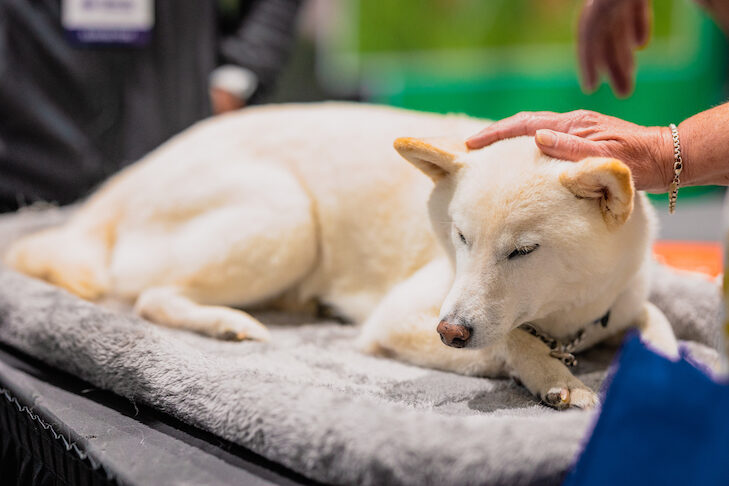
Allow a dog, cat, or other pet to choose whether to stay near you. Do not assume that a pet who tolerates ordinary stroking also wants Reiki touch. Avoid placing hands on the head, neck, spine, belly, or an injured area unless a veterinarian has advised that contact is appropriate and the animal remains relaxed. No special distance or hand position is required for this optional practice.
If your animal is injured, unwell, taking medication, or behaving differently, contact a veterinarian. Reiki must not delay examination, prescribed treatment, medication, food, or water. You may quietly offer a no-touch practice only if it does not interfere with care.
Cages, tanks and enclosures
Keep animals in their usual safe habitat. Do not pick them up, open a tank or enclosure, reach into a cage, or change food, water, or medication for Reiki. If an animal is frightened or defensive, give it space and stop.
For birds, reptiles, small mammals and fish, the enclosure is the animal's home and its temperature-controlled environment. Opening it can change the temperature, humidity or lighting and can frighten the animal. Work from outside. Do not tap the glass, wiggle fingers through bars, remove a hide, or take an animal out to sit with you. A session can be a few minutes of quiet presence while the animal remains in its own space.
Farm animals and horses
Observe from a safe distance and do not enter an enclosure or approach an unfamiliar animal to give Reiki. Large animals can injure people unintentionally. Follow the animal's handler and veterinarian guidance, and stop if the animal moves away, becomes tense, or shows distress.
Do not tie a horse for a Reiki session, and do not enter a pen with cattle, pigs, rams or a cow with a calf. Use a barrier. The animal's ability to move away is the first safety feature and the first consent signal. For more detail, see Reiki for Horses and Reiki for Farm Animals.
Wild animals
Do not capture, handle, move, or box a wild animal to offer Reiki. Handling wildlife can injure the animal and the person; contact a licensed wildlife rehabilitator or local animal-welfare service if an animal appears injured or orphaned. Keep a safe distance. Any optional spiritual practice should not interfere with professional wildlife care.
A session cannot show whether Reiki helped. Let the animal's comfort and veterinary needs guide your choices.
Hands-off or light touch
Many practitioners work entirely hands-off. That is a complete practice, not a lesser one. Hands-off work is usually the right choice for wild, fearful, injured, newly rescued, pregnant, very young or very old animals, and for birds, reptiles, small prey species and large animals.
If you do touch, keep it still and light. Do not stroke, massage, press, tap, cup, hold or move a limb. Do not put your hands around the animal's neck or chest. Do not put pressure on the spine, belly or an injured area. Keep the touch brief and stop if the animal tenses, shifts away or looks at your hand.
Hygiene matters. Wash your hands before and after a session, especially after contact with reptiles, amphibians, birds or farm animals. Do not let an animal lick your hands or face during a session. Do not bring food into an enclosure. If you have been around other animals, change or clean outer clothing as the handler or vet advises.
Reading comfort, not “energy”
Watch the whole animal rather than one signal. A relaxed dog may have a soft mouth, loose posture and a wagging tail, but tail wagging can also be tense or agitated. A cat may sit with paws tucked and eyes half-closed, or may freeze with ears back. A horse may stand quietly, or may be shut down rather than relaxed. A rabbit may flop over, or may lie rigid with wide eyes. These are general observations, not a diagnostic chart, and they do not tell you whether Reiki is “working”.
Stop or increase distance if the animal:
- turns its head or body away, or leaves;
- stiffens, freezes or holds its breath;
- hides, tucks its tail, pins its ears or raises its hackles;
- growls, hisses, snaps, kicks or shows defensive movement;
- pants, trembles or paces in a way that seems out of context.
Do not label a stress response as “releasing energy”. Give the animal space and let it decide whether to return.
Species-specific signals vary. A dog's tail, a cat's ears, a rabbit's thump, a bird's flutter, a reptile's retreat, a ferret's nip and a horse's tail swish do not mean the same thing. Learn the individual's normal behaviour and ask the caregiver what a change looks like. The species pages below explain the main differences.
Settling before you offer Reiki
Before you turn your attention to the animal, settle yourself. Put both feet on the floor, let your shoulders drop and take a few natural breaths; do not use the breath as a technique or try to slow it. In whatever Reiki form you practise, set a modest intention for the animal's safety and its freedom to choose. This is a spiritual practice, not a claim about energy or an expected outcome.
Let your hands rest in your lap or at your sides. Keep them still unless the animal already invites ordinary contact. Watch without asking for a response: where the animal settles, when it looks toward an exit, whether it hides. End quietly before it has to escalate, and leave first. Afterwards, reflect on one question: did I make space, or did I ask the animal to perform? Report only what you observed.
A short, low-pressure session
For a familiar pet in a calm home, a simple shape is enough:
- Ask the caregiver whether they are happy for you to sit quietly with the animal, and agree what you will and will not do.
- Sit at a comfortable distance, with your hands in your lap and your body turned slightly away rather than looming over the animal.
- Let the animal approach or ignore you. Do not call, coax, corner or follow it.
- If it settles nearby, stay still for a few minutes. If it moves away, let it go and end the session.
- Leave before the animal becomes restless, and tell the caregiver what you did in plain language.
There is no required hand position, duration or sensation. A session can be a few minutes of quiet sitting. If the animal is asleep, that is not an invitation to move closer or touch it.
Adapting to different species
The same quiet presence looks different in practice. Use these guides for the husbandry and handling details:
- Dogs: watch the whole body, keep the lead loose, never tether, and avoid head, neck and spine contact. See Reiki for Dogs.
- Cats: let the cat keep its territory, height and hiding places; never scruff or corner it. See Reiki for Cats.
- Horses: work loose or behind a barrier, never tied; keep a handler present and stay clear of hindquarters. See Reiki for Horses.
- Rabbits: stay at ground level, never trance or put a rabbit on its back, and do not separate a bonded pair. See Reiki for Rabbits.
- Pet birds: work from outside the cage, never towel or grab a bird, and take fluffed feathers and quietness seriously. See Reiki for Pet Birds.
- Small pets and rodents: do not wake, dig out or pick up a hamster, guinea pig, rat, mouse or gerbil for a session. See Reiki for Small Pets and Rodents.
- Reptiles: respect the heat gradient, do not handle to "warm" the animal, and wash your hands. See Reiki for Reptiles.
- Ferrets: choose a time after play, never wake a sleeping ferret, and do not scruff. See Reiki for Ferrets.
- Farm animals: stay outside the pen, follow the stockperson, and do not interfere with routine or biosecurity. See Reiki for Farm Animals.
For animals with a difficult history, see Reiki for Rescue Animals. For older animals, see Reiki for Senior Pets. For animals who are fearful or reactive, see Reiki for Anxious Pets.
Animals in cages and enclosures
A cage, tank or vivarium is not a treatment room. Do not open it to reach in, and do not take the animal out for a session. Work from outside at a distance that lets the animal move away inside its space. If the animal is hiding, do not remove the hide or dig it out.
Do not change the enclosure's heat, light, humidity or ventilation for Reiki. Do not cover a bird's cage to create calm, and do not put a heat pad against a reptile. If the enclosure is not appropriate for the species, that is a husbandry problem to fix with a vet or experienced keeper, not something a session can correct.
For aquatic animals, do not tap the glass, lift the lid, or put hands in the water. For animals in a run or aviary, sit outside and do not enter. Keep other pets away from the enclosure during the session.
Large-animal safety
Horses, cattle, pigs, sheep and goats can injure a person without intending to. Never enter an enclosure or approach an unfamiliar large animal to give Reiki. Work from outside a barrier, with the handler present, and keep a clear route to the exit. Do not stand directly behind an animal, in a gateway, or between a cow and her calf.
Do not tie a horse, put a horse in a crush, or hold a sheep or pig still for a session. Restraint removes the animal's ability to leave and increases the risk to both of you. If the handler is moving stock, keep out of the way. If the animal is ill or injured, call the vet and follow the handler's instructions.
Anxious, rescue and senior animals
An anxious animal needs space, predictability and professional care, not a practitioner who insists on closeness. Do not use Reiki as exposure therapy by sitting closer and closer to a frightened animal that cannot escape. Do not block its hiding place or ask a handler to restrain it. If the animal is already panicking, do not start a session.
A rescued animal may need days or weeks to settle. Keep visits short, let it hide, and do not expect gratitude or a visible "release". A senior animal may be in pain, deaf, blind, unsteady or confused. Keep sessions short and warm, do not lift it unnecessarily, and do not touch painful areas. For more detail, see Reiki for Anxious Pets, Reiki for Rescue Animals and Reiki for Senior Pets.
Owner and handler involvement
The owner or handler is the animal's advocate and the source of its history. Ask before entering, follow house rules, and do not overstay. Ask them to stay nearby if that helps the animal, but do not ask them to hold the animal still for you.
Explain in plain language what you will do, how long you expect to stay, and what will make you stop. Do not use vague claims about energy, blockages or healing crises to pressure the caregiver. Do not diagnose, and do not advise changes to medication, food or veterinary treatment. If the caregiver has questions about the animal's health, direct them to the vet.
The Reiki Council's animal training guidelines describe practitioners working alongside veterinary professionals, and Kathleen Prasad's Animal Reiki code of ethics asks practitioners to work in partnership with the animal, respect its decision to accept or refuse a session, and never diagnose. Those principles are more useful than any technique.
Working alongside a veterinarian
If an animal is under veterinary care, tell the vet or nurse what you are doing if it is relevant, and follow their handling advice. Do not ask a vet to endorse Reiki as a treatment, and do not suggest that a session can replace a diagnosis, medication, surgery, physiotherapy or a follow-up appointment.
You can offer practical support that does not interfere: helping the caregiver keep the animal's routine, driving to an appointment, or sitting quietly with the animal after a vet visit if the caregiver agrees. Keep any Reiki practice brief and optional, and do not perform it in an examination room without the clinic's permission.
Do not use Reiki to assess pain, a lump, a wound, a limp or a behaviour change. Those need veterinary examination. Do not delay emergency care for a session.
When to shorten or stop
Stop immediately if the animal:
- leaves, hides, or tries to get away;
- freezes, stiffens or holds its breath;
- pants, trembles, drools or paces;
- growls, hisses, snaps, kicks, bites or assumes a defensive posture;
- guards food, a bed, a toy or a companion;
- shows a sudden change in breathing, balance or responsiveness.
Shorten the session if the animal is restless, mildly tense, repeatedly looking at the exit, or simply losing interest. A short session that ends on the animal's terms is better than a long one that ends in fear.
If the animal's condition changes during or after a session, contact the caregiver and, if needed, the vet. Do not describe a deterioration as a "healing crisis" or a reason to continue.
Practical examples
A nervous cat in a new home. The cat stays under the bed. You sit on the floor in the doorway, hands in your lap, and do not look under the bed. After a few minutes, you leave. The next visit, the cat is on top of the wardrobe. You sit at the same distance and leave after five minutes. You do not pick the cat up, close the door, or move the bed. Progress is measured by the cat's choices, not by contact.
A dog after surgery. The dog is on pain medication and has a cone. The caregiver asks you to sit with it while they make dinner. You sit on the floor near the dog's bed, hands off, and leave when the dog shifts or pants. You do not touch the incision, remove the cone, or suggest that Reiki can replace the medication. If the dog seems painful, the caregiver calls the vet.
A horse in a field. The horse is loose with two others. You stand at the gate with the handler, not inside the field. The horse approaches the gate, then walks away. You do not follow. The session is over. You do not tie the horse, enter the field, or ask the handler to catch it.
Questions people ask
What can Reiki offer an anxious animal? A quiet room may give an animal a chance to rest, but its behaviour does not establish a Reiki effect. Anxiety needs veterinary and behavioural assessment, and Reiki does not replace a behaviour plan or medication.
Should I touch the animal? Only if it already welcomes ordinary contact, the caregiver agrees, and the animal remains relaxed. Many practitioners work entirely hands-off.
Can I send distant Reiki to an animal? Only with the caregiver's agreement and within the limits above. Distant practice does not remove the need for veterinary care, and the animal cannot consent in words.
What about a dying animal? Keep the animal's comfort and the caregiver's wishes central, follow veterinary advice, and do not promise a peaceful death or a cure. Quiet presence can be a kindness; it is not a treatment.
How long should a session last? As long as the animal remains comfortable and free to leave, and no longer. A few minutes is enough. Ending early is not failure.
Further reading
- AVMA: Complementary and alternative veterinary medicine guidelines
- RSPCA: Understanding your dog's body language
- International Cat Care: Handling and interactions
- RSPCA: How to hold a rabbit
- MSD Veterinary Manual: Management and husbandry of reptiles
- Kathleen Prasad, "Animal Reiki Practitioner Guidelines and Code of Ethics", Reiki News Magazine, Fall 2007, p. 27.
- Reiki Council: Giving Reiki to animals (professional guidance, not veterinary evidence).
Related topic: Animal Reiki, Animal Reiki: how to do it, Reiki for Dogs, Reiki for Cats, Reiki for Horses.