
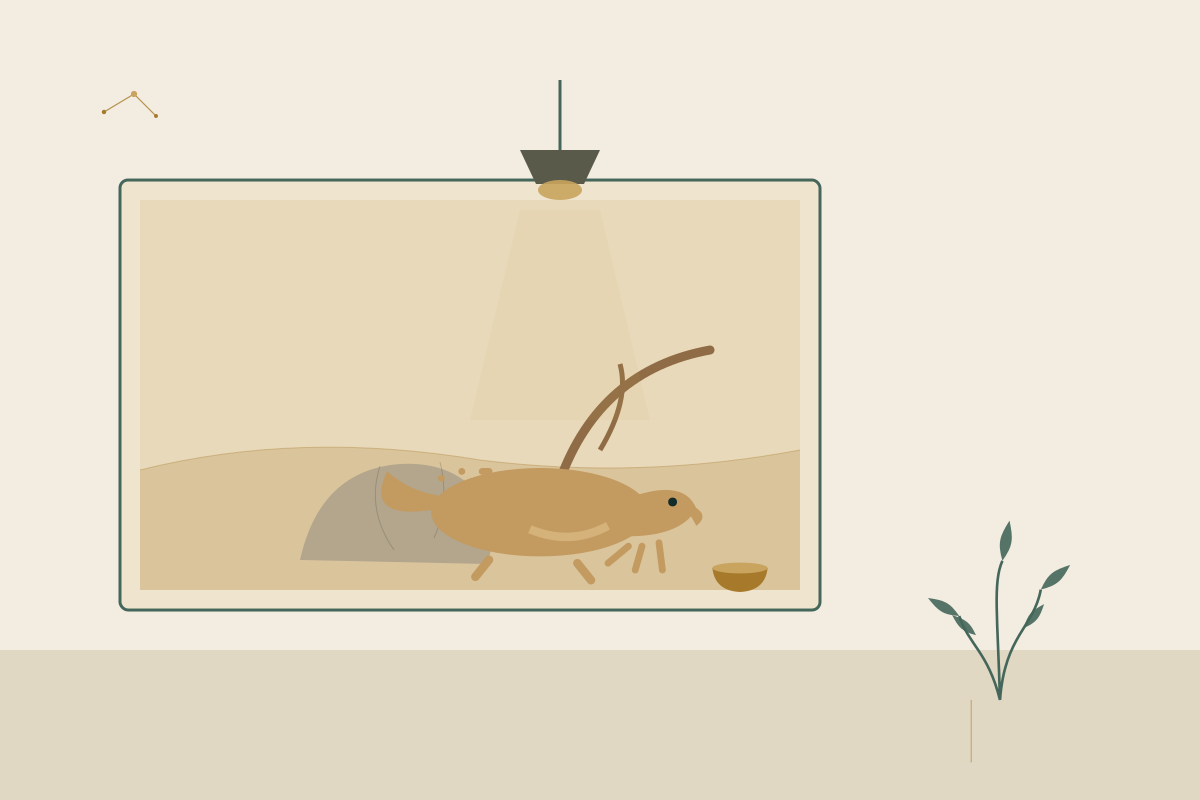
Reptiles are ectotherms: they rely on their environment to warm up and cool down. That single fact changes how Reiki can be offered. A reptile taken out of its enclosure for a session may lose heat, become stressed and struggle, while a reptile in a well-designed vivarium can choose whether to bask, hide or retreat. Reiki for reptiles is therefore overwhelmingly a hands-off practice done from outside the enclosure, with no opening of doors, no lifting and no "helpful" repositioning.
Reiki for reptiles is offered alongside that care, not as a substitute for species-appropriate husbandry or veterinary treatment. For the shared principles, read Animal Reiki and Using Reiki on Animals. This page focuses on the species-specific practicalities: heat gradients, humidity, shedding, feeding, hygiene and the stress of handling.
The enclosure is the treatment space
A vivarium is not a display case you can reach into whenever you like. It is a controlled environment whose heat, light, humidity and hiding places are set for that species. Those requirements vary widely between desert, tropical, arboreal and aquatic reptiles. Opening the door changes the environment and may frighten the animal. Do not open the enclosure to offer Reiki, do not reach in to stroke a snake or lizard, and do not take a reptile out to sit with you.
Sit outside the glass at a comfortable distance. Let the animal bask, hide, climb or watch you. If it is in a hiding place, do not lift the hide or dig it out. If it is in a feeding response, do not open the door or wave fingers near the glass. A session can be a few minutes of quiet presence while the reptile does exactly what it would do without you.
The RSPCA's species pages describe the importance of a secure enclosure and the conditions that suit that animal. The MSD Veterinary Manual's management and husbandry of reptiles notes that glass aquaria can be stressful for some species because the animal is highly visible, while others are habituated to glass; cover or a visual barrier may help where the handler says it does. The same source stresses that heat, lighting, humidity and retreats must match the species. Those are welfare requirements, not optional extras to be traded for a Reiki session.
Heat, light and why you should not "warm" a reptile
Reptile husbandry is species-specific. Many reptiles use a temperature range or basking zone so they can choose how warm or cool to be, but the exact temperatures, UVB needs and humidity vary with species, age and enclosure. A reptile removed from its enclosure may lose access to its chosen conditions. The RSPCA's bearded dragon guidance suggests around 10 to 15 minutes out of the vivarium at a time is appropriate for that species, depending on air temperature, and that the animal should not be out for so long that its core temperature drops. For Reiki, there is no reason to take it out at all.
Do not use Reiki as a substitute for a heat lamp, thermostat, UVB tube or humidity control. Do not hold a reptile under a lamp, put it on a hot-water bottle, or wrap it in a blanket to "help it absorb energy". Reptiles can be burned by inappropriate heat sources, and overheating is as dangerous as chilling. If the enclosure is not right for the species, fix the husbandry or call a reptile vet; do not try to compensate with spiritual practice.
Handling: only when necessary, and never by the tail
Some reptiles tolerate gentle handling, and some keepers handle them for health checks, transport or enclosure cleaning. That does not make handling a Reiki technique. If a reptile must be moved, use the species-appropriate method: support the whole body of a snake or lizard, scoop rather than grab, and never pick a lizard up by the tail. Many lizards can shed their tails as a defence, and the loss is stressful and energetically costly.
The RSPCA's corn snake guidance advises gently scooping a snake with one hand near the head and the other nearer the tail, supporting the whole animal, and never grabbing it. It also advises waiting 48 hours after feeding before handling, avoiding handling around shedding, and washing hands before and after handling prey. The royal python guidance gives similar advice. For a Reiki session, the simplest rule is: do not handle at all.
If a reptile is defensive, it may pull its head back into an S-shape, open its mouth, hiss, flatten its body, raise its tail or strike. Do not try to "calm" it by continuing. Close the enclosure quietly and give it space. A bite from a large snake or monitor lizard can be serious, and even a small gecko can drop its tail if grabbed.
Hygiene: salmonella and cross-contamination
Reptiles can carry Salmonella and other bacteria without appearing ill. The RSPCA advises washing hands before and after handling a reptile or its equipment, and cleaning enclosures regularly with a reptile-safe disinfectant. This is not a reason to be afraid of reptiles, but it is a reason to keep a Reiki session entirely outside the enclosure and to avoid touching your face, food or other animals afterwards.
Do not let a reptile walk over your hands, clothes or a shared table during a session. Do not put your hands in the enclosure and then touch your face. If you have touched anything in the enclosure, wash your hands with soap and water. Keep reptiles away from young children, pregnant people and anyone with a weakened immune system during handling, and follow the advice of a reptile vet or public-health guidance if you are unsure.
Species differences worth knowing
Snakes. Corn snakes and royal pythons are solitary, secretive and often nocturnal or crepuscular. They need secure vivaria, a thermogradient, hiding places and a humidity hide. They should not be handled during shedding or for 48 hours after feeding. A snake that refuses food, has difficulty shedding, wheezes, has abnormal droppings or spends long periods in its water bowl may need a reptile vet.
Bearded dragons. These are diurnal, territorial lizards that need strong UVB, a basking zone and a varied omnivorous diet. They should be housed separately. The RSPCA advises never surprising or grabbing a bearded dragon, scooping it with both hands so all four legs are supported, and leaving it alone if it backs away or threatens to bite. A dragon that is lethargic, has a soft jaw, trembles or cannot lift itself may have metabolic bone disease and needs a vet.
Leopard geckos. These are crepuscular, ground-dwelling lizards that need a thermal gradient, hides and calcium-supplemented insect prey. They are generally more tolerant of gentle handling than some species, but they are still small prey animals. Do not grab them by the tail, and do not handle them during shedding.
Tortoises and turtles. These need large enclosures, species-specific heat and UVB, water quality for aquatic species, and a diet that supports shell and bone health. Handling should support the plastron and carapace, not dangle the animal by the shell edge. The RSPCA's terrapin guidance notes that terrapins should not be petted, especially when young, and that hands should be washed before and after handling. A tortoise or turtle with a soft shell, swollen eyes, uneven scutes or lethargy needs a reptile vet.
A practice without opening the vivarium
Ask the handler about the species, its enclosure and its normal routine before you sit down. Then sit outside the glass at a distance that lets the animal retreat, with your hands in your lap and the room as it already is. Take a few natural breaths and, in your own Reiki practice, set a quiet intention that the animal keep its chosen temperature and hiding place. Do not treat the intention as a substitute for husbandry.
Do not open the door, tap the glass, move a hide or adjust a lamp. Let the reptile bask, hide or watch you. If it retreats, gapes, hisses or becomes restless, move away. If it is already out for a health check and remains settled, you may sit quietly nearby, but do not extend the handling or turn the check into a session.
Leave before the animal has to hide from you. Reflect on whether you changed anything in its environment and whether the handler had to intervene. Wash your hands if you touched the enclosure or the animal, and report only what you observed.
Working with the handler and the reptile vet
The handler knows the animal's normal behaviour, feeding response, shedding cycle and enclosure conditions. Ask before entering the room, and do not ask them to take the reptile out for you. If the animal is under veterinary care, follow the clinic's advice about handling, medication, heat support and feeding. Do not suggest that Reiki can replace an examination, radiograph, parasite test, surgery or follow-up appointment.
Reptile questions
Should I open the vivarium? No. Work through the glass and do not change heat, light, humidity or hides for a session.
What if the reptile is already out for a health check? You may sit quietly nearby if it remains settled, but do not extend handling or turn the check into a session. Return it to its enclosure as planned.
Do all reptiles need the same heat and UVB? No. Requirements vary by species and life stage. Ask the handler and a reptile vet, and do not treat one setup as a universal standard.
Related topic: Animal Reiki, Animal Reiki: how to do it, Using Reiki on animals, Reiki for Dogs, Reiki for Cats.