
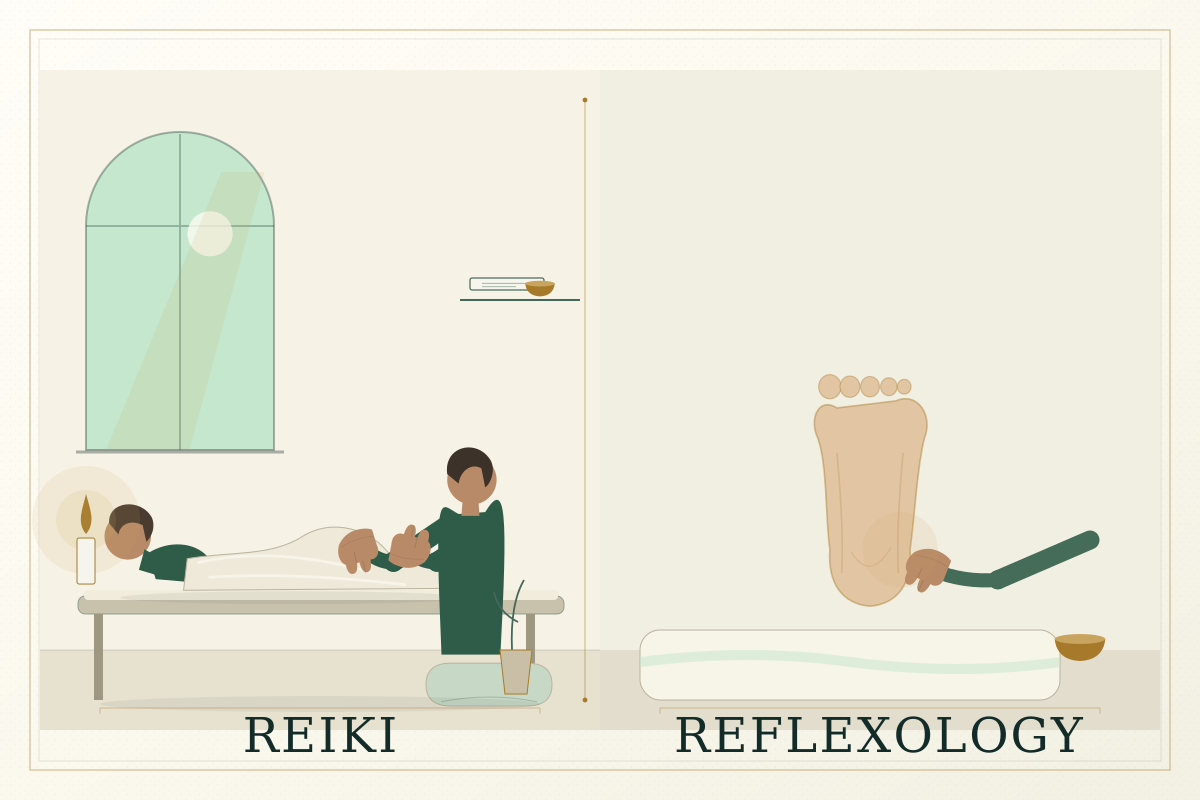
Reflexology and Reiki both involve a clothed client and a practitioner’s hands, but the similarity stops there. Reflexology is a manual practice: a practitioner applies specific pressure to points on the feet, hands, or outer ears that are understood to map to other parts of the body. Reiki is a spiritual practice in which the practitioner claims to channel universal energy, usually through light touch or hands held near the body.
The most useful difference for a client is this: reflexology is a structured form of touch with a physical technique you can feel, while Reiki is a quieter, less physically active practice whose central claim is metaphysical. Neither is a diagnostic tool, and neither has evidence strong enough to support disease-treatment claims.
What reflexology actually does
Reflexology maps zones or points on the feet, hands, and ears to organs, glands, and body systems. A practitioner uses thumb and finger pressure, sometimes with a cream or lotion, to work specific areas. The pressure can be firm or gentle, and a session usually focuses on the feet, though hand and ear reflexology are also taught.
The mapping is traditional, not anatomical. There is no nerve pathway or circulation route that connects a specific spot on the sole of the foot to a specific organ in the way reflexology charts suggest. That does not mean the touch is meaningless; it means the map should not be read as a medical diagram.
A reflexology session often begins with a foot bath or a cleansing wipe, followed by relaxation techniques and then focused pressure. The client sits in a recliner or lies on a table. The practitioner may ask about ticklishness, foot pain, verrucas, fungal infection, recent surgery, or circulation problems before starting.
What a Reiki session does
A Reiki session is usually less physically active. The practitioner may rest their hands lightly on the body or hold them just above it, moving through a sequence of positions or working intuitively. There is no pressure, no cream, and no mapping of the feet. The recipient remains fully clothed and may feel warmth, tingling, or nothing in particular.
Some Reiki lineages use symbols or distant practice; others do not. The session is framed as spiritual, and the practitioner’s authority comes from their teacher and lineage rather than a clinical licence.
| Feature | Reflexology | Reiki |
|---|---|---|
| Main action | Pressure on mapped points of feet, hands, or ears | Light touch or hands held near the body |
| Contact | Direct, often firm pressure | Light touch or no contact |
| Equipment | Recliner or table, cream, foot bath, towels | Table or chair; no equipment |
| Clothing | Shoes and socks removed; otherwise clothed | Fully clothed |
| Claimed basis | Reflex maps correspond to body systems | Universal energy flows through the practitioner |
Touch, consent, and comfort
Reflexology involves sustained touch of the feet or hands, which some people find uncomfortable or intrusive. Ticklishness is common, and it does not mean the treatment is “working.” A good practitioner will adjust pressure, avoid painful areas, and stop if you want them to. They should also ask about foot conditions such as athlete’s foot, verrucas, ingrown toenails, recent surgery, or diabetes-related nerve changes before working.
Reiki touch is lighter, but consent still matters. A recipient may not want hands on the head, chest, abdomen, or injured areas. A hands-off session is a complete Reiki session in many lineages, not a lesser version. If a practitioner insists that touch is necessary for the energy to flow, that is a preference being presented as a rule.
In both practices, the client should be able to keep their clothes on, ask questions, change position, and end the session without justifying it.
Training, certification, and regulation
Reflexology training varies widely. In the United States, the American Reflexology Certification Board offers a national certification based on a psychometrically validated exam, but it does not teach reflexology or endorse a particular school. State licensing and local rules vary, and many reflexologists practise without a state licence. In the UK, the Association of Reflexologists is a professional membership body that sets training and practice standards for its members; it is not a statutory regulator.
Reiki has no statutory licence in the UK or the US. Certificates and master titles are private credentials, and training ranges from short courses to long apprenticeships. In the UK, a voluntary register accredited by the Professional Standards Authority is a useful signal, but it is not a legal licence.
In both fields, ask what the certificate actually represents. A reflexology certificate may reflect a short foot-massage course or a full professional training with anatomy, pathology, and supervised practice. A Reiki certificate may reflect a weekend attunement or years of mentorship. The title alone does not tell you.
What the research shows
Reflexology research is limited and uneven. A Cochrane review of manual methods for pain in labour found no trials examining reflexology, which is a striking gap given how often the technique is offered for pain. Other systematic reviews have reported some positive findings for specific symptoms, but the studies are often small, heterogeneous, and at risk of bias.
A 2023 review of reflexology for multiple sclerosis, for example, reported some pain and fatigue findings but no difference in most quality-of-life measures, with high heterogeneity between studies. That is not a basis for recommending reflexology as a treatment for MS. It is a suggestion that the practice deserves better research, not that it has already been proven.
Reiki research has similar problems. NCCIH’s assessment is cautious: the studies are inconsistent, often small, and do not clearly establish benefit for any health condition. The sources reviewed here do not establish a clinical advantage of reflexology over Reiki, or the reverse.
Can reflexology diagnose illness?
No. A tender spot on the foot is a tender spot on the foot. It may reflect pressure, footwear, injury, inflammation, or simply the practitioner’s technique. It does not reliably indicate a problem in a corresponding organ, and it should not be used to diagnose or rule out disease.
The same caution applies to Reiki. A practitioner may say they sense heat, cold, or “blocked” energy, but those sensations are not a diagnostic test. If either practitioner tells you that a serious symptom is caused by an energy imbalance, or that you do not need medical investigation, seek appropriate medical advice.
How to compare practitioners
For reflexology, ask:
- What training did you complete, and are you certified by a recognised board or association?
- How do you adapt pressure for ticklishness, foot pain, diabetes, or circulation problems?
- Do you use a foot bath, and how do you clean equipment and towels between clients?
- What do you claim reflexology can help with, and what do you say it cannot do?
- Do you have insurance and a complaints process?
For Reiki, ask:
- Which lineage and level are you working within, and who trained you?
- Is touch involved, and can I choose hands-off practice?
- Do you use symbols or distant practice, and what do they mean in your tradition?
- Will you make medical claims or ask me to change my care?
- How do you respond if I become uncomfortable or want to stop?
If you have diabetes, peripheral neuropathy, a foot infection, or a recent foot injury, tell the reflexologist and your clinician. A practitioner should not work on broken skin, an infected area, or a foot that is being medically treated without appropriate advice.
Questions people ask
Is reflexology a form of massage? It is a manual practice, but it is not a general massage. It uses focused pressure on mapped points rather than stroking muscles and soft tissue.
Does reflexology hurt if there is a problem in the corresponding organ? No. Tenderness can have many causes and does not reliably map to an organ. Pain during a session is a reason to adjust pressure, not a diagnosis.
Is Reiki safer than reflexology? Reiki does not involve pressure or removal of clothing, so it has different physical risks. Both can carry indirect risks if a practitioner makes medical claims or discourages care.
Can I have reflexology if I am pregnant? Ask your midwife or clinician and a trained reflexologist. Some practitioners modify pressure or avoid certain points during pregnancy, but the evidence for specific precautions is limited.
Which is better for stress? There is no reliable evidence that either is a specific treatment for stress. Both may feel relaxing, and reflexology adds physical touch and a structured session.
Sources
- American Reflexology Certification Board, Home, accessed 23 October 2026.
- Association of Reflexologists, Home, accessed 23 October 2026.
- NHS, Herbal medicines and complementary therapies, reviewed 1 May 2026.
- Smith CA, Levett KM, Collins CT, et al., Massage, reflexology and other manual methods for pain management in labour, Cochrane Database of Systematic Reviews, 2018.
- Ma X, Yuan Z, Qian B, Guan Y, Wang B, Systematic review and meta-analysis of reflexology for people with multiple sclerosis, Medicine, 2023.
- National Center for Complementary and Integrative Health, Reiki, last updated December 2018.
For the needle-based practice that also works with traditional points, see Reiki vs Acupuncture. For another hands-on session, see Reiki vs Healing Touch.
Related topic: Reiki healing guides, Heyoka empath, Levels of consciousness, Inspirational quotes, The benefits of Reiki healing.