
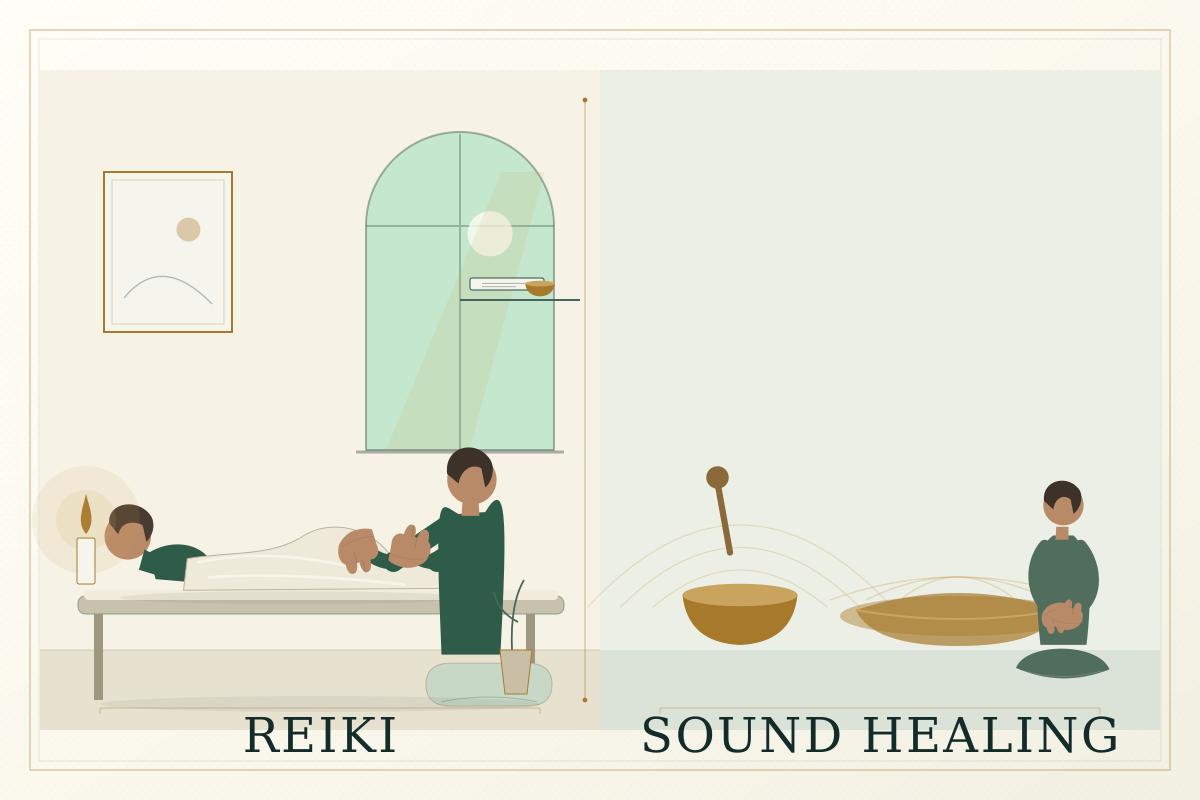
Reiki and sound healing are both offered as relaxing, spiritual experiences, and both are often found in the same wellness centres. The obvious difference is the sensory channel: sound healing works through what you hear and feel, while Reiki works through a practitioner’s hands and intention. The less obvious difference is that sound healing is not one practice. It can mean a group sound bath with singing bowls and gongs, a one-to-one tuning-fork session, a drum journey, or a form of music therapy delivered by a credentialed clinician.
That range matters. A sound bath and music therapy are not the same service, and neither is the same as Reiki. Comparing “Reiki vs sound healing” only becomes useful once you know which kind of sound practice is being offered.
What a sound session involves
A typical sound bath is a group event. Participants lie on mats or sit in chairs, often with blankets and eye masks, while a facilitator plays singing bowls, gongs, chimes, drums, or other instruments. The sound may be continuous or interspersed with silence. The facilitator usually does not touch participants, and the session may last from 30 minutes to over an hour.
A one-to-one sound session may use tuning forks placed near or on the body, bowls held near the ears, or guided voice and toning. Some practitioners combine sound with massage, breathwork, or energy work. The equipment and the level of physical contact vary widely, so the label alone does not tell you what will happen.
A Reiki session is usually quieter and more focused on the practitioner’s hands. The recipient remains clothed, and the practitioner may use light touch or hold their hands above the body. Sound may be played in the background, but it is not the active ingredient in the way it is in a sound bath.
| Feature | Sound healing | Reiki |
|---|---|---|
| Main channel | Hearing and physical vibration | Light touch, hover, and intention |
| Typical format | Group sound bath or one-to-one session | One-to-one session |
| Equipment | Bowls, gongs, tuning forks, drums, audio system | Table or chair; no instruments required |
| Contact | Usually none, but tuning forks may touch the body | Light touch or hands-off |
| Training | No single standard; varies by school | Lineage-based attunement and mentorship |
Sound healing, sound baths, and music therapy are not the same
“Sound healing” is an umbrella term, not a protected title. A sound bath is a group listening experience. A sound therapy session may be one-to-one and use specific frequencies or instruments. Music therapy is a clinical and evidence-based use of music interventions by a credentialed professional who has completed an approved music therapy program.
That last distinction is important. A board-certified music therapist is trained to assess needs, design interventions, and work within a clinical team. A sound-bath facilitator may have completed a weekend training or may have years of experience with instruments and group holding. Neither is automatically qualified to provide medical treatment, and the music therapist’s credential should not be borrowed to validate a sound bath.
If a provider says they offer “music therapy,” ask whether they are a credentialed music therapist and whether they are working within a clinical role. If they say they offer “sound healing,” ask what training and instruments are involved, and whether the session is group or individual.
What the research shows
Research on singing bowls and sound baths is growing but still limited. A 2024 overview of singing-bowl studies noted that the practice has been associated with changes in mood, tension, blood pressure, heart rate, and respiratory rate, but that the reasons are not fully understood and longer-term effects are unknown. Many studies are small, short, and use different instruments and protocols, which makes them hard to compare.
That evidence does not establish sound healing as a treatment for anxiety, depression, pain, or any other condition. It is consistent with the idea that a relaxing sound environment can affect how people feel in the short term. It does not establish a specific therapeutic effect of a particular frequency, bowl, or gong.
Reiki research has similar limits. NCCIH describes an inconsistent literature without a clearly demonstrated health benefit. The sources reviewed here do not establish which produces better outcomes.
Training and regulation
There is no single statutory credential for sound healing in the UK or the US. Training ranges from short workshops to longer practitioner programs, and organisations set their own curricula. Some sound practitioners are also music therapists, massage therapists, yoga teachers, or nurses; others are self-taught.
Music therapy is different. In the United States, the American Music Therapy Association describes music therapy as a clinical, evidence-based practice delivered by a credentialed professional who has completed an approved program. That credential is a meaningful signal, but it applies to music therapy, not to every sound bath.
Reiki also has no statutory licence. Certificates and master titles are private credentials, and training varies widely. In the UK, the voluntary register accredited by the Professional Standards Authority is the nearest thing to a quality check, but it is not a statutory licence.
Safety and sensory considerations
Sound is not physically invasive, but it is not always comfortable. Group sound baths can be loud, and volume may be difficult to control once the session begins. People with tinnitus, hyperacusis, hearing aids, migraines, or sound sensitivity may find bowls and gongs unpleasant. A responsible facilitator will explain the instruments, keep the volume reasonable, allow earplugs, and make it easy to leave.
Some people find lying still in a dark room difficult, especially if they have trauma, anxiety, or chronic pain. A sound bath is not a trauma treatment, and a facilitator should not pressure a participant to stay through distress. If a session brings up strong feelings, the participant should be free to leave and seek appropriate support.
Reiki has different physical risks but similar consent issues. Light touch may be unwelcome, and a practitioner should offer a hands-off option. Neither practice should be used to delay medical care or to explain away a serious symptom.
How to compare providers
For sound healing, ask:
- Is this a group sound bath or a one-to-one session?
- Which instruments are used, and how loud will it be?
- Can I bring earplugs, sit up, or leave if I need to?
- What training have you completed, and are you a credentialed music therapist if you call it music therapy?
- What do you claim the session can do, and what do you say it cannot do?
For Reiki, ask:
- Which lineage and level are you working within, and who trained you?
- Is touch involved, and can I choose hands-off practice?
- Do you use symbols or distant practice, and what do they mean in your tradition?
- Will you make medical claims or ask me to change my care?
- How do you respond if I become uncomfortable or want to stop?
A calming experience can be genuine without being a treatment. The safest providers are clear about that difference and do not use the word “healing” to imply a medical outcome.
Questions people ask
Is sound healing the same as music therapy? No. Music therapy is delivered by a credentialed professional within a clinical relationship. Sound healing is an umbrella term for various sound-based practices, with no single credential.
Does Reiki use sound? Some practitioners play music or use chanting, but sound is not the active method in Reiki. The practice is centred on hands, intention, and lineage.
Can sound baths help anxiety? Some people feel calmer after a sound bath, and small studies report short-term changes in mood and tension. That is not the same as evidence that sound healing is a treatment for an anxiety disorder.
Is a sound bath safe during pregnancy? Ask your clinician and the facilitator. There is no strong evidence of harm from gentle sound, but loud volume, prolonged lying on your back, and group settings may need modification.
Which is better for relaxation? Either may help some people relax. The better choice is the one whose format, sensory demands, and practitioner conduct suit you.
Sources
- American Music Therapy Association, What is Music Therapy?, accessed 23 October 2026.
- Seetharaman R, Avhad S, Rane J, Exploring the healing power of singing bowls, Explore (NY), 2024.
- National Center for Complementary and Integrative Health, Reiki, last updated December 2018.
- NHS, Herbal medicines and complementary therapies, reviewed 1 May 2026.
For the difference between Reiki and a personal meditation practice, see Reiki vs Mindfulness Meditation. For a movement-based practice, see Reiki vs Yoga.
Related topic: Reiki healing guides, Heyoka empath, Levels of consciousness, Inspirational quotes, The benefits of Reiki healing.