
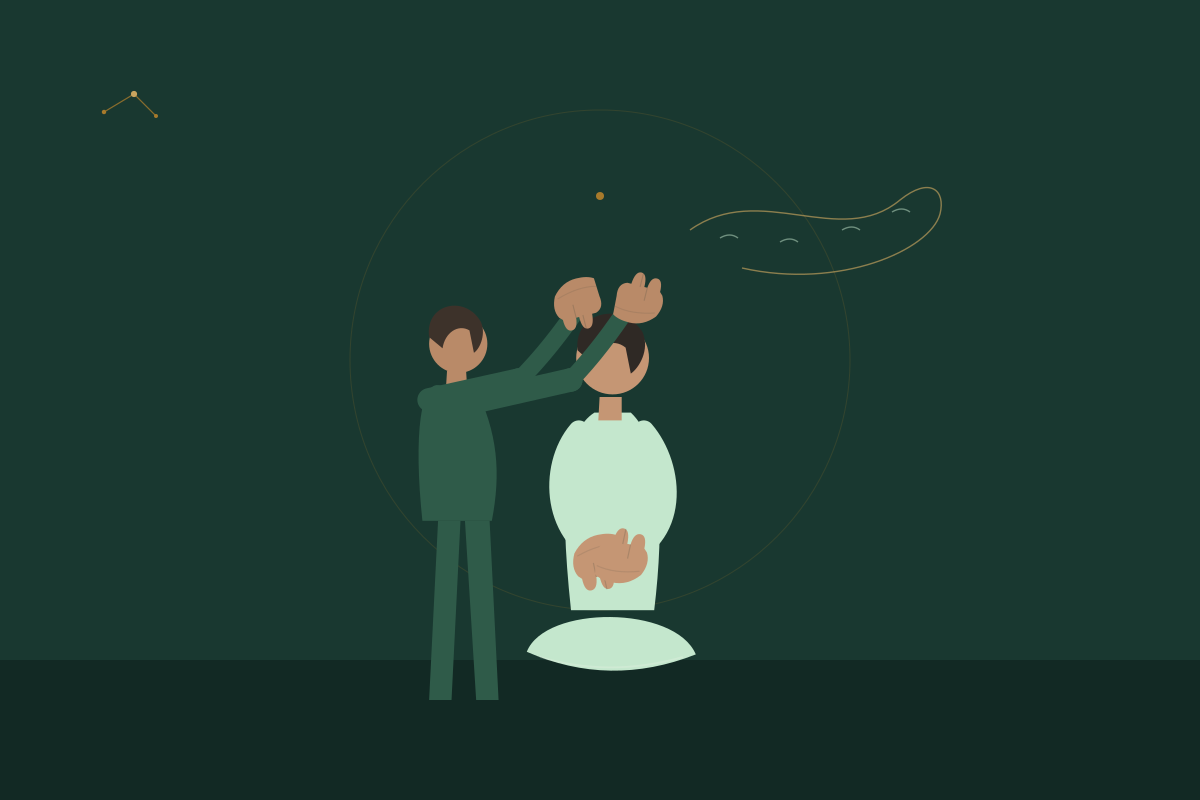
Nentatsu Ho (念達法) is the Reiki method of sending a thought, wish or intention. In Japanese-lineage teaching it is often described as a way of quietly communicating a positive wish to oneself or another person while Reiki is flowing. It is sometimes called a “deprogramming” technique in English, a word that sounds more clinical than the practice usually is.
Nentatsu Ho is not mind control, subliminal persuasion or a substitute for psychotherapy. It is a ritualized way of holding an intention, and its value depends on consent, realism and the relationship in which it is used.
What Nentatsu Ho means
Nen can mean thought, wish or attention; tatsu suggests reaching or conveying. English sources translate Nentatsu Ho as “thought-sending,” “intention method” or “affirmation method.” The Usui Reiki Ryoho International Society (URRIS), a lineage organization connected with Hiroshi Doi’s Gendai Reiki, describes Nentatsu as a way of conveying one’s prayers and blessings to another person. In its account, the practitioner places a hand at the forehead hairline and silently repeats the wish while Reiki flows, with the traditional aim of supporting change at a deep level (URRIS, On Misunderstandings of Nentatsu Ho).
That is a traditional claim about the practice, not a verified mechanism. The same article criticizes teachers who dress Nentatsu up as the “Pygmalion effect” or “observer effect” and present those ideas as proof. The honest position is that Nentatsu Ho is a Reiki ritual with a long lineage, and that its effects on habits or wellbeing have not been established by controlled research.
James Deacon describes Nentatsu Ho as a method for transforming habits and “setting” positive intentions, and notes that it is close to Seiheiki Chiryo Ho but does not use the Reiki symbols (AETW, Nentatsu Ho). That distinction is useful: Nentatsu is the intention practice; Seiheki Chiryo Ho is a symbol-based variant used in some lineages for habit work.
How it is described in Japanese-lineage teaching
The details vary by school, but a common structure is:
- The practitioner centers themselves and invites Reiki.
- The hands are placed on the recipient’s head — often one hand at the forehead or hairline and one at the back of the head.
- The practitioner silently or quietly states a short, positive intention.
- Reiki is allowed to flow for a few minutes.
- The hands are removed slowly, and the session closes.
URRIS emphasizes the forehead hairline and the silent repetition of a wish. Deacon’s version describes covering the occipital area and holding a clear intention. Neither version is a universal standard. Some teachers use Nentatsu Ho only for self-practice; others use it in attunement or habit-change work; still others do not teach it at all.
The International House of Reiki lists Nentatsu Ho among the techniques once practiced in the Usui Reiki Ryoho Gakkai tradition (IHREIKI, How Japanese is Gendai Reiki-Ho?). That gives the practice a named lineage context, but it does not make every modern version traditional.
Consent and boundaries
Nentatsu Ho is an intimate practice. A hand on the head and a spoken or silent intention can feel supportive, but it can also feel invasive. The following boundaries are not optional:
- Explain the practice before doing it. Say where you will place your hands, how long it will last, and what kind of intention you propose to hold.
- Get clear consent for the intention itself. Do not decide what another person “needs” to change. If they want to stop a habit, improve sleep or feel calmer, use their words, not your diagnosis.
- Never attempt to change someone’s will, beliefs, sexuality, relationships or medical decisions. Nentatsu Ho is not a tool for persuasion.
- Do not use it on someone who cannot consent. That includes a sleeping person, an unconscious person, a young child without a guardian’s agreement, and anyone who has withdrawn consent.
- Do not promise results. A habit may be complex, and a single session is not a treatment for addiction, depression, trauma or any other condition.
- Stop if the person becomes distressed. A hand on the head can trigger memories or discomfort. Ask before continuing, and be willing to end the session.
For self-practice, the same honesty applies. Choose an intention you actually want, not one you think you “should” want. Keep it short and realistic. “I will take a five-minute walk after lunch” is more useful than “I am perfectly healthy” if the latter is not true.
A self-directed version
If you want to try Nentatsu Ho on yourself, keep it simple:
- Sit comfortably and let the breath settle. A few minutes of Seishin Toitsu or natural breathing is enough.
- Rest one hand lightly on the forehead or crown, and the other on the back of the head if that is comfortable. Do not press.
- State a short intention silently or in a whisper. Use the present tense if that feels natural, but avoid claims that contradict medical reality.
- Let Reiki flow for two or three minutes. If you do not feel anything, that is not a failure.
- Release the intention. You are not holding the universe to a contract.
- Close with a moment of gratitude or a precept, then move gently.
Do not use Nentatsu Ho as a replacement for medical or psychological treatment. If you are trying to change a habit, a therapist or a qualified habit-change program may be more appropriate. Reiki can be a supportive practice alongside that work, not a substitute for it.
Nentatsu Ho versus Seiheki Chiryo Ho
Seiheki Chiryo Ho is a related method used in some Reiki lineages for habits and emotional patterns. The main difference is that Seiheki Chiryo Ho uses Reiki symbols, while Nentatsu Ho does not (AETW, Nentatsu Ho). The symbol-based version belongs to a later level in many schools, and it should be learned from a teacher who can explain the lineage and the limits.
Neither method is a substitute for informed consent. A symbol does not make an intention ethical, and a ritual does not make a claim true.
What intention can and cannot do
Nentatsu Ho is not a way to “reprogram” another person’s subconscious, cure addiction, erase trauma or guarantee success. It is a structured intention held within a Reiki session; its effects are personal and not established by research, and Reiki has not been clearly shown to be effective for any health-related purpose (NCCIH, Reiki).
Learning it in a lineage
Ask your teacher whether Nentatsu Ho is part of your level, whether it is taught with or without symbols, and what kinds of intentions are considered appropriate. If a teacher claims that Nentatsu Ho can cure disease, control another person’s behavior or replace therapy, treat that as a warning sign.
For related material, see Seishin Toitsu for the contemplation practice, Koki Ho for the breath method, and Reiki Symbols for the symbol material used in some lineages. The treatment hub lists the wider set of Japanese techniques, and Reiki Level 2 explains the level at which many schools introduce symbols and distance practice. The ten-day sequence is a separate practice page; it is not a Nentatsu Ho protocol.
Related topic: Treatment and hand positions, 10-day treatment with acupressure, Advanced techniques, Alternative techniques in treatment, Alternative ways to use the hands.