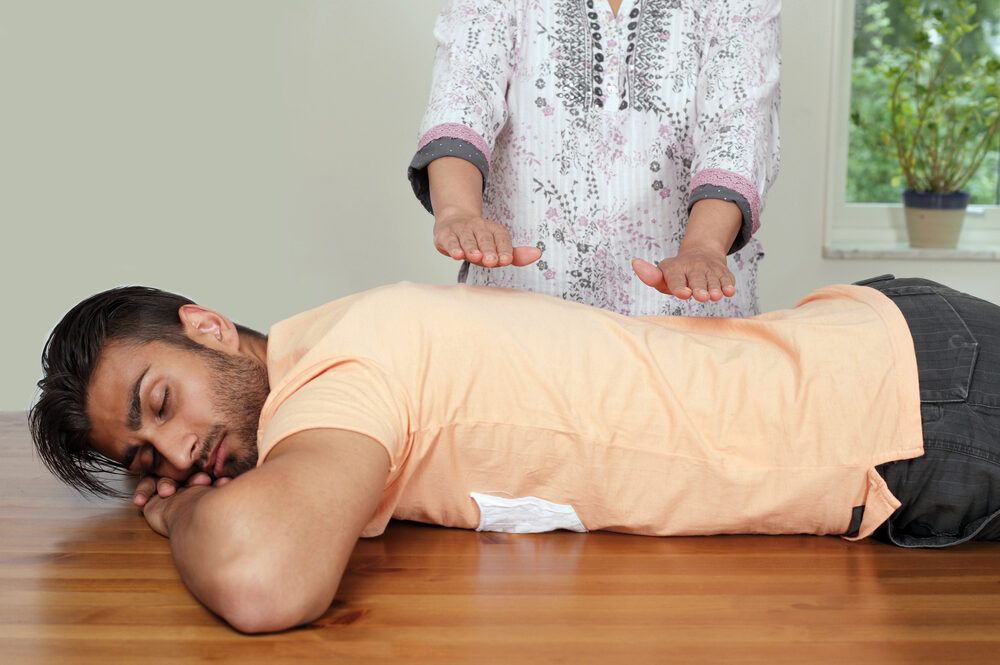
This page describes three optional techniques associated with Reiki practice: uchi-te (light tapping), nade-te (stroking) and oshi-te (gentle pressure). Names and forms can vary between teachers. Practitioners may describe warmth, tingling or other sensations during practice; these are personal experiences, not a way to identify illness or locate a medical problem.
Before offering any contact, explain the particular movement and the body area, then ask for the person's specific, freely given permission. Permission for one movement or area does not cover another. A person can say no, choose a hands-hovering or no-touch version, ask to skip a technique, or change their mind at any time. Do not touch breasts, genitals or other areas the person considers sensitive. These techniques are not massage or medical treatment. Reiki has not been clearly shown to be effective for health-related purposes, according to the U.S. National Center for Complementary and Integrative Health.
The Usui Reiki Hikkei is often discussed in connection with hands, eyes and breath in Reiki practice. Treat descriptions of energy as part of Reiki tradition and personal experience, not as an established physical mechanism.
What Are The Alternative Ways Of Using The Hands With Reiki?
Uchi-Te Chiryo-Ho
The name Uchi-te Chiryo-ho is commonly rendered as a hand-tapping method:
Uchi: strike, hit, knock, pound
Te: hand
Chiryo: treatment or care
Ho: treatment, method, way
This is a light tapping practice within some Reiki lineages. It is not reflexology and is not intended to change cells or treat a physical condition.
- Explain where and how you propose to tap, and ask permission for that area and movement before starting.
- If the person agrees, use a light, comfortable touch only. Do not increase force or slap. Stop immediately if they ask, tense, pull away, or seem uncomfortable; check in without pressuring them to continue.
- They may instead choose a hands-hovering version, another position, or to skip this practice altogether.
- If appropriate to your tradition, close with gassho (palms together) and a bow; the recipient need not participate.
Nade-Te Chiryo-Ho
The name Nade-te Chiryo-ho means:
Nade: stroke, pat, smooth down
Te: hand
Chiryo: treatment or care
Ho: treatment, method, way
Some practitioners use a short stroking movement as part of their tradition; others prefer still hands or no touch. It is not necessary to undress for Reiki. Keep the recipient clothed and covered.
- Describe the proposed area and direction of movement and ask for permission before each area. Never infer consent from a person's stillness or from their earlier agreement to a session.
- If they choose contact, use a gentle short stroke over clothing only. Do not stroke across the body or approach breasts, genitals, pelvis or any area they identify as sensitive. A hover or skipped position is always available.
- Pause and stop if permission is withdrawn or the person seems uncomfortable. Do not explain discomfort as an energy response.
- If appropriate to your tradition, close with gassho and a bow.
Oshi-Te Chiryo-Ho
The name Oshi-te Chiryo-ho means:
Oshi: push, pressure
Te: hand
Chiryo: treatment or care
Ho: treatment, method, way
Oshi-te is described in some Reiki practice as gentle fingertip pressure. It is not a method for finding or dissolving a blockage, and it is not massage or medical care.
- Explain the exact area and pressure you propose to use, then ask separately before touching it. Do not use this method on sensitive areas, injured or painful areas, or anywhere the recipient has not specifically agreed to.
- If they choose contact, use only light pressure over clothing, with short clean nails. Do not press, rub or rotate the fingers to try to change a symptom. Offer a hands-hovering or skipped position instead.
- Stop as soon as the person asks or appears uncomfortable. Clothing stays on; no part of this practice requires undressing.
- If appropriate to your tradition, close with gassho and a bow.
Related topic: Treatment and hand positions, 10-day treatment with acupressure, Advanced techniques, Alternative techniques in treatment, Techniques to strengthen the mind.