
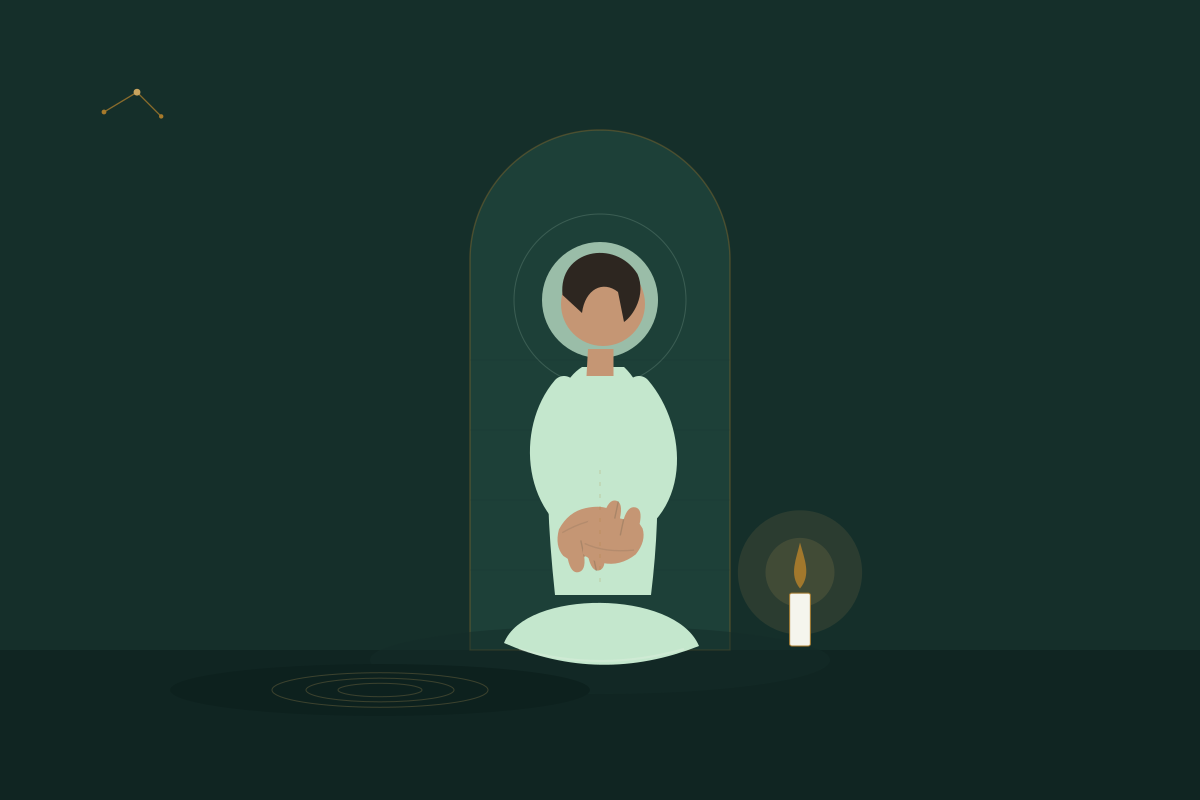
Seishin Toitsu (精神統一) is usually translated as “unification of mind and spirit” or “concentration meditation.” In Japanese-lineage Reiki it names a quiet, collected state rather than a dramatic technique. Some teachers treat it as a short contemplation within the larger Hatsurei Ho practice; others teach it as a standalone seated exercise. It is not a test of willpower, and it is not a medical treatment for anxiety, attention problems or any other condition.
This guide explains what the term means, where it sits in Reiki practice, how a beginner can try it, and where the practice ends and clinical care begins.
What Seishin Toitsu means
The phrase combines seishin (mind, spirit or inner disposition) and tōitsu (unification, making one). In ordinary Japanese it can describe concentration before a task, a calm and undivided frame of mind, or the state of being collected under pressure. In Reiki contexts it is closer to “gathering yourself” than to intense focus on an object.
That distinction matters. A person practicing Seishin Toitsu is not trying to clamp the mind shut or stop thoughts by force. The practice is usually described as settling the attention, letting the breath become natural, and returning gently when attention wanders. The aim is a stable, soft presence — not a blank mind and not a performance.
James Deacon’s compilation of Japanese-lineage material describes Seishin Toitsu as a “contemplation” and an element of Hatsu Rei Ho, with the gloss “unification of mind/spirit” (AETW glossary). That is a useful starting point, but it is a secondary compilation rather than a universal syllabus. Different Reiki schools place the practice differently, and some do not use the term at all.
Where it sits in Reiki practice
In several Japanese-style lineages, Seishin Toitsu appears inside Hatsurei Ho, a longer practice that combines centering, breathing, Reiki flow and the precepts. One recorded version places a “concentration meditation” after the breathing and before the Reiju empowerment, with attention moving between the hands and the seika tanden, the lower-abdominal centre (AETW, Hatsurei Ho). Hiroshi Doi’s Gendai Reiki-ho is one of the lines that teaches a Hatsurei Ho with added contemplative elements; the International House of Reiki notes that Gendai Reiki teaches “a slightly different version” of Hatsurei Ho from the Gakkai’s (IHREIKI, How Japanese is Gendai Reiki-Ho?).
This means you may encounter Seishin Toitsu in three ways:
- as a brief pause inside a longer Hatsurei Ho or daily practice;
- as a standalone seated meditation with a teacher’s guidance;
- as a general name for the collected state a practitioner tries to bring to hands-on Reiki.
None of these is the “correct” version for everyone. Ask your teacher what your lineage teaches and whether the practice is part of your level. For a wider map of Reiki methods, see the treatment hub.
A simple seated practice
The following is a conservative, beginner-friendly outline. It is not a ritual prescription, and it does not require a particular religion, altar or symbol.
- Sit comfortably. A chair is fine. Keep the feet supported and the spine upright without stiffness. Rest the hands in the lap or in a light gassho, whichever feels less strained.
- Let the eyes soften. You can close them or lower the gaze. If closing the eyes makes you sleepy or anxious, keep a soft focus on the floor a metre or two ahead.
- Notice the breath without changing it. Feel one natural inhale and one natural exhale. Do not force a special rhythm. If you already practice a breathing method, use the one your teacher gave you rather than mixing systems.
- Gather the attention. Let the attention rest in the lower abdomen, the hands, or the simple sensation of sitting. There is no need to visualize a colour or chase a sensation.
- Return when you notice. When the mind moves into planning, remembering or judging, notice that it has moved and return to the chosen anchor. The return is the practice, not a failure.
- Close with a moment of gratitude or a precept. A short bow, a quiet word, or simply a pause can mark the end. Then move gently before standing.
Five minutes is enough to learn the shape. Longer sittings are not automatically better. If you have a history of dissociation, panic or trauma, keep the eyes open and the sessions short, and work with a qualified meditation teacher or clinician who knows your situation.
A note on claims
Seishin Toitsu is sometimes marketed as a way to “clear the mind,” “raise your vibration,” or “reprogram the subconscious.” The sources consulted here describe it more modestly as a contemplative practice of gathering and settling attention; they do not support those promotional claims. Reiki has not been clearly shown to be effective for any health-related purpose, and this practice is not a substitute for medical or mental-health care (NCCIH, Reiki).
Common questions
Do I have to empty my mind?
No. The instruction to empty the mind is misleading for most beginners. The work is to notice activity and return, not to suppress it.
Should I visualize Reiki light?
Some lineages use light visualizations; others do not. If your teacher has given you a specific visualization, follow that. If not, the sensation of sitting and breathing is sufficient. Adding elaborate imagery is not a sign of progress.
How long should I practice?
Start with three to five minutes and stop while you still feel settled. A daily short practice is generally more useful than an occasional long one. There is no spiritual minimum, and missing a day is not a moral failure.
Can I practice with others?
Yes, with consent and a shared understanding of what the session is. A group can sit quietly together without anyone touching anyone else. Do not turn the practice into a diagnostic session or tell another person what their mind or body “needs.”
Learning it in a lineage
If you want to learn Seishin Toitsu as part of Reiki rather than as a generic meditation, ask a teacher in your line about three things: where the practice sits in their syllabus, whether it is taught inside Hatsurei Ho or separately, and what they mean by tanden in their instructions. The answers vary, and the variation is part of the tradition rather than a problem to be smoothed away.
For related practices, see Tanden Chiryo Ho for the lower-abdominal treatment, Nentatsu Ho for the intention method, and Reiki Breathing Exercises for breath-focused practice. If you are new to Reiki, begin with Reiki Level 1 and Reiki Healing. The meditation guide offers a broader view of how meditation and Reiki relate.
Related topic: Treatment and hand positions, 10-day treatment with acupressure, Advanced techniques, Alternative techniques in treatment, Alternative ways to use the hands.