
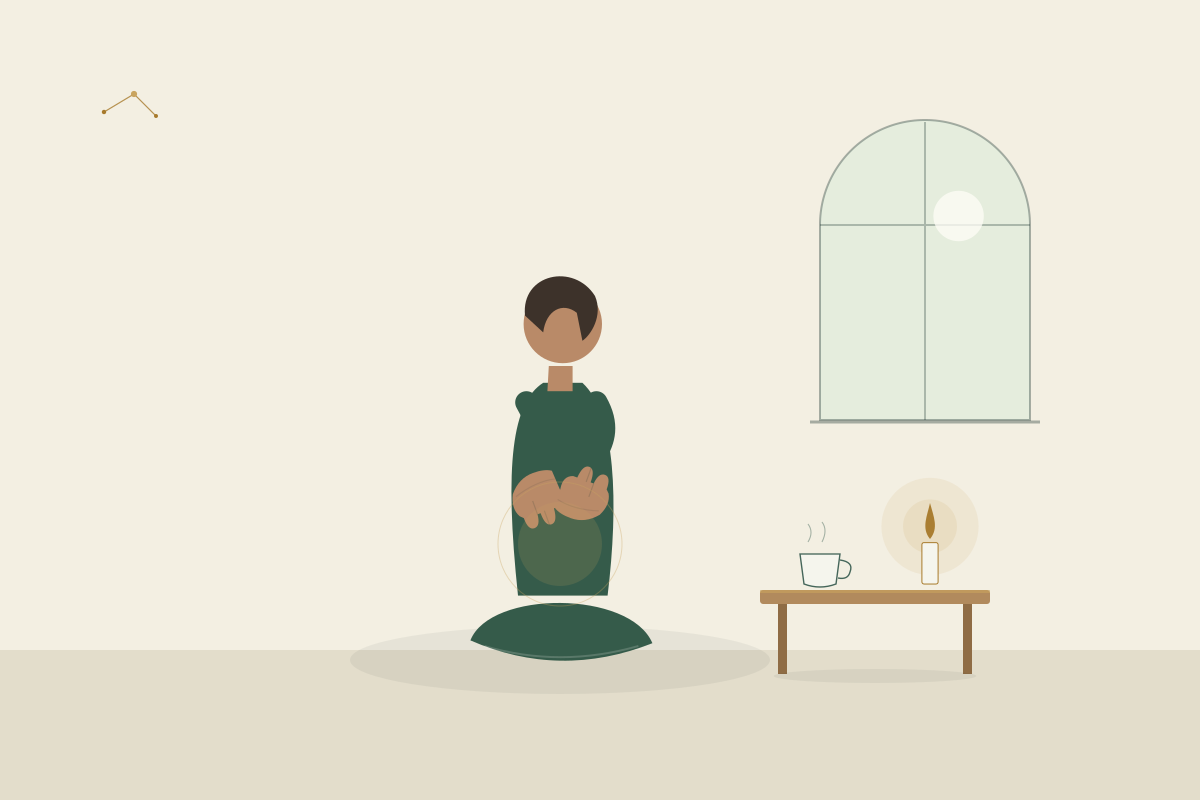
Tanden Chiryo Ho (丹田治療法) is the Reiki treatment focused on the tanden, the lower-abdominal centre used in many Japanese contemplative and martial traditions. Tanden is often translated as “elixir field” or “sea of ki”; chiryō means treatment or care; hō means method. The practice usually involves a light hand on the lower abdomen, a settled breath, and a few minutes of Reiki.
The tanden is not an organ. It is a felt centre, a postural and attentional reference point. That distinction is central to this guide: Tanden Chiryo Ho can be a grounding practice, but it is not a medical treatment for digestive disease, anxiety, infertility or “toxins.”
What Tanden Chiryo Ho is
In the recorded Japanese-lineage material, Tanden Chiryo Ho is also called Hara Chiryo Ho. James Deacon describes it as a method of “detoxification,” while explaining that the term does not refer only to physical substances but also to psychological, emotional and spiritual “toxins” (AETW, Tanden Chiryo Ho and Hara Chiryo Ho). That broader meaning is important: the practice is traditionally about settling and clearing the person’s state, not about flushing the colon or purifying the blood.
The International House of Reiki lists Tanden Chiryo Ho among the techniques once practiced in the Usui Reiki Ryoho Gakkai tradition, alongside Heso Chiryo Ho (IHREIKI, How Japanese is Gendai Reiki-Ho?). The two practices are close relatives. Heso focuses on the navel; Tanden focuses on the lower abdomen, usually a few finger-widths below the navel.
Tanden and hara in Japanese practice
In Japanese arts, the hara is the belly as a whole, and the tanden is a centre within it, often described as being about the size of a grapefruit and located deep in the lower abdomen. The International House of Reiki’s discussion of hara quotes the 1933 Reiki text Reiki and the Benevolent Art of Healing by Tomita Kaiji: “For a long time, it has been said that self-cultivation must be centered on the tanden [hara]. This is also the case in this therapy – one must always focus on the tanden” (IHREIKI, Hara and Reiki).
That is a traditional claim about practice, not an anatomical discovery. The tanden is not a gland, a nerve plexus or a reservoir of physical energy. It is a way of organizing posture, breath and attention. When a practitioner says “bring your attention to the tanden,” they are usually asking you to soften the belly, settle the breath low, and stop living in your head. Those are real, teachable skills even if the metaphysical map is not scientifically verified.
The practice in outline
A conservative version looks like this:
- Sit or lie comfortably. If sitting, keep the feet supported and the spine upright without rigidity. If lying down, support the knees if that helps the lower back relax.
- Let the breath settle. Notice the natural breath for a minute. Do not force the belly to move.
- Rest a hand on the lower abdomen. Place a warm palm a few finger-widths below the navel, over clothing. If the person prefers no contact, hold the hand a short distance above.
- Let Reiki flow. Stay for three to five minutes. There is no need to circle, press or “release” anything. If you notice pressure, soften.
- Check in. Ask whether the contact is comfortable and whether the person wants to continue. A tense belly or a change in breathing is a signal to lighten or stop.
- Close slowly. Remove the hand, let the person rest, and offer a moment before they sit up. Do not interpret gurgles, warmth or emotions as medical findings.
For self-practice, the same outline works with your own hand. A few minutes of Seishin Toitsu before or after can help you notice the difference between “settling” and “trying hard to relax.”
Heso Chiryo Ho versus Tanden Chiryo Ho
Heso Chiryo Ho focuses on the navel. Tanden Chiryo Ho focuses on the lower abdomen. Both use light contact and both are described in traditional language as systemic or cleansing practices. The difference is one of emphasis:
- Heso treats the navel as a symbolic gateway and often uses a more specific hand placement at or around the umbilicus.
- Tanden treats the lower abdomen as a centre of gravity and breath, and the hand usually rests below the navel.
In practice, many teachers blend the two. The important thing is not to turn either into deep abdominal massage or a diagnostic examination. The belly is soft tissue with organs beneath it; a Reiki hand should rest, not probe.
Safety and contraindications
Avoid pressure on the lower abdomen, and seek medical advice where appropriate, if:
- Do not apply abdominal pressure after recent surgery, including a caesarean section or laparoscopy.;
- you have a hernia, a bulge that appears when you cough, or a history of hernia repair;
- you are pregnant, especially if you have pain, bleeding or contractions;
- the area is painful, tender, red, warm, swollen or has a discharge;
- you have a bleeding disorder or take anticoagulants;
- you have an abdominal aortic aneurysm, a known mass or unexplained swelling;
- you have recently eaten a large meal or feel nauseated.
Do not press on a child’s abdomen without a guardian’s consent and a clinician’s advice. Do not use a buckwheat grain, coin, plaster or any other object on the belly.
What the hara practice can and cannot do
Tanden Chiryo Ho is not a cure for digestive, pelvic or mental-health conditions, and it is not a way to “detox” the body or diagnose an organ problem. Reiki has not been clearly shown to be effective for any health-related purpose (NCCIH, Reiki). The traditional language of clearing can be meaningful within a lineage, but it is not a medical mechanism.
Learning it in a lineage
Ask your teacher how their line locates the tanden, whether they use contact, and what they mean by “detoxification.” If a practitioner claims that abdominal pressure can diagnose an organ problem or cure a disease, seek a second opinion from a qualified health professional.
For related practices, see Heso Chiryo Ho for the navel treatment and Seishin Toitsu for the seated contemplation. Reiki Breathing Exercises offers breath-focused support, and Reiki Hand Exercises can help with hand sensitivity. The treatment hub lists the wider set of Japanese techniques. If you are new to Reiki, begin with Reiki Level 1 and Reiki Healing.
Related topic: Treatment and hand positions, 10-day treatment with acupressure, Advanced techniques, Alternative techniques in treatment, Alternative ways to use the hands.