
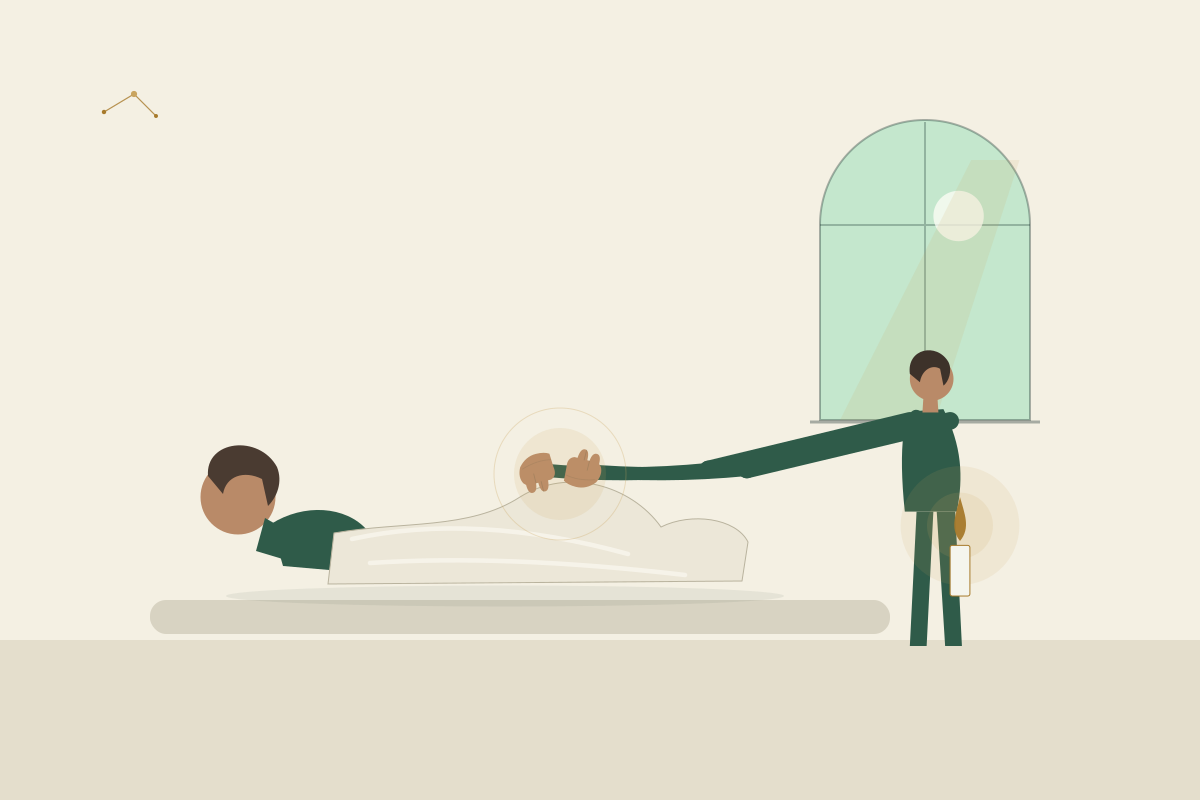
Heso Chiryo Ho (臍治療法) is the Reiki treatment focused on the navel. Heso means navel, chiryō means treatment or care, and hō means method. In Japanese-lineage Reiki the navel is sometimes described as an important meeting point in the body’s energetic geography. That is a traditional symbol, not a medical fact about the umbilicus.
The practice itself is usually gentle: a hand rests near the navel, Reiki flows, and the practitioner and recipient settle. It is not a manipulation of the abdomen, a diagnosis of digestive disease, or a substitute for medical care. This guide explains the traditional framing, a safe approach and the situations in which the navel should not be pressed at all.
What Heso Chiryo Ho is
James Deacon describes Heso Chiryo Ho as a “systemic” treatment through the navel, which the tradition views as an important nexus in healing. In his recorded version, the practitioner centers themselves, performs a gassho, stands to the client’s left side, and places a bent middle finger or the palm near the navel before letting Reiki flow (AETW, Heso Chiryo Ho). The exact hand shape varies by teacher; some use a flat palm, some use a fingertip, and some work above the clothing without contact.
The International House of Reiki lists Heso Chiryo Ho among the techniques once practiced in the Usui Reiki Ryoho Gakkai tradition, alongside Tanden Chiryo Ho (IHREIKI, How Japanese is Gendai Reiki-Ho?). The pairing is logical: the navel and the lower abdomen are neighboring symbolic centres, and some teachers use the terms in overlapping ways. They are not identical, but the boundary is not always sharp in the sources.
Why the navel?
In traditional Japanese and Chinese-influenced medicine, the navel area is associated with the hara, the belly as a whole, and with the tanden, a felt centre in the lower abdomen. Reiki teachers sometimes describe the navel as a place where the body’s “original ki” is remembered or where deep relaxation can begin. These are poetic and ritual claims. The umbilicus is also a real anatomical scar with blood vessels, connective tissue and a potential site of hernia, infection or endometriosis.
That double reality is why Heso Chiryo Ho should be taught with both symbolism and ordinary medical caution. A practitioner can hold the traditional meaning without telling a recipient that their navel reveals a liver problem, a blocked chakra or a childhood wound.
The practice in outline
A conservative version, suitable for self-practice or a clothed table session with consent, looks like this:
- Agree on the frame. Explain that you will rest a hand near the navel, that there will be no deep pressure, and that the person can stop at any time.
- Center yourself. Let the breath settle and bring your attention to your own lower abdomen. A minute of Seishin Toitsu is enough.
- Rest the hand lightly. Place a warm, relaxed palm over the clothing, a little below or around the navel. Do not push into the navel. If the person prefers no contact, hold the hand a few centimetres above the area.
- Let Reiki flow. Stay for a few minutes. There is no need to circle, knead or “work out” a knot. If you notice yourself pressing, soften.
- Check in. Ask whether the pressure is comfortable and whether the person wants to continue. A change in breathing or a tense abdomen is a signal to lighten or stop.
- Close slowly. Remove the hand, let the person rest for a moment, and offer water if appropriate. Do not interpret sensations as medical findings.
The same outline can be adapted for self-practice: rest your own hand on your lower abdomen, breathe naturally, and stop if anything hurts.
Safety and contraindications
The navel is not a safe place for deep pressure in every situation. Avoid pressure, and seek medical advice where appropriate, if:
- Do not apply abdominal pressure after recent surgery, including a caesarean section or laparoscopy.;
- you have an umbilical hernia, a bulge that appears when you cough, or a history of hernia repair;
- you are pregnant, especially if you have abdominal pain, bleeding or contractions;
- the area is painful, tender, red, warm, swollen or has a discharge;
- you have a bleeding disorder or take anticoagulants;
- you have an abdominal aortic aneurysm, a known mass, or unexplained abdominal swelling;
- you have recently eaten a large meal or feel nauseated.
Do not press on a child’s navel without a guardian’s consent and a clinician’s advice, especially if the child has a hernia or has had recent surgery. Do not use a coin, band, plaster, buckwheat grain or any other object on the navel.
Heso Chiryo Ho versus Tanden Chiryo Ho
Heso Chiryo Ho focuses on the navel. Tanden Chiryo Ho focuses on the lower abdomen, usually a few finger-widths below the navel, and is often described as a grounding or “detoxification” practice in traditional language. The two overlap in practice: both involve a light hand on the belly, both use the hara, and both are often taught in the same level.
The difference is mostly one of emphasis. Heso Chiryo Ho treats the navel as a symbolic gateway; Tanden Chiryo Ho treats the lower abdomen as a centre of gravity and breath.
What the navel practice can and cannot do
Heso Chiryo Ho is not a cure for digestive or pelvic conditions, and it is not a way to diagnose an organ problem. Reiki has not been clearly shown to be effective for any health-related purpose (NCCIH, Reiki). A gentle hand on the belly can be comforting, but comfort is not the same as treatment.
Learning it in a lineage
Ask your teacher how their line places the hand, whether contact is used, and what they consider contraindicated. If a practitioner tells you that navel pressure can diagnose or cure a disease, or that a “prolapsed navel” explains your symptoms, seek a second opinion from a qualified health professional.
For related practices, see Tanden Chiryo Ho for the lower-abdominal treatment and Seishin Toitsu for the seated contemplation. The treatment hub lists the other Japanese techniques. If you are new to Reiki, Reiki Level 1 and Reiki Healing cover the foundations. The ten-day sequence includes abdominal points; its cautions apply there too.
Related topic: Treatment and hand positions, 10-day treatment with acupressure, Advanced techniques, Alternative techniques in treatment, Alternative ways to use the hands.