
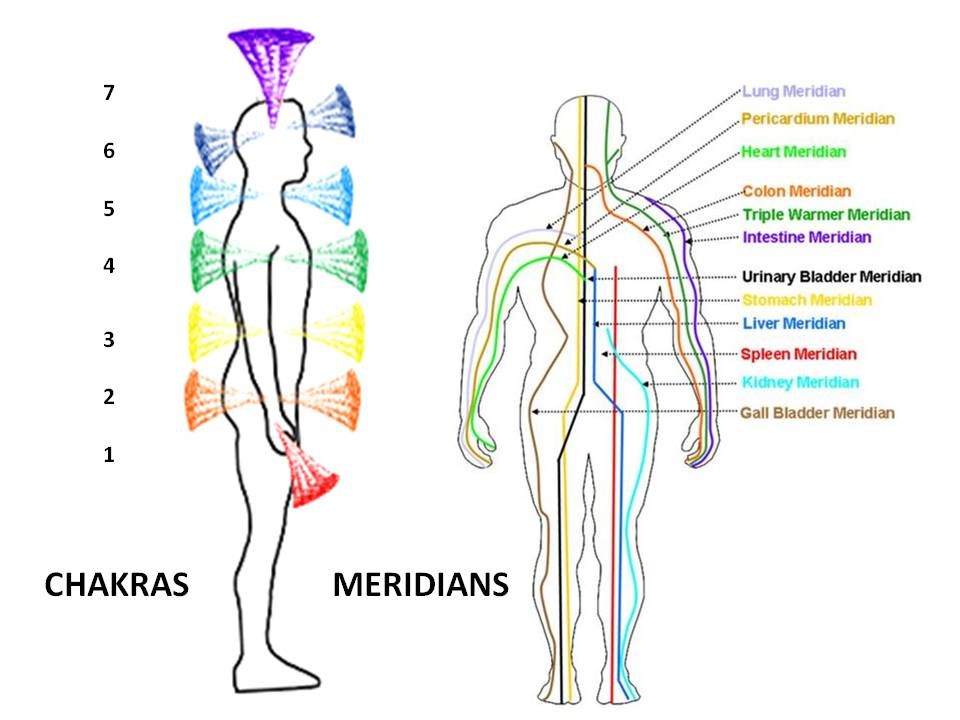
In Eastern energetic traditions, the chakras and meridians are described as centers and channels of subtle energy. They belong to a traditional map of the body, not to anatomy: the chakras are not organs, and the meridians are not veins or arteries. The comparison is a teaching device—chakras are likened to organs and meridians to vessels—but the tradition's Ki is a spiritual concept, not something that has been measured. Acupuncture and acupressure use points along the meridian model; that model is distinct from the circulatory system.
The 7 Major Chakras
Seven major chakras are described at the base of the spine/perineum, near the navel, at the solar plexus, in the middle of the chest, in the throat, and at the crown of the head. Chakra is a Sanskrit word for "wheel" or "vortex." In this map there are also many minor chakras—in the hands, the knees, and the soles of the feet, for example. A balanced chakra is pictured as a funnel that widens as it moves away from the body, like an evenly vibrating circle.
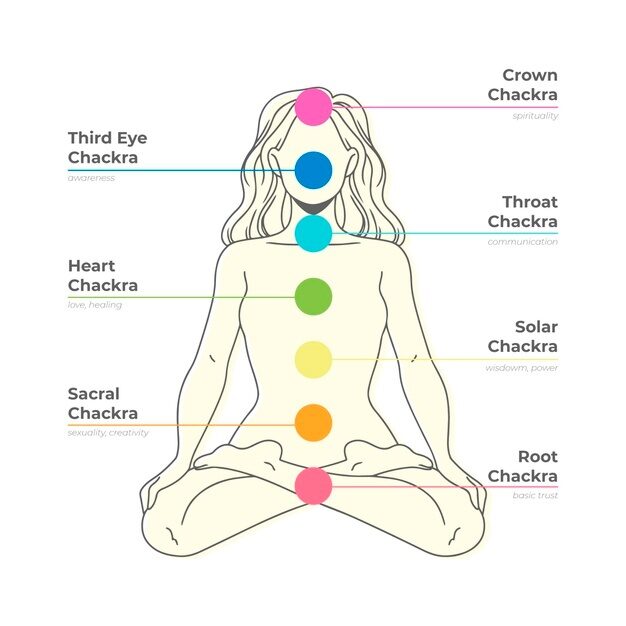
In this tradition, the state of the chakras is said to mirror the wellbeing of the body and its systems, and the major chakras are used as hand positions in a Reiki session because they are seen as places where energy is easily absorbed and distributed. This is a symbolic map, not a diagnostic method; reading the energy body cannot diagnose a medical condition.
In this imagery, a balanced chakra shares its harmony with the parts of the body it is linked to, while a blocked one is described as quiet and out of tune. The chakras are said to be influenced by what happens in life: joy may be pictured as adding colour, while difficult experiences are said to weigh on energy. These are poetic images, not medical explanations.
In this symbolic language, the phrase "broken heart" is linked to the heart chakra; feeling "suffocated" is linked to the throat and heart; and writer's block is linked to the sacral chakra. These are metaphorical correspondences, not literal injuries.
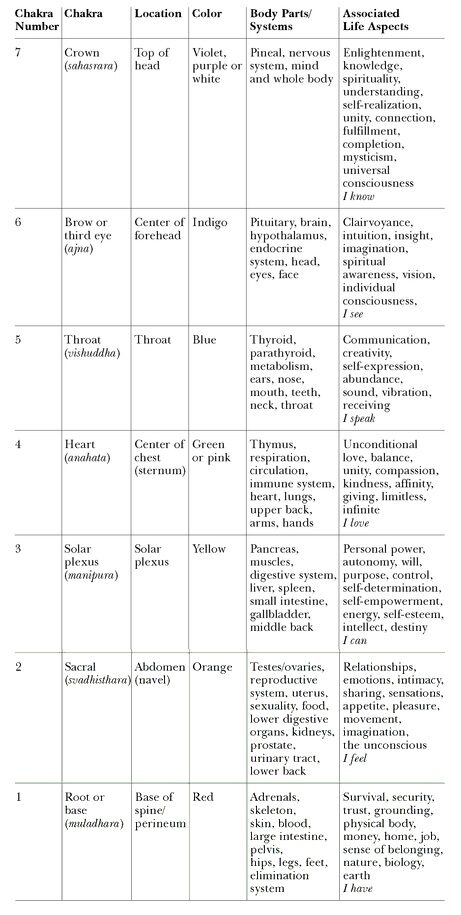
In the chart, you can see not only each chakra's number, name, and location, but also its colour, the body parts and systems linked with it, and the aspects of life associated with it.
The Meridians
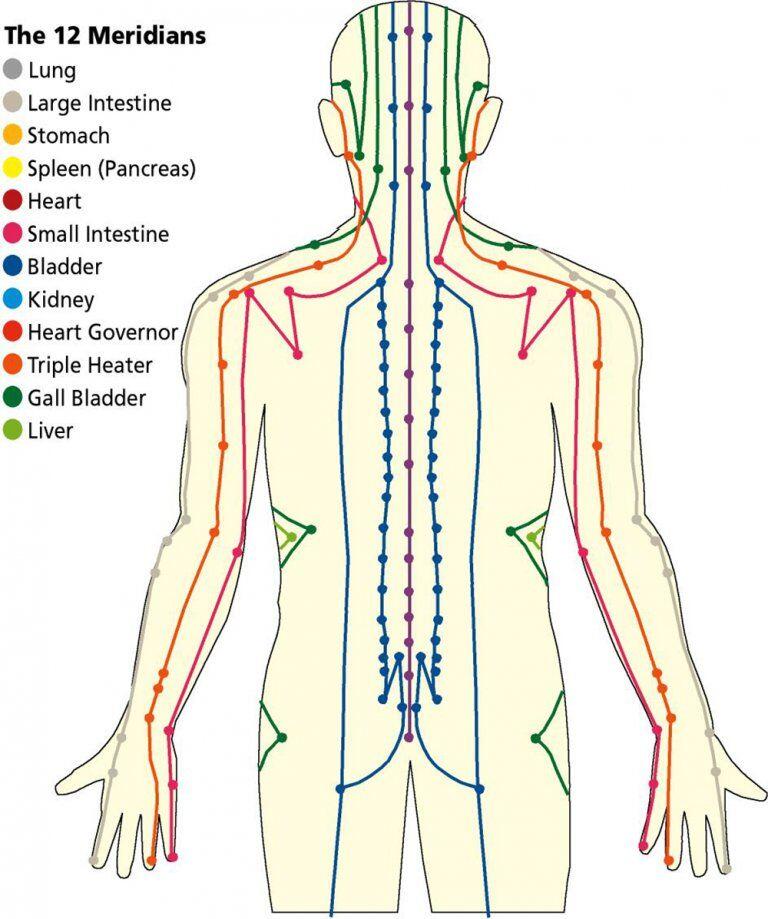
Meridians are the last component of this energy model. In the tradition, they are channels that carry life force, or Ki, throughout the body. The major meridians are described as running lengthwise and linking the organs in the tradition's map, with smaller channels (Nadis) throughout. They are not blood vessels.
The points used in acupuncture and acupressure belong to the meridian model. Reflexology uses its own separate maps of reflex areas on the feet and hands; it is not part of the Chinese meridian system, even though both are practised as complementary therapies (NCCIH).
How The Two Maps Differ
The chakra and meridian models are often printed side by side, which can make them look like two views of one system. They developed in different contexts and answer different questions. This comparison is a teaching aid, not a claim that either map describes measurable anatomy.
| Question | Chakra model | Meridian model |
|---|---|---|
| Basic image | Centres or wheels along the spine | Channels running through the body |
| Typical number | Seven major centres in the common Western map | Twelve main channels in the traditional Chinese map |
| Main use in Reiki | Hand positions and symbolic focus | Explaining Ki, pressure points, and some Japanese techniques |
| Relation to organs | Symbolic associations, not direct control | Traditional organ relationships, not anatomical pathways |
| Evidence status | Spiritual framework | Traditional framework; acupuncture has its own clinical research literature |
In practice, many Reiki teachers use the chakra map for hand positions and the meridian map for techniques such as Byosen scanning or pressure-point work. The two are not required to agree. A session can use one map, both, or neither.
How The Maps Are Used In A Session
A typical Reiki session does not involve measuring either system. The practitioner places hands in a sequence, often including positions near the head, chest, abdomen, and feet. The chakra map supplies a familiar language for those areas: heart, solar plexus, sacral, root. The meridian map may supply a rationale for working along the arms or legs, or for a specific Japanese technique.
What the maps do is help a practitioner remember a sequence and describe an experience. What they do not do is tell you which organ is ill. A “blocked” chakra is not a blocked artery, and a tender point on a meridian is not a confirmed organ problem. If a recipient reports pain or symptoms, the appropriate response is to listen, adjust comfort, and encourage medical advice where needed—not to translate the symptom into an energy diagnosis.
Reading The Map Without Diagnosing
It is easy to slip from symbolism into certainty. Three habits help keep the line clear:
- Use “in this model” language. Saying “the heart chakra is associated with love” is accurate; saying “your heart chakra is closed” is a claim about a person that the model cannot support.
- Separate sensation from meaning. A warm feeling in your hands is a sensation. “Your sacral energy is blocked” is an interpretation layered on top.
- Keep the body's own signals in view. Pain, numbness, breathlessness, and sudden changes are health information. They deserve ordinary medical attention, not only a spiritual explanation.
The maps can still be meaningful. Many people find that a symbolic image helps them pause and reflect on an area of life. The value lies in the reflection, not in the precision of the map.
Questions That Come Up
Are there really seven chakras? Seven is the most common number in modern Western writing, but Hindu and Buddhist traditions describe different numbers and systems. The seven-centre map is a convention, not a universal count.
Do meridians exist in the body? They are not blood vessels, nerves, or lymph channels. Research has looked for anatomical correlates without reaching a consensus, and traditional practitioners often describe them as a functional map rather than a physical structure.
Can a Reiki practitioner tell which chakra is blocked? No reliable method exists for this. A practitioner may offer an interpretation, but it should be treated as a personal impression, not a diagnosis. You can read more about the seven chakra colours or explore the root, sacral, solar plexus, and heart pages for the symbolic associations used on this site.
Is acupuncture the same as Reiki? No. They come from different traditions and use different methods. Acupuncture is a regulated profession in many places and has its own evidence base; Reiki is a spiritual practice offered as complementary support.
Related topic: Chakras and aura, Herbs for chakra wellness, Chakra colors, Daily chakra exercises, The heart chakra.