


Hui Yin - Using Hui Yin Point In A Reiki Session
Hui Yin refers to a point in the perineal or pelvic-floor area in traditional Chinese practice. Some Reiki teachings borrow the term for attention or visualisation during meditation and attunements. It is optional: you do not need to contract muscles, hold your breath or maintain tension to take part in Reiki.
The Hui Yin Point
Some teachers include a light awareness of the pelvic-floor area during meditation or an attunement. No contraction is required, and this practice does not need to be held throughout a session. Avoid straining or creating discomfort; you can leave the area relaxed and breathe normally.
Claims that a contraction retains energy, bridges channels or increases the flow through the hands are beliefs within some practices, not established physical effects. The U.S. National Center for Complementary and Integrative Health reports that Reiki has not been clearly shown effective for health-related purposes and that scientific evidence does not support its proposed energy field.
Using Hui Yin Point In A Reiki Session
If you want to explore the idea, sit or stand comfortably in a private setting and keep your breathing easy. You may simply notice the breath or imagine a gentle circle of light; do not contract the pelvic floor or hold your tongue in a position that causes discomfort. You can stop or return to ordinary breathing at any time.
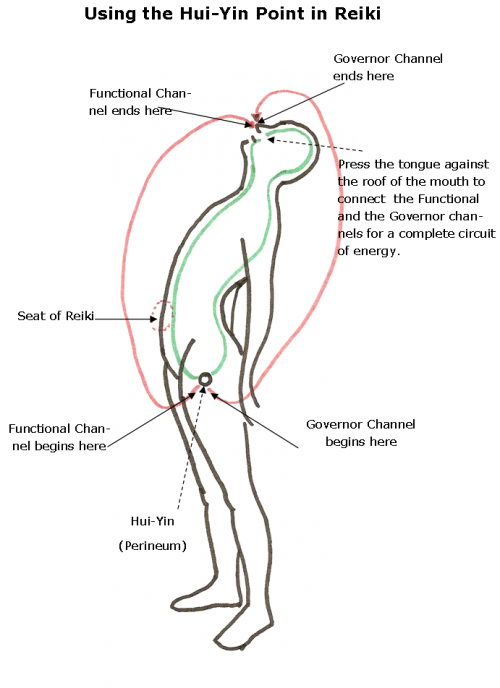
The microcosmic orbit is described in some Taoist practices as a symbolic route for attention or energy. If you study it, use a teacher and source from that tradition rather than treating the visualization as a proven flow through the body. This exercise does not extend a supply of Reiki or provide a health benefit.
There is no required duration, physical sensation or contraction. Comfortable breathing and the option to stop are more important than completing a sequence.
A seated five-minute version
This is a quiet attention practice, not a pelvic-floor exercise. Sit upright but not rigid, with both feet on the floor and your hands resting in your lap. Let your breath be ordinary. For a minute or two, notice the base of your sitting bones and the weight of your body on the chair; this is a simple way to bring attention to the lower body without tightening anything.
If you want a visual anchor, imagine a small circle of warm light low in the body, and let it remain still or slowly expand as you breathe. Do not push the image downward, hold your breath, or clench to make it feel stronger. If the image fades, return to the physical sensation of sitting. After a few minutes, widen your attention to the whole body, move your shoulders and hands, and open your eyes.
Some people prefer to end with the Reiki Principles or a single sentence of intention. Others simply sit for a moment. Both are complete.
What this practice is not
Hui Yin is sometimes described in wellness writing as a way to “retain” or “raise” energy, improve digestion, or affect sexual function. Those are not established effects, and this page does not teach them. The practice described here involves no contraction, no breath retention and no pressure on the pelvic floor. If you have pelvic pain, prolapse, recent surgery, or a condition affected by pelvic-floor training, speak to a qualified clinician before adding any internal or contraction-based practice; what is on this page is deliberately not that. The microcosmic orbit can be practiced without a pelvic-floor contraction; the orbit guide makes that point alongside the Hui Yin discussion.
Common questions
Do I have to visualize a specific colour? No. Colour is a personal anchor; use one that feels calm, or use the sensation of sitting instead.
Can I do this during an attunement? You can rest your attention this way if it helps you settle, but the attunement does not depend on it. Follow the teacher's instructions and skip anything that creates strain.
Is Hui Yin the same as a Kegel exercise? No. A Kegel is a deliberate pelvic-floor contraction. This page describes a relaxed attention practice and explicitly does not ask for a contraction.
Can I practise lying down? Yes, if you can breathe comfortably and stay awake. Many people find sitting easier because it is simpler to return to ordinary awareness afterwards.
Related topic: Treatment and hand positions, 10-day treatment with acupressure, Advanced techniques, Alternative techniques in treatment, Alternative ways to use the hands.