
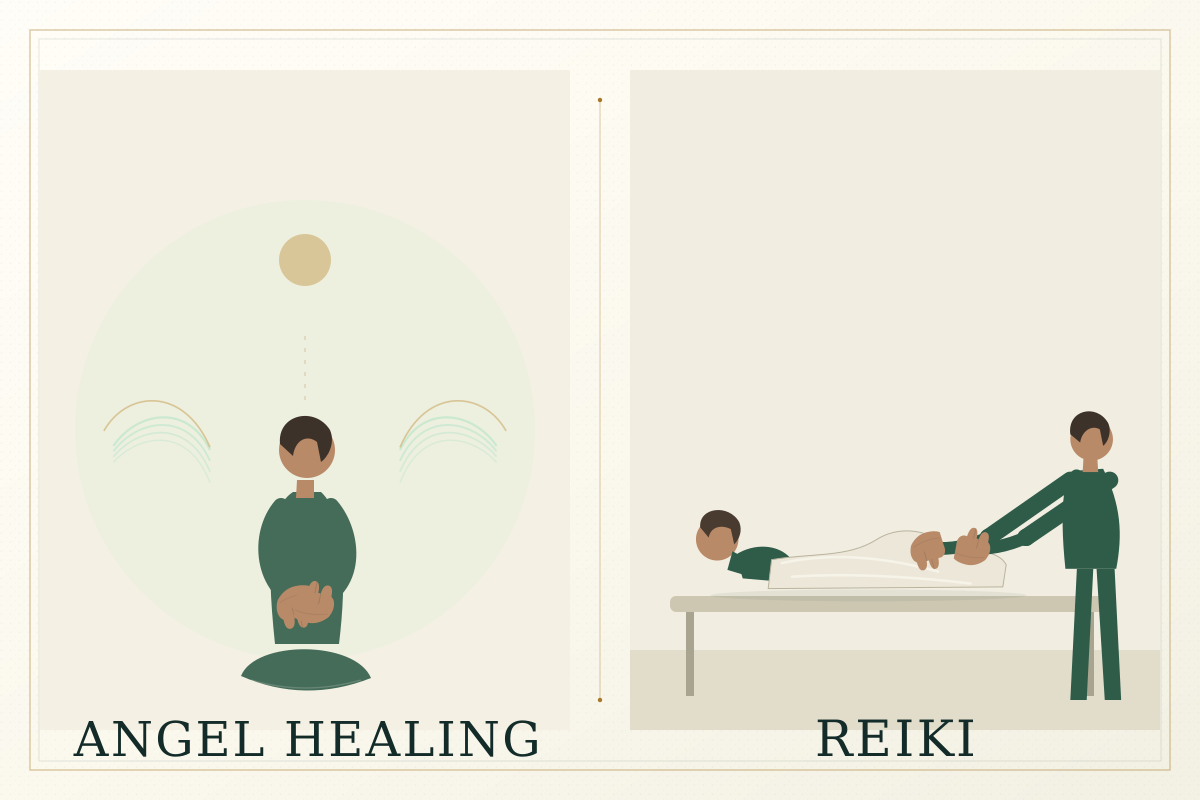
Angel healing and Reiki are often mentioned together, but they are not the same category. "Angel healing" is an umbrella term for many different spiritual practices that invoke angels, guides or archangels. "Reiki" is a family of named energy practices with Japanese roots, its own lineages and its own training structures. Angelic Reiki is one specific modern system that combines the two: it uses Reiki symbols within an explicitly angelic framework.
The short answer is therefore: not all angel healing is Reiki, and not all Reiki involves angels. A session described as "angel healing" may have no Reiki attunement, no Reiki symbols and no connection to a Reiki lineage. A Reiki session may be entirely secular in presentation, with no angels mentioned at all. The label tells you less than the actual practice.
Definitions First
Angel healing is not a single tradition. It can refer to prayer, guided visualisation, channelled messages, angel card readings, crystal layouts, sound, energy work or a general intention to invite angelic support. Some angel healers have formal training; others are self-taught or work within a religious community. There is no single governing body, no universal curriculum and no agreed definition of what "angel healing" involves.
Reiki is a family of practices usually traced to Mikao Usui in 1920s Japan. Practitioners place their hands lightly on or just above a fully clothed recipient, or work at a distance, with the intention of directing energy. Reiki training typically includes attunements, symbols and a lineage of teachers. The NCCIH describes Reiki as a complementary health approach based on an Eastern belief in an energy that supports the body's own healing abilities, while noting that the practice has not been clearly shown to be effective for any health-related purpose (NCCIH).
Angelic Reiki is a specific modern system within the Reiki family. Its official history dates it to 2002–2003 in England, where Kevin and Christine Core developed it from Usui and Shamballa Reiki and their own esoteric study. It has its own founders, attunements, workshops and organisations. It is not a generic synonym for angel healing; the separate Reiki Angels archive is a different subject.
A Comparison
| Question | General angel healing | Reiki (Usui family) | Angelic Reiki |
|---|---|---|---|
| What is it? | An umbrella term for practices that invoke angels | A family of Japanese-origin energy practices | A modern Reiki system with an angelic framework |
| Is there one founder? | No | Usually traced to Mikao Usui | Kevin and Christine Core |
| Is attunement required? | Not necessarily | Usually, in recognized lineages | Yes, in person, according to the official bodies |
| Are symbols used? | Sometimes, but not standardized | Yes, especially at Level 2 and Master | Yes, but said to be activated by the Angels rather than drawn by the practitioner |
| What happens in a session? | Varies widely: prayer, visualization, cards, energy work, conversation | Hands-on or hands-off positions, often a sequence | One basic hand position; the practitioner holds space |
| Training | Highly variable | Lineage-based courses and attunements | Four official workshops, in person |
| Evidence | No unified evidence base | Limited, inconclusive research | No specific clinical evidence; shares the general Reiki limits |
| Typical claim | Angelic guidance, comfort, insight | Relaxation, balance, energy | Angelic connection, healing, spiritual development |
The table is a guide, not a set of rules. Many practitioners blend categories, and a Reiki practitioner may use angel imagery without calling their work Angelic Reiki. That is why it is worth asking what a practitioner actually does rather than relying on the label.
Where They Overlap
The overlap is real. Angelic Reiki uses Reiki symbols and a Reiki-style session. Many Reiki practitioners pray, visualize angels or work with guides. Many angel healers have Reiki training and use a hands-on format. A client may have a similar experience in either setting: quiet, warmth, tears, relaxation, a sense of being cared for.
The difference is in the framework and the training, not necessarily in the felt experience. Angelic Reiki has a specific lineage, a specific attunement theology and a specific set of workshops. General angel healing has no single lineage, so its quality and content depend almost entirely on the individual practitioner.
What an Angel Healing Session Might Involve
Because the term is broad, a session could include:
- A conversation about what you hope to receive.
- A guided meditation or visualization.
- Prayer or an invitation to angels or archangels.
- Hands-on or hands-off energy work.
- Angel cards, crystals, essential oils, sound or ritual.
- Channelled guidance or a written message.
- A closing conversation and suggestions for reflection.
None of these is inherently unsafe, but some carry more risk than others. A practitioner who claims to receive medical diagnoses from angels, who tells you to stop treatment or who pressures you into expensive follow-up sessions is not offering good care. The same is true of a Reiki practitioner who makes those claims.
What a Reiki Session Might Involve
A typical Usui Reiki session is simpler in structure. The client remains clothed and usually lies on a treatment table. The practitioner may move through a series of hand positions or work intuitively, with light touch or hands just above the body. There may be a short conversation before and after. Some practitioners use symbols, crystals or sound; others keep it minimal.
The NCCIH notes that Reiki has been studied for pain, anxiety and depression, but that most research has not been of high quality and results have been inconsistent. It also says there is no scientific evidence for the energy field said to underlie Reiki, and that Reiki has not been shown to have harmful effects. Those conclusions apply to Reiki generally; they are not a specific endorsement of Angelic Reiki or of any angel healing practice.
Training and Accountability
This is where the categories diverge most sharply.
Reiki training usually has a recognizable structure: Level 1, Level 2, Master, and in some lineages teacher training. There are many schools and lineages, and quality varies, but a prospective student can ask who trained the teacher and what the certificate represents.
Angelic Reiki has a more specific official structure: Levels 1 and 2, Levels 3 and 4, Professional Practitioner and Master Teacher. It also has competing organisations and a disputed claim to authenticity. A student can at least check which organisation a teacher belongs to and what its requirements are.
General angel healing has no universal structure. A practitioner may have years of training, a weekend certificate, a religious vocation or no formal training at all. That does not make them fraudulent, but it does mean the buyer has to ask more questions. "Certified angel healer" is not a protected title, and the certificate may represent very different things depending on who issued it.
Evidence and Safety
There is no body of clinical evidence that angel healing, as a category, has a medical effect. There is also no evidence that it is uniquely dangerous. The risks are mostly the ordinary risks of any unregulated spiritual service: financial pressure, boundary violations, discouragement of medical care, and the harm that comes from being told a frightening or shaming story about yourself.
A few safeguards apply across the board:
- Consent. You should know what will happen, including any touch, and be free to stop.
- No diagnosis. A practitioner should not diagnose illness or tell you to stop medication or treatment.
- No promises. Be cautious of claims of cure, certain results or spiritual powers.
- Clear pricing. You should know the cost before the session and not be pressured into extras.
- Ordinary care. If you have a health concern, see a qualified professional. A spiritual session can be a complement to ordinary care, not a replacement.
How to Choose
If you are drawn to angels, you might prefer Angelic Reiki for its structured lineage, or a general angel healer for a more personalised or devotional approach. If you want a clearly defined Reiki lineage, Usui Reiki may be a better fit. The useful questions are:
- What exactly happens in the session?
- What training does the practitioner have, and with whom?
- Do they make medical claims or promise specific outcomes?
- Do they respect your autonomy and your other care?
- Do they have a complaints or referral process?
- Does the price and the setting feel transparent and safe?
A practitioner's calm, respectful manner is often a better guide than an elaborate certificate. Conversely, an impressive certificate does not excuse poor boundaries or unsupported claims.
Frequently Asked Questions
Is angel healing the same as Reiki?
No. Angel healing is an umbrella term for many practices that invoke angels. Reiki is a family of named energy practices with Japanese roots. Angelic Reiki is a specific modern system that combines Reiki with an angelic framework.
Is Angelic Reiki a form of angel healing?
Yes, in the broad sense: it is a Reiki system with an explicitly angelic cosmology. But it is more specific than the general term, because it has named founders, official workshops and a defined lineage.
Do I need Reiki training to do angel healing?
Not necessarily. General angel healing has no universal training requirement. Angelic Reiki, by contrast, is taught through official in-person workshops and attunements. If you want to practise Angelic Reiki within its official lineage, you need the training.
Can a Reiki practitioner channel angels?
Some say they do; others do not. Reiki itself does not require belief in angels, and Usui Reiki is not inherently an angelic practice. A practitioner may integrate angel imagery as a personal spiritual approach, but that is an addition rather than a requirement of Reiki.
Which is safer?
Neither category is inherently safe or unsafe. Safety depends on the practitioner's conduct: consent, boundaries, honesty about evidence and respect for medical care. A well-run session in either category can be supportive; a poorly run one can be harmful.
Can angel healing replace medical care?
No credible evidence supports that claim. Anyone who promises a cure, tells you to stop prescribed care or offers a medical diagnosis on the basis of angelic guidance should be avoided. Spiritual practice can be meaningful without making medical claims.
Where to Go Next
Read Angelic Reiki for the named system, Angelic Reiki vs Usui Reiki for the lineage comparison, and Archangel Metatron and Angelic Reiki for the Metatron attribution. Reiki Angels is the separate historical archive. The angels hub collects the related material, and What Is Reiki? gives the broader foundation.
The most useful question is not whether angels or Reiki are "real" in the abstract. It is whether a particular practice, teacher and setting help you feel more grounded, more honest and more free—and whether they leave room for you to decide for yourself.
Related topic: Reiki Angels, Reiki Angels, Contacts, Courses, Distant healing.