
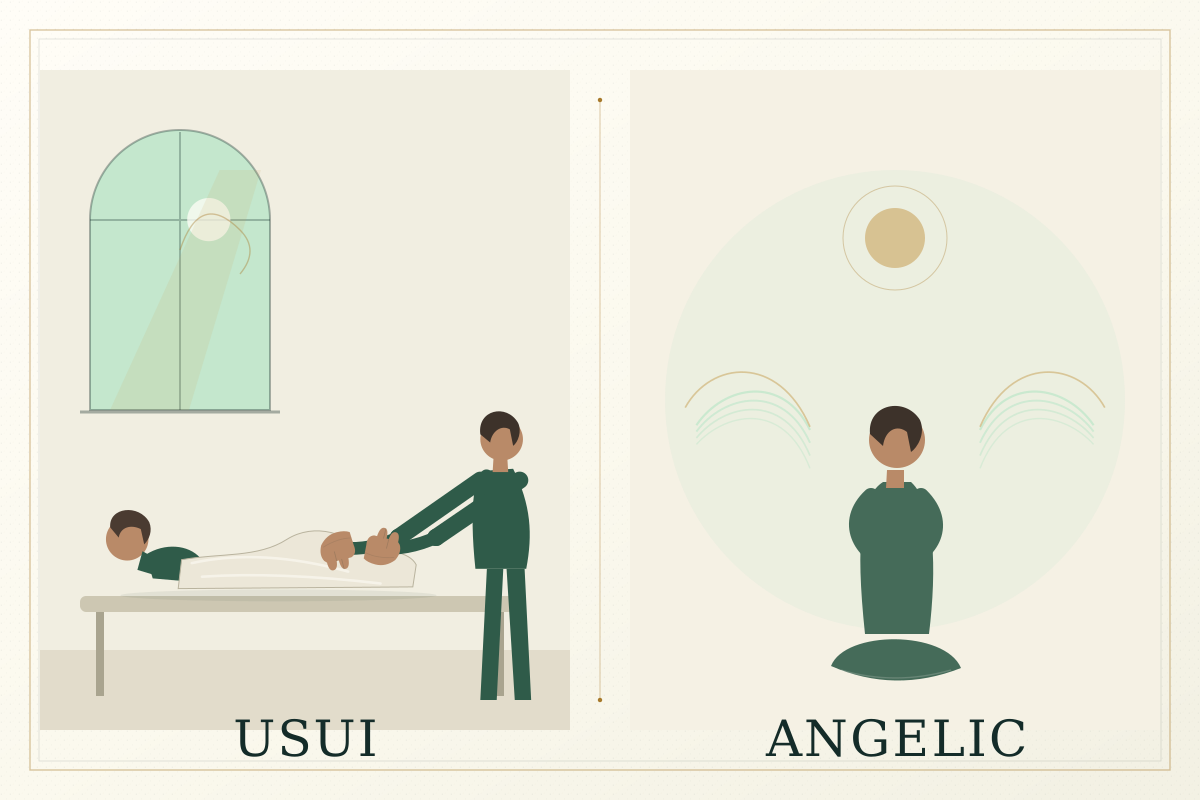
Angelic Reiki and Usui Reiki are both named Reiki systems, but they are not the same practice. Usui Reiki is usually traced to Mikao Usui in 1920s Japan and passed to the West through a lineage of teachers that includes Hawayo Takata. Angelic Reiki is a much later system, dated by its own founders to 2002–2003 in England, that draws on Usui and Shamballa Reiki while adding an explicitly angelic cosmology, a different attunement theology and a different workshop structure.
The simplest distinction is this: Usui Reiki is the older family of practices from which many modern Reiki systems descend; Angelic Reiki is one of those modern descendants, with its own founders, rituals and organisations. Angelic Reiki is not a more advanced "version" of Usui Reiki, and Usui Reiki is not a more authentic alternative to Angelic Reiki. They are different traditions with different claims.
At a Glance
| Question | Angelic Reiki | Usui Reiki |
|---|---|---|
| Origin | Official history dates it to 2002–2003 in England | Usually traced to Mikao Usui in Japan in the 1920s |
| Key figures | Kevin Core and Christine Core | Mikao Usui, Chujiro Hayashi, Hawayo Takata and later lineages |
| Attunement | Said to be given by the Angelic Kingdom / Healing Angels, not the human teacher | Given by a human teacher through an established lineage |
| Lineage | Official teaching says there is no human lineage because each attunement is given anew | Human lineage is central to most Usui transmission |
| Symbols | Reiki symbols activated to angelic, galactic and universal levels; not usually drawn or visualised by the practitioner | Traditional Usui symbols taught and used in Level 2 and Master practice |
| Session | One basic hand position; the practitioner holds space while Angels are said to direct the healing | A sequence of hand positions, or a more intuitive hands-on/off practice, depending on the lineage |
| Levels | Four workshops: 1&2, 3&4, Professional Practitioner, Master Teacher | Commonly Level 1, Level 2, Master/Level 3, with teacher training varying by school |
| Teaching format | In-person group workshops; official bodies reject distance attunement | Varies widely; many schools teach in person, some offer online or distance attunement |
| Evidence | No specific clinical evidence for the Angelic Reiki system | General Reiki research is limited and inconclusive |
The table is a simplification. "Usui Reiki" is not one uniform tradition: Japanese Usui Reiki Ryoho, Western Usui Shiki Ryoho and various offshoots differ in technique, terminology and emphasis. Angelic Reiki also has more than one organisation claiming to represent the authentic form.
Origins: A Modern System and an Older Family
The official Angelic Reiki account begins with Christine Core's homeopathy practice and healing centre in Yorkshire, her Usui and Shamballa Reiki training, and her partnership with Kevin Core. Their work with Merkabah philosophy, meditation groups and esoteric study led to the first Angelic Reiki workshops in 2002–2003. The founders' chronology dates a first Masters workshop to November 2003, while the same site's copyright page says November 2002; the one-year discrepancy is left as the founders' own pages state it.
The association says Angelic Reiki draws on the Usui and Shamballa lineages and combines them with transmissions channelled by Kevin Core (Angelic Reiki Association). It presents the system as a new synthesis that includes Usui material rather than a rejection of it.
Usui Reiki's own history is not simple either. The standard Western story traces the practice to Mikao Usui, then to Chujiro Hayashi, then to Hawayo Takata, who brought it to Hawaii and trained teachers in the mid-twentieth century. Historical research has questioned parts of that story, and Japanese and Western lineages differ in how they describe Usui's life and teaching. For the historical background, see the Mikao Usui memorial stone, Chujiro Hayashi, Hawayo Takata and Usui Reiki Ryoho vs Usui Shiki Ryoho.
Attunement: Human Lineage or Angelic Transmission?
This is the sharpest difference between the two systems.
In Usui Reiki, an attunement is normally given by a human teacher who has received it through a lineage. The teacher may use a ritual, symbols, breathing and touch or near-touch. The exact form varies by school, but the transmission is understood to pass from teacher to student within a human chain. That chain is why lineage matters in many Usui communities: it is the assurance that the practice has been handed on.
In Angelic Reiki, the official teaching says the teacher does not perform the attunement. The teacher opens a space, and the Angelic Kingdom is said to give the attunement directly to each participant through their own Healing Angel. The founders' site says the attunement does not pass through a human body or consciousness, and that there is no human lineage because each attunement is given anew by the Angels (Angelic Reiki International).
Those are theological claims, not empirical ones. They cannot be tested by comparing outcomes, and they are not accepted by Usui lineages that regard human transmission as essential. What can be said is that the two systems have different theories of how authority and transmission work. A student who values a documented human lineage may prefer Usui; a student drawn to a direct, angelic framing may prefer Angelic Reiki.
Symbols and Practice
Usui Reiki typically introduces symbols at Level 2 and Master level. The three best-known Level 2 symbols are Cho Ku Rei, Sei He Ki and Hon Sha Ze Sho Nen; the Master symbol is Dai Ko Myo. Students learn their forms, meanings and uses, and may draw or visualise them in practice. Different Usui lineages teach different additional symbols and emphasise different techniques.
Angelic Reiki also uses Reiki symbols, but the official teaching says they are activated through sacred geometry and the angelic vibration rather than taught as drawings to be reproduced. The system describes the symbols as activated to their angelic, galactic and universal levels, and the practitioner is not required to draw, chant or visualise them during a session. The symbols are said to be integrated into the student's consciousness during the attunement.
This does not mean Angelic Reiki has no symbols; it means the relationship to them is different. A Usui practitioner may work with a symbol deliberately; an Angelic Reiki practitioner may be taught to let the Angels direct the energy and not to rely on mental symbol work. For the Usui side, see Reiki Symbols and Reiki Symbols and Their Structures.
What a Session Is Like
A typical Usui session involves the client lying fully clothed while the practitioner moves through a series of hand positions, often starting at the head and working down the front and back of the body. Some practitioners use a fixed sequence; others work intuitively. The session may include conversation before and after, and the practitioner may use symbols, scanning or other techniques depending on their training.
An Angelic Reiki session is usually simpler in its outer form. The official description says the practitioner places the left hand on the higher heart and the right hand on the solar plexus, whether the client is sitting or lying. The practitioner does not move through a sequence of positions, chant or visualise symbols. The Angels are said to direct the healing. The session usually lasts about an hour and may include music.
The felt experience can be similar: quiet, warmth, relaxation, emotional release or nothing in particular. The difference is in the framework the practitioner uses to explain it, not necessarily in what the client notices.
Levels and Teacher Training
Usui Reiki is commonly taught in three levels: Level 1 (physical/self-practice), Level 2 (symbols and distance practice) and Master/Level 3 (master symbol and, in some schools, teacher training). The content and the meaning of "Master" vary considerably between schools. Some lineages require years of practice before teacher training; others offer short courses.
Angelic Reiki's official structure is four workshops: Levels 1 and 2, Levels 3 and 4, Professional Practitioner, and Master Teacher. The 3 and 4 workshop is explicitly not a teaching qualification. The Master Teacher workshop is the teaching route and requires the Professional Practitioner stage plus approved case studies. A nine-day full-syllabus workshop is also offered by the founders' organisation.
This is a real structural difference. In some Usui schools, "Master" includes the right to teach; in the official Angelic Reiki system, "Master" is a personal initiation and teaching is a separate step. A prospective student should ask what a qualification actually permits, not just what it is called. See Angelic Reiki Levels and Reiki Certification vs Accreditation for the wider question.
Worldview and Spiritual Framework
Usui Reiki is not a religion, and practitioners vary widely in their beliefs. Some regard Reiki as a spiritual practice grounded in Japanese Buddhist and Shinto influences; others treat it as a secular relaxation practice; others weave in crystals, angels, guides or channelled material. The Usui system itself does not require belief in angels.
Angelic Reiki is explicitly angel-centred. Its cosmology includes the Angelic Kingdom, Archangel Metatron, the Mighty Sarim, Ascended Masters and Galactic Healers. The official literature describes the work as preparation for ascension and a path of consciousness expansion. These are named spiritual beliefs; they are meaningful to participants and are not required for a person to benefit from quiet, consensual touch or relaxation.
A person can be a devout member of a religious tradition and practise Reiki; a person can be an atheist and practise Reiki; a person can be drawn to angels and prefer Angelic Reiki. The systems differ in how much metaphysical framing they bring, not in whether a person is allowed to be spiritual.
What the Evidence Says
Research on Reiki as a whole is limited. The NCCIH says Reiki "hasn't been clearly shown to be effective for any health-related purpose", that most studies have not been of high quality, and that there is no scientific evidence for the energy field said to underlie it. It also says Reiki has not been shown to have harmful effects (NCCIH).
There is no separate body of clinical evidence for Angelic Reiki as a distinct system. Claims that Angelic Reiki works on DNA, cellular memory, past lives or multidimensional levels are spiritual claims, not scientific findings. That does not make them worthless to a believer, but it does mean they should not be presented as medical facts or used to discourage ordinary care.
How to Choose
There is no universally "better" system. The useful questions are personal and practical:
- What do you want from the training? A structured hands-on practice, a spiritual community, a personal development path or a professional qualification?
- What kind of authority do you trust? A documented human lineage, a direct angelic transmission, or both?
- How much metaphysical framing do you want? Usui Reiki can be taught in a relatively pared-back way; Angelic Reiki is explicitly angelic.
- What does the qualification permit? Ask whether it includes teaching, insurance eligibility or professional practice.
- Who is the teacher? Their ethics, experience and willingness to answer questions matter more than the label on the certificate.
If you are choosing a practitioner rather than a training, the same questions apply: what does the session involve, what claims are being made, and do you feel able to say no or stop at any point?
Frequently Asked Questions
Is Angelic Reiki a type of Usui Reiki?
It is a separate modern system that draws on Usui and Shamballa Reiki. The official association says it combines those lineages with transmissions channelled by Kevin Core. It is not simply Usui Reiki with angels added, because it has its own founders, attunements and workshop structure.
Which is older?
Usui Reiki is older. Its usual origin story places Mikao Usui in 1920s Japan. Angelic Reiki's official history dates it to 2002–2003.
Is Angelic Reiki more powerful?
No reliable comparison exists. "Powerful" is not a measurable property of a spiritual system, and different practitioners will report different experiences. Anyone who claims that one system is objectively stronger is making a promotional claim, not a scientific one.
Can I practise both?
Some people do. The systems are not mutually exclusive in practice, although their theories of attunement differ. If you are training formally, check the prerequisites and the views of your teacher. Some Usui lineages are relaxed about other modalities; others are not.
Do I need Usui Reiki before Angelic Reiki?
The official Angelic Reiki Level 1 and 2 workshop is open to beginners with no previous experience. Levels 3 and 4 require a valid Angelic Reiki 1 and 2 certificate. Prior Usui training is not required for the first workshop, though experienced practitioners may find the comparison useful.
Where to Go Next
Read Angelic Reiki for the system overview, Angelic Reiki Attunement for the ritual in detail, and Angelic Reiki Levels for the training structure. For the Usui side, see What Is Reiki?, Reiki Level 1, Reiki Level 2 and Reiki Symbols. The angels hub collects the related angelic material, and Reiki Angels remains a separate historical archive.
The choice between Angelic Reiki and Usui Reiki is not a test of spiritual seriousness. It is a choice about which language, lineage and community help you practise with honesty and care.
Related topic: Reiki Angels, Reiki Angels, Contacts, Courses, Distant healing.