
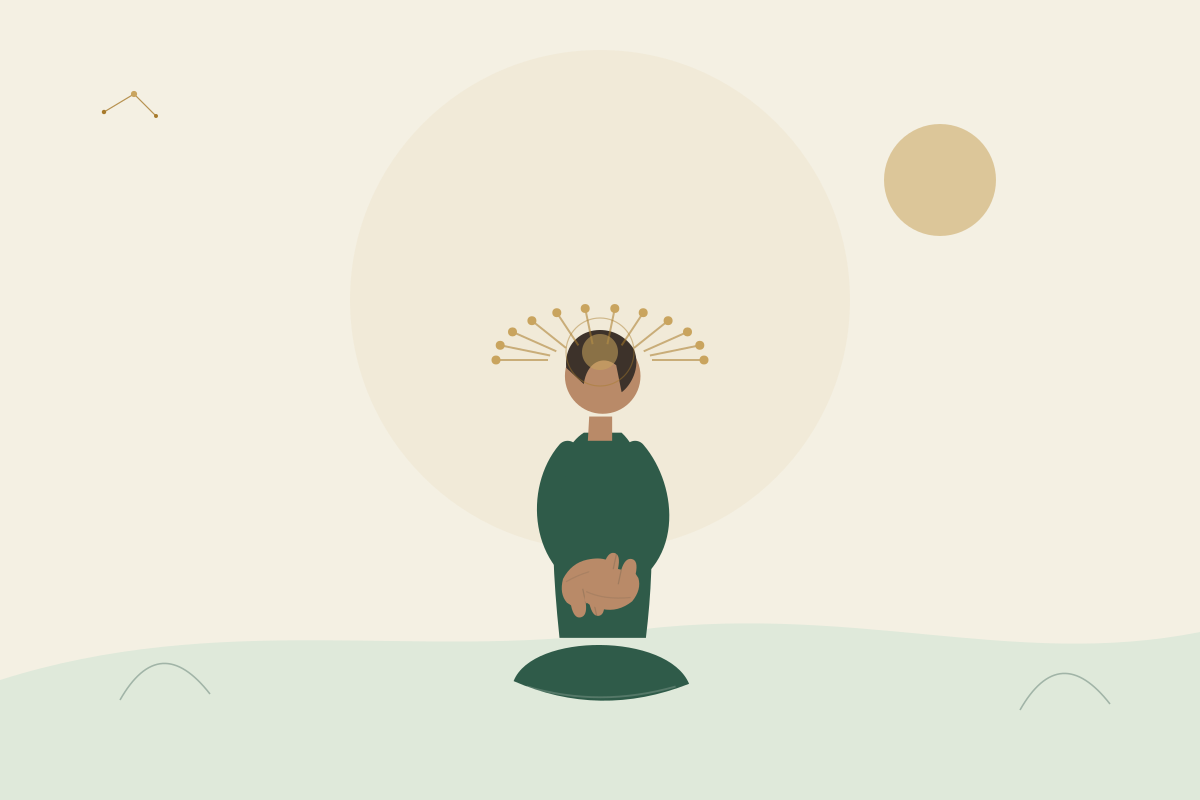
The crown chakra is the seventh centre in the familiar seven-chakra map. It is associated with the top of the head and with connection, meaning, silence and what the tradition calls union or pure consciousness. Its Sanskrit name, Sahasrara, means "thousand-petalled." The image is deliberately extravagant: a lotus with a thousand petals, often described as opening upward beyond the body.
That image can be beautiful, and it can also be misleading. The crown chakra is not a hatch in the skull, and "opening" it is not a way to escape ordinary life. In the traditional map it is the summit of a journey that begins at the base of the spine. The point of reaching the crown is not to leave the body behind; it is to bring the whole of life into a larger perspective.
This article treats the crown as a spiritual and symbolic centre rather than an anatomical or medical one.
Sahasrara at a Glance
- Sanskrit name: Sahasrara, "thousand-petalled"
- Location: the crown of the head, or in some texts just above it
- Colour: violet or white in modern Western listings
- Element: often described as none, or as space, thought or consciousness
- Traditional lotus: one thousand petals, arranged in layers
- Seed sound: silence in some traditions; Om in others
- Themes: connection, unity, meaning, surrender, spiritual insight
The crown is the least uniform of the seven centres. Some medieval texts place it at the fontanelle, the soft spot on a baby's skull; others place it above the head. Some describe it as a chakra, while others regard it as a state or a threshold rather than a centre like the others. The colour violet and the "thousand-petalled lotus" are common in modern presentations, but the details vary by lineage.
Why a Thousand Petals?
A thousand petals is not a literal count. It suggests multiplicity, abundance and the way a single centre can hold an enormous range of qualities. The number also has a traditional resonance: a thousand is a way of saying "innumerable." The lotus itself is an image of unfolding. It grows out of mud, rises through water and opens in the air—a natural symbol for a spiritual life that is rooted in ordinary conditions rather than separated from them.
In some descriptions, the petals are arranged in twenty layers of fifty, each layer carrying a different quality or letter. You do not need to memorise the scheme to use the image. The useful question is: what would it mean to hold my life as a whole rather than as a series of separate compartments?
The Crown and the Kundalini Image
In the classical map, the crown is the destination of Kundalini, the coiled energy pictured at the base of the spine. As the energy rises through the centres, it is said to reach Sahasrara and unite with Shiva, giving self-realisation or Samadhi. The Encyclopaedia Britannica describes the crown as the highest centre, associated with the realm of self-illumination, and notes that the six-plus-one system is the best-known variant of a much more varied tradition (Britannica).
This is a powerful image, but it is not a physical description of a nerve or a fluid. Different traditions describe the rising process in different ways, and some warn that forcing it is unwise. The crown is not a prize to be seized. In the symbolic language of the tradition, it is the place where effort and grace meet, and where the practitioner discovers that the boundary between self and world was never as solid as it seemed.
Surrender Is Not Passivity
The crown is often associated with surrender. That word can be misunderstood. Surrender does not mean giving up your judgment, your boundaries or your responsibility. It means loosening the demand that reality conform to your preferences, and being willing to be changed by what you learn.
A useful distinction:
- Passivity says, "Nothing I do matters, so I will do nothing."
- Surrender says, "I will do what is mine to do, and release what is not mine to control."
The first can look spiritual while actually being despair. The second is a practice of trust that still involves action. In the crown-chakra language, surrender is the willingness to be a participant rather than the director of every scene.
Connection Without Dissociation
People sometimes describe crown-chakra experiences as feelings of expansion, timelessness, light or being part of something larger. Those experiences can be profound. They can also be disorienting. Spiritual practice is not immune to psychological difficulty, and intense meditation, fasting, sleep deprivation or drug use can produce states that feel meaningful but leave a person ungrounded.
A grounded spirituality includes:
- A body. Eat, sleep, move and rest. The crown does not cancel the root.
- A community. Talk to people who knew you before the experience and who can help you tell the difference between insight and inflation.
- A routine. Ordinary tasks are not a distraction from practice; they are part of it.
- A limit. If an experience leaves you frightened, confused or unable to function, stop the practice and seek qualified support.
The crown is not an escape hatch. In the tradition's own logic, it is the centre that integrates the whole system. If a practice makes you less kind, less capable or less present, that is a warning sign, not proof of advancement.
Silence as a Practice
The crown is often linked with silence, especially in traditions that treat it as beyond sound. Silence here does not mean the absence of noise. It means a quality of attention that is not constantly narrating, evaluating or planning.
A simple practice is to sit for five minutes and listen. Not to a guided recording, not to music, just to the sounds around you. When a thought arrives, notice it and return to listening. You are not trying to empty your mind. You are practising the difference between hearing and commentary.
Optional Practices for the Crown Centre
These are invitations, not requirements, and they should feel comfortable.
Silent sitting
Sit in a comfortable, upright position. Let your hands rest in your lap. Close your eyes or lower your gaze. For five minutes, follow the natural breath and listen to the room. If you become drowsy, open your eyes or sit somewhere more alert. If you become restless, shorten the session.
Walking meditation
Walk at an ordinary pace, indoors or outdoors. Feel the contact of each foot with the ground. When the mind wanders, return to the next step. This is a good practice for people who find seated meditation difficult, and it keeps the body involved.
Awe in ordinary places
The crown is associated with wonder. Once a week, spend ten minutes with something larger than your daily concerns: a tree, the night sky, a piece of music, a poem, a religious text or a landscape. Do not turn it into a productivity exercise. Let yourself be small in a way that feels freeing rather than diminishing.
Prayer or intention
If you have a prayer practice, the crown is a natural place to hold a question rather than a demand. You might pray for clarity, for the courage to accept what you cannot change, or for the wellbeing of someone you find difficult. If prayer is not part of your life, a written intention can serve a similar function: "What I am opening to this season is..."
Rest
Savasana, or lying flat in a comfortable position, is a simple way to let the body settle. It is also a reminder that spiritual practice includes rest. If lying flat is uncomfortable, rest with the knees supported or sit in a chair.
The Crown and the Other Chakras
The crown is not a replacement for the lower centres. A person can have a vivid sense of cosmic connection and still struggle to pay bills, hold a boundary or tell the truth. The traditional map is hierarchical in one sense—the crown is the highest centre—but it is not a ranking of human worth. Each centre has its own intelligence:
- The root asks, "Am I safe?"
- The sacral asks, "What do I feel and desire?"
- The solar plexus asks, "What do I choose?"
- The heart asks, "What do I love?"
- The throat asks, "What is true, and how do I say it?"
- The third eye asks, "What do I perceive?"
- The crown asks, "What is this all for?"
A spiritual life that skips the earlier questions is not more advanced. It is often less grounded.
Crown Chakra and Reiki
Reiki practitioners sometimes place their hands lightly above the crown or at the top of the head during a session. In the tradition, this is described as supporting connection and balance. The NCCIH notes that Reiki has not been clearly shown to be effective for any health-related purpose, and that there is no scientific evidence for the energy field said to underlie it (NCCIH).
If you practise Reiki, the crown can be a focus for a quiet self-treatment: sit comfortably, rest your hands in your lap or lightly above the head, and hold a simple intention for clarity and connection. Then return to ordinary life. The value is in the practice of attention, not in a promised spiritual status.
Frequently Asked Questions
Where is the crown chakra?
It is traditionally located at the top of the head, near the fontanelle, or just above the head. The exact placement varies by tradition and should not be treated as a physical location.
What colour is the crown chakra?
Violet is the most common modern association, with white as another common choice. The colours are a modern convention rather than a fixed ancient system.
What does "thousand-petalled lotus" mean?
It is a symbolic image of abundance, unfolding and the many qualities held within a single centre. It is not a literal count of petals or a physical structure.
Does the crown chakra govern the pituitary or pineal gland?
Some modern charts list those glands as correspondences. They are symbolic associations, not claims that the chakra controls the glands. The pituitary and pineal glands have their own physiological functions, and concerns about them belong with a qualified clinician.
How do I know if my crown chakra is open?
There is no reliable test. "Open" and "closed" are metaphors used in some traditions, not measurable states. Be cautious of anyone who claims to diagnose your chakras or who offers promised spiritual results.
Can meditation be harmful?
Meditation is generally considered low-risk, but intensive or prolonged practice can be uncomfortable for some people, particularly those with a history of trauma or dissociation. Start with short sessions, keep a grounded routine, and seek qualified support if practice leaves you distressed or unwell.
Where to Go Next
The crown completes the upper three centres. Read the throat chakra and the third eye chakra alongside this page, or return to the heart chakra to reconnect the upper and lower halves of the map. For the wider system, see chakra colours, chakras and meridians and the chakras and aura hub. Daily exercises for your chakras offers a gentle daily structure.
The crown chakra is not an escape from the world. It is an image for seeing the world—and your place in it—with a little more perspective, humility and quiet.
Related topic: Chakras and aura, Herbs for chakra wellness, Chakra colors, Daily chakra exercises, The heart chakra.