
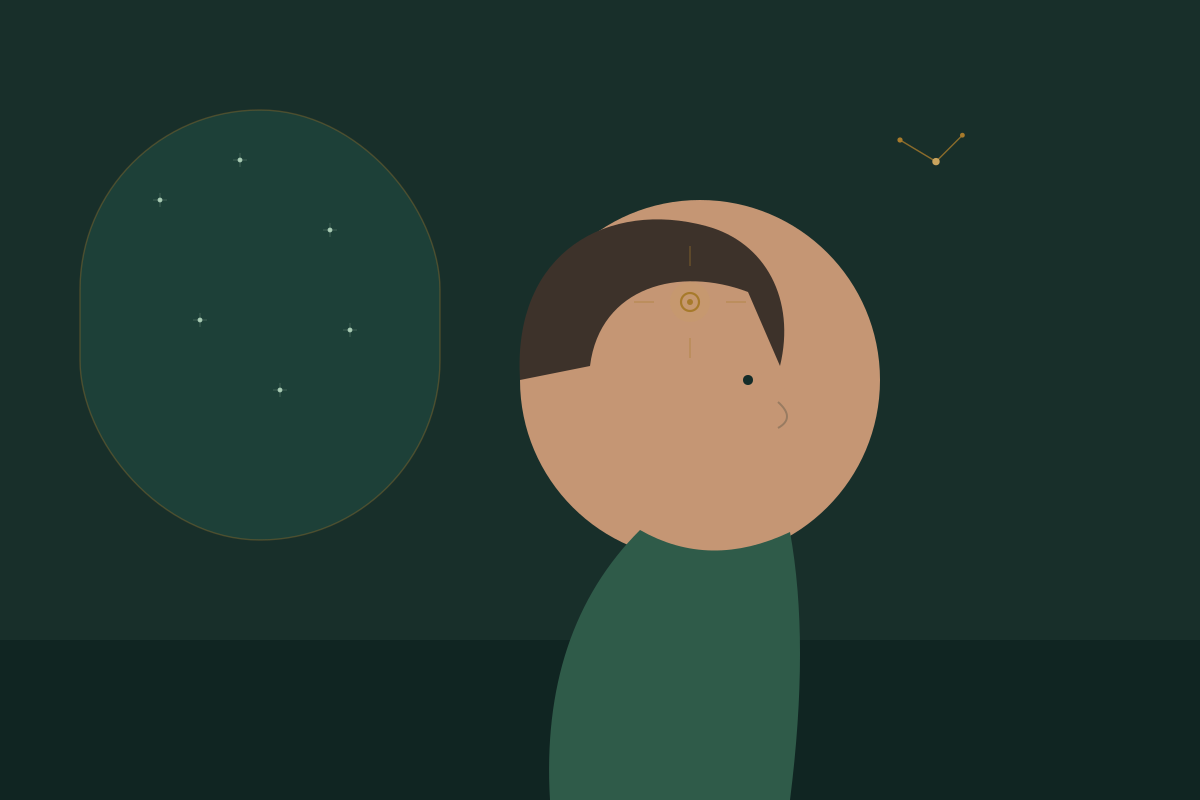
The third eye chakra is the sixth centre in the familiar seven-chakra system. It is associated with the forehead, between the eyebrows, and with perception that is not limited to the physical eyes: insight, imagination, discernment, memory and the stories we tell ourselves about what is happening. In the tradition it is called Ajna, a Sanskrit word often translated as "command" or "authority." The name is a useful clue. This is less about having visions than about what has authority in your inner life.
The chakra map is a spiritual and symbolic framework, not a description of the brain or the eyes. What it offers is a vocabulary for examining perception: what you notice, what you assume, what you ignore, and how you decide what to trust.
Ajna at a Glance
- Sanskrit name: Ajna, also written Ājñā
- Meaning: command, authority, perception
- Location: the brow, between the eyebrows
- Element: light in many modern Western listings
- Colour: indigo, or sometimes dark blue or violet
- Traditional lotus: two large petals
- Seed sound: Om is commonly used; some sources give ksham
- Themes: insight, discernment, imagination, inner seeing, clear perception
The numbers and correspondences vary by lineage. Traditional Hindu diagrams describe a two-petalled lotus, while modern Western charts often add an indigo colour and a link with the pituitary or pineal gland. Those gland associations are symbolic in the chakra literature, not scientific findings. The pineal gland does produce melatonin and is involved in the sleep cycle, but that is a separate physiological fact; it is not evidence that a "third eye" is a physical organ or that meditation activates it in a measurable way.
The Brow, the Bindi and the Inner Witness
The brow has been a focus of religious attention for a long time. In Hindu practice, the bindi or tilak is worn at the forehead, and the space between the eyebrows is treated as a place of reverence and attention. The Encyclopaedia Britannica notes that the ajna chakra is commonly marked with a bindi and that, in the tradition, this chakra "sees the inner world just as physical eyes see the external world" (Britannica).
That image is worth keeping. The third eye is not usually described as a literal organ that sees through the skull. It is an image for the inner witness: the part of awareness that can notice a thought without immediately believing it, or notice an emotion without being carried away by it. In that sense, the practice is closer to reflection than to clairvoyance.
Intuition Is Not the Same as Anxiety
Many people come to the third eye because they want to trust their intuition. The difficulty is that intuition, anxiety, wishful thinking and plain habit can all feel like a strong inner signal. The chakra tradition does not solve that problem, but it offers a useful question: is this perception clear and quiet, or urgent and repetitive?
A few practical distinctions can help:
- Intuition tends to leave room. It can be stated simply and may feel calm even when the message is uncomfortable.
- Fear tends to insist. It often repeats, catastrophises or demands immediate action.
- Wishful thinking tends to flatter. It shows you the outcome you want without the obstacles.
- Habit tends to be familiar. It may feel like "just the way things are" because it has not been examined.
None of these is a reliable test on its own. The point is to slow down enough to tell the difference, and to check important impressions against evidence and other people. A felt sense in the forehead is not proof of anything; it is a sensation. The meaning you give it is an interpretation.
Imagination, Memory and the Stories We Live In
The third eye is also associated with imagination. That is not a trivial function. Imagination lets you rehearse a conversation, picture another person's perspective, or see a situation from a different angle. It also lets you invent a story about what someone meant and then react to that story as if it were established fact.
A useful third-eye practice is to separate observation from narrative:
- Observation: "They did not reply to my message."
- Narrative: "They are annoyed with me."
- Feeling: "I feel uneasy."
- Check: "What else could be true? What evidence do I have?"
This is not an argument against intuition. It is a way of giving intuition a fair hearing without letting it run the whole conversation. In the symbolic language of the chakra, clear seeing includes seeing your own projections.
Optional Practices for the Brow Centre
These practices are optional and should be comfortable. They are not treatments for eye conditions, headaches or mental-health difficulties. If you have an eye condition, recent eye surgery, migraines triggered by light, or a history of dissociation, choose the gentler options and speak to a qualified professional about what is appropriate for you.
Palming
Sit with your elbows supported on a table. Rub your palms together briefly, then cup them over your closed eyes without pressing on the eyes or the brow. Let the eyes rest in the warmth and darkness. Breathe naturally for a minute or two. This is a rest for the eyes and a simple way to reduce visual stimulation; it does not "activate" a chakra.
A short insight journal
At the end of the day, write three lines:
- What did I notice today that I almost overlooked?
- What did I assume that I did not actually check?
- What is one thing I now see differently?
Keep the answers short. The aim is not to produce profound revelations but to build a habit of reflecting on perception.
Gentle candle or point gazing
Some traditions use trataka, steady gazing at a candle flame or a small point. If you try it, keep the session very short, use a safe distance, and avoid it if you are prone to eye strain, light-triggered headaches or seizures. Do not stare until your eyes water or ache. Close your eyes afterwards and rest. This is a concentration practice, not a test of spiritual progress.
Alternate nostril breathing
A simple seated breath practice: close the right nostril with the thumb, inhale through the left, close the left and exhale through the right, then inhale through the right, close it and exhale through the left. Keep the breath quiet and comfortable. The Cleveland Clinic notes that alternate nostril breathing has been studied as a way to reduce stress and increase alertness, while also noting that claims that it balances chakras are not scientifically established (Cleveland Clinic). Stop if you feel dizzy.
The Two Petals and the Meeting of Channels
Traditional descriptions give Ajna two petals, often associated with the Ida and Pingala channels, which meet the central Sushumna channel before rising to the crown. The image is architectural rather than anatomical: two currents converge at the brow, and the centre is the point of integration. The two petals are sometimes linked with the syllables ham and ksham, representing Shiva and Shakti, or with the sun and moon.
You do not need to memorise the symbolism to use it. The useful idea is integration: the third eye is not only "up" or "spiritual." It is where complementary ways of knowing meet—reason and imagination, observation and intuition, self and world. A balanced image of the centre includes doubt as well as vision.
When "Opening the Third Eye" Becomes Unhelpful
Modern spiritual writing sometimes promises that opening the third eye will bring psychic powers, permanent clarity or access to hidden truths. The chakra tradition itself is more modest and more varied. It describes states of concentration and insight that are cultivated over time, and it warns that experiences along the way can be misleading.
A few cautions are worth stating plainly:
- Do not force it. Intense gazing, sleep deprivation, fasting and prolonged meditation can produce altered states that are not necessarily insights.
- Do not use it to explain ill health. A headache, eye strain or unusual perception is not evidence of a blocked or opening chakra.
- Do not neglect ordinary care. If you are experiencing distressing unusual perceptions, dissociation or a change in mental health, seek qualified support rather than trying to "open" or "close" a chakra.
- Keep grounded practices in the mix. Walking, eating, sleeping, conversation and practical tasks are part of a balanced spiritual life.
The third eye is best treated as a symbol of honest seeing, not as a supernatural upgrade. The question is not "how do I open it?" but "what am I not seeing, and what would help me see more clearly?"
Third Eye Chakra and Reiki
In a Reiki session, practitioners sometimes place their hands near the brow or simply hold an intention for clarity. In the tradition this is described as supporting balance and insight. The NCCIH's review of Reiki notes that the practice has not been clearly shown to be effective for any health-related purpose, and that there is no scientific evidence for the energy field said to underlie it (NCCIH).
If you practise Reiki, you might use the brow as a focus for a quiet self-treatment: rest your hands somewhere comfortable, let the eyes soften, and bring to mind one situation you would like to see more clearly. Then ask the reflective questions above. The practice is the attention, not a promised result.
Frequently Asked Questions
Where is the third eye chakra?
It is traditionally located between the eyebrows, at the brow. It is not a physical organ and cannot be found by dissection.
What does Ajna mean?
Ajna is usually translated as "command," "authority" or "perception." It suggests that this centre is concerned with what we accept as true and what we allow to guide us.
Is the third eye the pineal gland?
No. Some modern writers make that comparison, and the pineal gland is a real endocrine gland involved in melatonin production and sleep regulation. But the chakra is a symbolic and spiritual concept, not an anatomical structure, and the comparison is not a scientific equivalence.
Can meditation open the third eye?
Meditation may change how you notice and interpret experience, and many people find it increases calm and reflective capacity. There is no scientific evidence that it opens a chakra or produces reliable psychic abilities. Treat reports of dramatic experiences with discernment.
Why do I feel pressure between my eyebrows?
People feel pressure or tingling in many places for many reasons, including attention, muscle tension, fatigue and ordinary sensation. It is not by itself evidence of a chakra opening. If it is persistent or distressing, seek appropriate medical advice.
Where to Go Next
The third eye sits between the throat and the crown. Read the throat chakra and the crown chakra to complete the upper three centres. For the wider map, see the heart chakra, chakra colours and chakras and meridians. The chakras and aura hub collects the full series, and daily exercises for your chakras offers a simple daily structure.
The third eye is not a secret camera. It is an invitation to look at your own looking—carefully, kindly and with enough humility to revise what you thought you saw.
Related topic: Chakras and aura, Herbs for chakra wellness, Chakra colors, Daily chakra exercises, The heart chakra.