
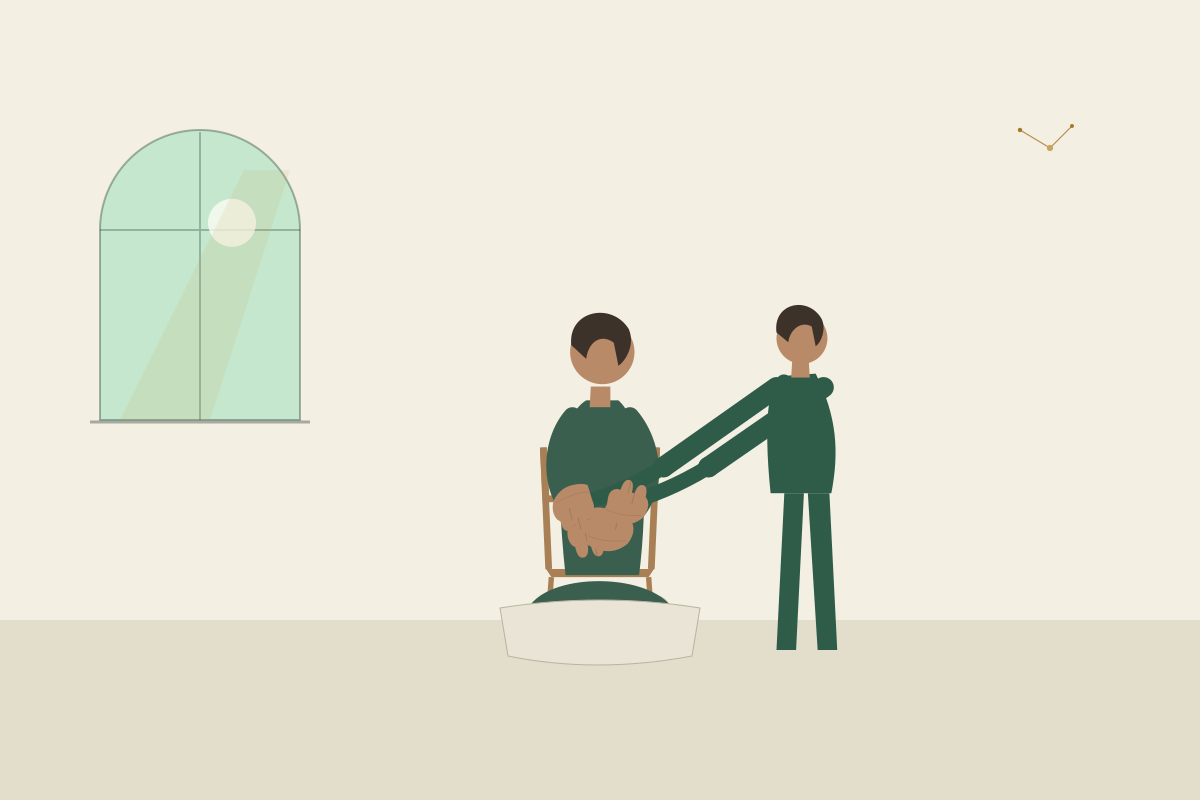
Hanshin Koketsu Ho is one of the older Japanese-lineage Reiki methods that English sources often translate as “half-body blood cleansing.” The translation is dramatic, and it has caused a great deal of confusion. It does not mean that a Reiki practitioner can filter, oxygenate, thin or purify blood. It is a historical name for a light-touch sweeping practice, and the “blood cleansing” vocabulary belongs to an earlier way of talking about the body.
This guide explains the name, the lineage context, one recorded form of the practice, and why the medical language should not be taken literally.
What the name means
Hanshin means “half body.” Koketsu is romanized in different ways in Reiki sources and is often rendered as “blood cleansing” or “blood exchange.” Hō means method. In the recorded form, the method works down the back and shoulders — an upper-body sequence, shorter than the full-body method — rather than treating one lateral half of the body. The name should not be read as a left-side or right-side protocol.
The important word is historical. The name reflects an older Japanese and Chinese-influenced vocabulary in which health was discussed through ideas of blood, ki and flow. It is not a laboratory description. A practitioner cannot “clean” blood by sweeping a hand above the skin, and no Reiki method has been shown to change blood composition, remove toxins or treat a blood disorder.
James Deacon’s compilation groups Hanshin Koketsu Ho with Ketsueki Kokan Ho and Zenshin Koketsu Ho as the so-called “blood-exchange” techniques, while noting that the label is more properly “blood cleansing” in the traditional vocabulary and that several versions are taught in different Reiki schools (AETW, Ketsueki Kokan Ho, Hanshin Koketsu Ho and Zenshin Koketsu Ho). That is a fair description of the sources: a family of sweeping methods with a shared name, not a standardized medical procedure.
Where it comes from
The lineage picture is less tidy than popular Reiki histories suggest. The International House of Reiki’s list of techniques once practiced in the Usui Reiki Ryoho Gakkai tradition includes Ketsueki Kokan-ho, but not Hanshin Koketsu Ho or Zenshin Koketsu Ho by those names (IHREIKI, How Japanese is Gendai Reiki-Ho?). Hanshin and Zenshin appear in other Japanese-lineage and Western manuals as variant names or as shorter and longer forms of the same sweeping idea.
That means you should not assume that every Reiki teacher knows Hanshin Koketsu Ho, or that the version you find online is the version taught in a particular line. Some schools teach only Hanshin and Zenshin; some teach Ketsueki Kokan Ho; some teach none of them. The names are a map of transmission, not a guarantee of historical uniformity.
One recorded form of the practice
In the version recorded by Deacon, Hanshin Koketsu Ho is done with the recipient lying face down or seated. The practitioner places the hands at the base of the neck, one on either side of the spine, and strokes outward and down along the shoulders. The hands return to the spine a little lower and repeat, gradually working down the back. The sequence takes roughly ten to fifteen sweeps to reach the coccyx. A second phase uses the index and middle fingers on either side of the spine, sweeping downward without pressure, ten to fifteen times (AETW, Ketsueki Kokan Ho, Hanshin Koketsu Ho and Zenshin Koketsu Ho).
Three details matter. The strokes are light: the hand stays off the spine, and the sweep can be done a few millimetres above the body or clothing. The hands arc away on the return rather than sweeping back up the spine. The practice is not diagnostic, and a student should follow the version their teacher trained in. Other teachers may use different hand positions, a different number of sweeps, or no physical contact at all.
The blood-cleansing metaphor
The phrase “blood cleansing” is historical, not physiological. A light hand sweep does not filter blood, remove toxins or treat a blood disorder, and Reiki has not been clearly shown to be effective for any health-related purpose (NCCIH, Reiki). The traditional vocabulary can still be meaningful inside a lineage, but it should not be presented as medical detox.
Safety
Because Hanshin Koketsu Ho involves the back and spine, it deserves ordinary physical caution:
- Do not press on the spine. Light contact or hands-near work is enough. A practitioner should not use body weight, elbows or tools.
- Do not use vigorous strokes. The recorded versions emphasize a steady, even, light pace. Fast or forceful sweeping can irritate the skin and startle the nervous system.
- Avoid recent fractures, spinal surgery, osteoporosis with fragility, and acute back injury. Ask a clinician whether light touch is appropriate.
- Avoid areas with skin infection, rash, open wounds, bruising or unexplained swelling.
- Be cautious with anticoagulants and bleeding disorders. Light touch is usually low-risk, but any technique that could cause bruising should be discussed with a clinician.
- Do not treat a suspected clot, unexplained pain, numbness, weakness or loss of bladder or bowel control with Reiki. Those symptoms need urgent medical assessment.
- Get consent for touch and for the direction of the session. A person may prefer hands-near work, a seated position, or no physical contact.
Do not perform the practice on a person who is unconscious, unable to consent, or in an emergency. Call emergency services and provide first aid instead.
Learning it responsibly
If you want to learn Hanshin Koketsu Ho, ask a teacher in your line to demonstrate it and to explain where the name comes from. Ask specifically whether they teach it as a standalone method, as part of a longer treatment, or as a historical variant of Ketsueki Kokan Ho. A teacher who can distinguish the traditional metaphor from a medical claim is a better guide than one who promises detoxification.
For the longer variant, see Zenshin Koketsu Ho. For the navel and lower-abdomen practices that often accompany it in Japanese-lineage teaching, see Heso Chiryo Ho and Tanden Chiryo Ho. The treatment hub lists the wider set of techniques. If you are studying Reiki history, Reiki History provides the wider lineage context, and Reiki Level 2 explains the level at which many schools introduce symbols and distance work.
Related topic: Treatment and hand positions, 10-day treatment with acupressure, Advanced techniques, Alternative techniques in treatment, Alternative ways to use the hands.