
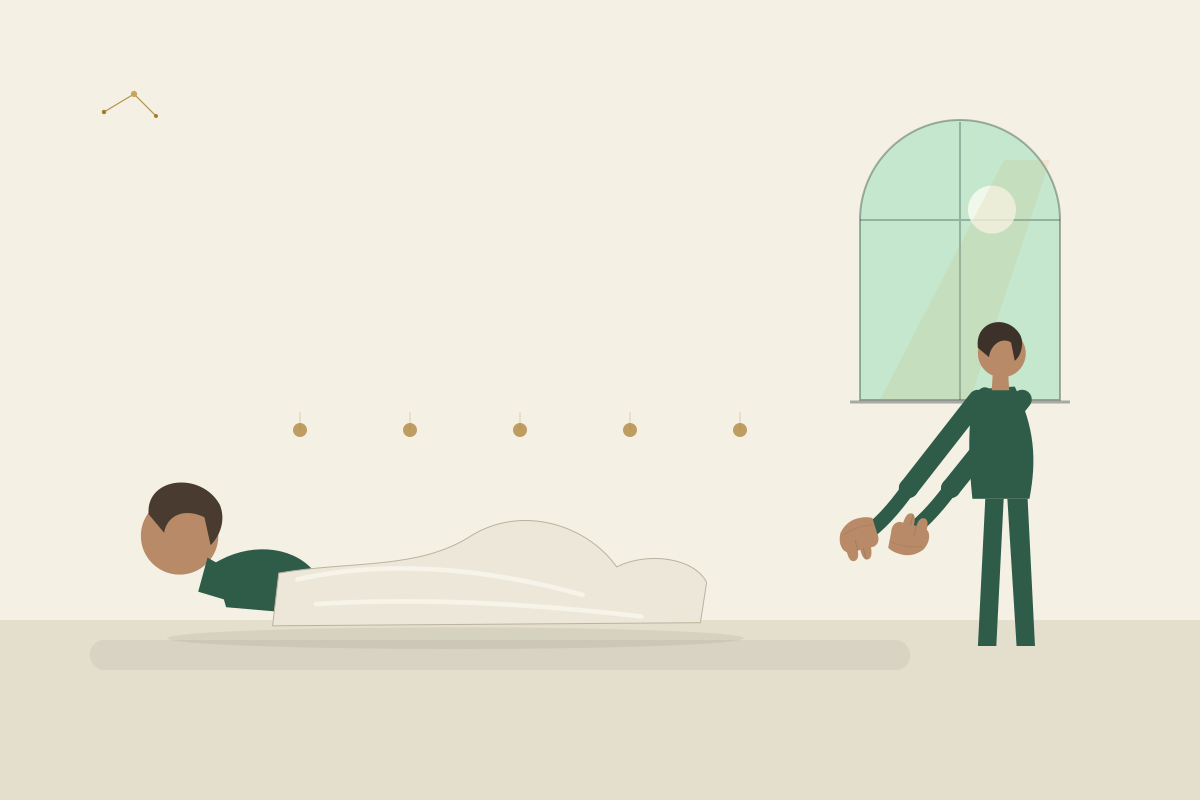
Zenshin Koketsu Ho is the longer companion to Hanshin Koketsu Ho. Zenshin means “whole body,” and the method extends the light sweeping approach from the back and shoulders to the arms and legs. English sources often call it “full-body blood cleansing,” a translation that sounds medical but is actually a historical metaphor.
This is a light-touch ritual, rather than massage or medical care. Its meaning belongs to the Reiki tradition. It is a Reiki method from a particular lineage vocabulary, and it should be learned and offered with that distinction intact.
What the name means
Zen means whole or complete; shin means body. Koketsu is the same romanized term found in Hanshin Koketsu Ho, usually translated as “blood cleansing” or “blood exchange.” Hō means method. The name therefore describes a whole-body version of the sweeping practice, not a medical process that cleans the blood.
The phrase “blood cleansing” comes from an older way of speaking about circulation, ki and health. It is not a description of what a hand sweep does. If a practitioner tells you that Zenshin Koketsu Ho removes toxins or changes the blood, ask for the evidence and treat the answer with caution. No Reiki method has been shown to change blood composition or cure a blood disorder.
James Deacon records Zenshin Koketsu Ho alongside Ketsueki Kokan Ho and Hanshin Koketsu Ho as one of the “blood-exchange” techniques, while noting that the label is more properly “blood cleansing” in the traditional vocabulary and that several versions exist (AETW, Ketsueki Kokan Ho, Hanshin Koketsu Ho and Zenshin Koketsu Ho). The International House of Reiki’s list of Gakkai techniques includes Ketsueki Kokan-ho rather than Zenshin by name (IHREIKI, How Japanese is Gendai Reiki-Ho?). The names traveled unevenly, and a student should not assume that every line teaches the same sequence.
How it differs from Hanshin Koketsu Ho
Hanshin Koketsu Ho works over the back and shoulders in a shorter sequence. Zenshin Koketsu Ho covers the whole body: the head and front, then each arm, then each leg. The full-body version takes longer, but length is not a measure of value. A shorter practice done with care is not inferior to a longer one.
In the recorded version, the practitioner first treats the head and front using formal hand positions. The recipient then lies face down, and the practitioner works on each side in turn: a light stroke from the shoulder down the arm to the fingertips, repeated about fourteen times, then the same on the other arm; then a light stroke from the hip down the outside of the leg to the toes, repeated about fourteen times, then the same on the other leg. The hand lifts and arcs away between strokes rather than sweeping back up the body. No pressure is applied (AETW, Ketsueki Kokan Ho, Hanshin Koketsu Ho and Zenshin Koketsu Ho).
That is one recorded form. Other teachers may use different numbers of strokes, a seated position, hands-near work, or a shorter sequence. The important constants are lightness, consent and the absence of diagnostic claims.
The “blood cleansing” language problem
The phrase “full-body blood cleansing” is the part of this practice most likely to mislead. Blood is not a stagnant fluid that a practitioner can filter by sweeping, and medical conditions of the blood require medical diagnosis and treatment.
A useful rule is to keep the traditional name but drop the physiological claim: it is a light-touch Reiki practice, not a blood treatment.
The National Center for Complementary and Integrative Health states that Reiki “hasn’t been clearly shown to be effective for any health-related purpose,” and that there is no scientific evidence for the energy field thought to play a role in it (NCCIH, Reiki). That does not prevent the practice from being meaningful, but it does rule out selling it as a medical detox.
Zenshin Koketsu Ho is a Reiki practice with a historical name, not a blood purification treatment or diagnostic method. Its value, if any, lies in the quality of attention and quiet contact, not in a measurable change to the blood.
Safety
Zenshin Koketsu Ho covers more of the body than Hanshin, so it has more opportunities for unintended pressure or discomfort. Keep these boundaries:
- No pressure on the spine, joints, belly, throat or eye. The strokes are light and superficial, or hands-near.
- Avoid swollen, hot, red or painful legs. Unilateral swelling, warmth and pain can be signs of a clot and need urgent medical assessment, not Reiki.
- Avoid varicose veins, fragile skin, recent surgery, fractures and open wounds.
- Be cautious with anticoagulants, bleeding disorders and neuropathy. Light touch may still be safe, but the person should know what to expect and be able to stop.
- Do not use the practice on a person who cannot consent or in an emergency. That includes an unconscious person, a young child without a guardian’s agreement, and anyone who has withdrawn consent.
- Do not diagnose from what you feel. A “cold” or “heavy” area is not a medical finding.
The full-body format can be tiring for the practitioner. Take breaks, keep the room warm, and do not continue if your own back, wrists or shoulders hurt. A shorter session is better than an injury.
Learning it responsibly
Ask your teacher whether they teach Zenshin Koketsu Ho as a standalone method or as part of a longer treatment, and whether their version includes the head and front positions. Ask what they mean by “cleansing” and whether they make medical claims. A good answer will distinguish tradition from physiology.
For the shorter variant, see Hanshin Koketsu Ho. For the navel and lower-abdomen practices, see Heso Chiryo Ho and Tanden Chiryo Ho. The treatment hub lists the wider set of Japanese techniques. For the history of how these methods were transmitted, see Reiki History. If you are new to practice, Reiki Level 1 and Reiki Healing cover the foundations.
Related topic: Treatment and hand positions, 10-day treatment with acupressure, Advanced techniques, Alternative techniques in treatment, Alternative ways to use the hands.