


Microcosmic orbit meditation is a Taoist qigong practice that directs attention around an imagined circuit up the back and down the front of the body. This page teaches a Reiki adaptation using symbols and chakra imagery. The circuit describes a traditional spiritual model of qi, not a medically established anatomical pathway.
For the gentler version described later on this page:
- Sit comfortably and let your breathing stay natural.
- Picture attention moving up the back and down the front without forcing a sensation.
- Return to ordinary breathing and your surroundings when you finish.
Keep breathing comfortable and stop if you feel dizzy or distressed. NCCIH describes traditional Chinese medicine and its varied practices.
The Microcosmic Orbit
The microcosmic orbit, alternatively known as the Law's Self-Winding Wheel, is a Taoist Qigong energy cultivation technique. It entails deep breathing exercises combined with meditation and concentration techniques that facilitate the flow of qi along specific energy pathways in the human body. These pathways may be familiar to students of traditional Chinese medicine, Qigong, T'ai chi ch'uan, Neidan, and Chinese alchemy. The exercise is typically performed in a sitting position, but it can also be performed standing, as in Zhan Zhuang, or with the addition of movements, as in T'ai chi ch'uan.
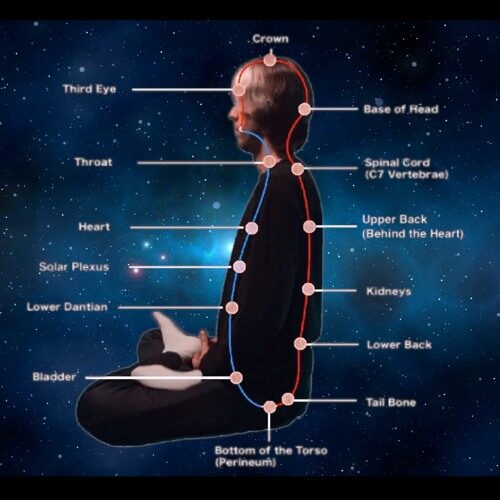
Microcosmic Orbit Meditation
Part 1
- Sit with your feet supported, or choose another comfortable position. If you use Antahkarana symbols in your Reiki lineage, you may place one nearby as a visual focus; it is optional.
- If taught in your lineage, draw UDKM, TDKM, or both on your hands and rest them on your legs. Treat the symbols as part of the spiritual practice, not as proof of energy moving through the body.
- You may offer a prayer or set a personal intention. You do not need to share a particular belief or expect healing or increased consciousness.
- Picture CKR at the solar plexus chakra if this is meaningful to you. Let thoughts come and go; gently return to the image if you choose. This is a symbolic focus, not a method for opening, cleansing, or balancing a physical structure. A few minutes is enough, or you can stop sooner.
- If you wish, repeat the image at the sacral chakra and continue from the root up the spine to the heart chakra. You can skip any point or shorten the sequence.
- You may notice warmth, coolness, images, colors, or nothing in particular. These sensations are personal and do not show that a chakra changed or that the body is sending a message. Keep attention gentle rather than trying to hold one image perfectly.
Part 2
- If you wish, picture a ball of light at the solar plexus. You can keep the image still or move it in imagination; it does not need to follow a physical pathway.
- In this Reiki adaptation, you may picture the light moving down toward the sacral area, up toward the root, then along the back of the chakras to the crown and down the front. The route is visualization, not anatomy.
- Continue only as long as comfortable. There is no need to hold your breath, contract the pelvic floor, or practice for ten minutes. You may read about the Hui Yin point as part of the page's Reiki vocabulary, but contraction is not required for this meditation.
To finish, let the image fade, relax your tongue and pelvic muscles, and return to ordinary breathing. Open your eyes when ready. If you feel dizzy or distressed, stop, sit comfortably, and orient to the room.
The Traditional Frame
The microcosmic orbit is usually described as a Taoist internal practice. In the traditional account, qi is cultivated and circulated through a pathway that runs up the back and down the front of the body. Teachers differ on the exact route, the role of the tongue and pelvic floor, and whether the practice belongs to a larger sequence of internal alchemy. Some schools teach it only after preliminary breathing or standing practice.
That traditional frame is more specific than the version on this page. We are not presenting a Taoist initiation, and the Reiki adaptation here should not be taken as a complete qigong curriculum. If you want to study the traditional practice, look for a qualified teacher in that lineage and ask what preparation they require.
The value of knowing the background is that it keeps the practice honest. The orbit is not a universal “energy exercise” that means the same thing everywhere. It is a named technique with its own history, and its Reiki version is a modern blend.
A Shorter Version
The full sequence above can take ten or fifteen minutes. A shorter version is useful on ordinary days:
- Sit comfortably and take three easy breaths.
- Picture a soft light at the solar plexus. Let it rest there for one or two breaths.
- In imagination, let the light move down to the lower abdomen, then around to the base of the spine, up the back, and over the head.
- Let it return to the solar plexus and fade.
- Sit for a moment, then open your eyes.
You can do this without symbols, without a chakra count, and without moving anything in your body. The movement is entirely in the imagination, and the breath stays natural throughout. If the image is hard to hold, picture a slow circle of light rather than a precise route.
Common Difficulties
The image keeps disappearing. That is ordinary. Return to it when you notice, without scolding yourself. A few seconds of imagery is enough for the practice to count as done.
I feel dizzy or tense. Stop and return to normal breathing. Dizziness can come from breathing too deeply, holding the breath, or straining to concentrate. Sit quietly and orient to the room. If it persists, treat it as a health question rather than a practice problem.
I feel nothing. Nothing needs to happen. The practice is a visualization, not a sensation test. You can stop and simply rest.
I am not sure whether my tongue should touch the roof of my mouth. Some traditional instructions include this detail; the adaptation on this page does not require it. Keep your mouth and jaw relaxed. If a teacher has given you a specific instruction, follow that.
Can I do this lying down? Yes, if you are comfortable and unlikely to fall asleep. Sitting is traditional because it supports alertness, but it is not a rule.
How It Relates To Reiki
Reiki does not traditionally include the microcosmic orbit. The connection here is modern: some Reiki practitioners borrow the visualization because it offers a structured way to move attention through the body. The Reiki symbols are then added as a familiar focus, not because the Taoist practice requires them.
That means you can practise Reiki without the orbit, and you can practise the orbit without Reiki. Combining them is a personal choice. If you do combine them, keep the two frameworks distinct in your own mind: qi is a traditional Chinese concept, Ki is the Japanese term used in Reiki, and chakras come from Indian traditions. They are related ideas in popular writing, but they are not the same system.
For a gentler starting point, the chakra and meridian guide offers a simpler way to move attention through the body without a specific route. If you are drawn to geometric symbols, the Antahkarana page describes a modern symbol used as a visual focus.
Related topic: Chakras and aura, Herbs for chakra wellness, Chakra colors, Daily chakra exercises, The heart chakra.